

A nation that plants saplings for applause while felling forests for profit is not greening its future; it is disguising its destruction.
There is something almost grotesquely contradictory about planting a sapling with great ceremony while a mature tree, perhaps decades old, is being felled somewhere behind the mountains.
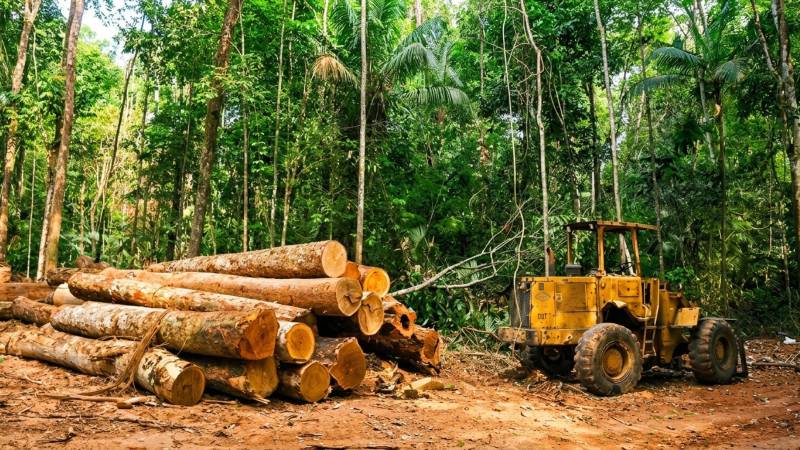
Governments announce plantation drives. Ministers pose beside newly planted trees. Millions of saplings are counted, targets celebrated and “green” initiatives advertised. Yet videos continue to emerge from our northern regions showing trees being brought down, timber piled high and entire stretches of forest apparently surrendering to the axe.
A recent video circulating on social media, purportedly showing extensive tree cutting in the Hazara region, is deeply disturbing. Its precise location and circumstances require independent verification; social media must never substitute for evidence but one does not need that particular video to establish that illegal felling and timber smuggling remain serious problems. The official record itself tells a sufficiently alarming story.
In March 2025, eight Forest Department officials in Mansehra were arrested following an anti-corruption inquiry into the alleged illegal cutting and smuggling of more than 400 high-quality deodar trees from the Upper Siran Forest Division.
A year later, in May 2026, Forest Department officials again reported seizing a large quantity of timber allegedly cut illegally from the forests of Siran Valley. Saw machinery operating without lawful authority was reportedly sealed during the operation. Within days, three station house officers and another police official in Mansehra were suspended over allegations that they had been harbouring timber smugglers.
The provincial picture is even more unsettling. In May 2026 alone, according to figures released by the Khyber Pakhtunkhwa authorities, 233 anti-smuggling operations resulted in the confiscation of 6,770 cubic feet of allegedly illegally transported timber and more than 73,000 kilograms of fuel wood.
Fifty-nine vehicles were seized, 53 alleged offenders arrested and 31 illegal saw machines dismantled. One could regard those figures as evidence of vigorous enforcement but they invite another question.
The problem also extends beyond Mansehra. Allai Valley situated in Battagram district. An official Khyber Pakhtunkhwa statement in July 2024 acknowledged that a viral video concerning tree cutting in the Allai Forest Sub-Division had triggered an inquiry which reportedly found three Forest Department officials and a private individual involved, leading to suspensions and further proceedings.
Future generations will not judge us by photographs of politicians holding saplings. They will judge us by the forests we leave standing.
The significance of this episode is difficult to miss. When those charged with protecting forests themselves become implicated in their destruction, the problem is no longer merely environmental. It becomes institutional.
A tree cannot bribe anyone. A forest cannot file a complaint. Mountains do not march outside Parliament demanding protection. Nature therefore survives only to the extent that human institutions are willing to defend something that cannot defend itself. A mature forest is not something that can simply be replaced by a plantation photograph. A sapling is valuable. It should be planted, protected and nurtured but planting one young tree after cutting down one mature tree is environmentally dishonest. The two are not equivalent.
A mature tree represents years—sometimes generations—of accumulated ecological capital. Its roots stabilise soil. Its canopy intercepts rain. It stores carbon, moderates temperature and provides habitat. Entire ecological relationships develop around forests over time. Cut the tree today and one may plant another tomorrow, but one cannot plant fifty years of growth tomorrow morning. This distinction becomes especially important in mountain regions.
Remove enough vegetation from steep terrain and rainfall behaves differently. Water runs faster over denuded surfaces. Soil becomes more vulnerable to erosion. Sediment enters waterways. Slopes lose some of the natural binding provided by roots. Habitats fragment. These are not romantic arguments made by people who simply enjoy looking at trees. They concern water security, agriculture, landslides, floods, biodiversity and ultimately human lives.
Satellite monitoring by Pakistan's Space and Upper Atmosphere Research Commission-linked climate platform offers an extraordinary illustration of how dramatically landscapes can change. At Bisala village in Mansehra, satellite analysis recorded forest-tree cover declining from 8.515 hectares in 2001 to merely 0.131 hectares in 2025—a reduction of 98.5 per cent. In that particular case the principal documented cause was mining rather than timber smuggling, but the image demonstrates the brutal physical reality of forest loss: what appears permanent can disappear within a generation.
Pakistan has now gone further than environmental rhetoric. Article 9A of the Constitution expressly declares that every person is entitled to a clean, healthy and sustainable environment. That constitutional promise must surely mean more than planting campaigns. It must mean protecting what already exists.
The Khyber Pakhtunkhwa government has not remained entirely passive. Patrolling squads have been established, seizures made, officers suspended, arrests carried out and a digital dashboard developed to monitor illegal forest cutting and enforcement activity. These measures deserve acknowledgment. Yet repeated crackdowns also reveal persistence of the disease.
A system should not merely become efficient at catching trucks full of timber after trees have fallen. It must become capable of preventing the trees from being felled in the first place.
That requires accountability extending along the entire chain: Who authorised the cutting? Was there a permit? Was the marked tree actually the tree removed? Who inspected the forest compartment? Who allowed transportation? Which checkpoint was crossed? Which sawmill received the timber? Who purchased it? And, where officials were complicit, what eventually happened to disciplinary and criminal proceedings? Unless the financial trail is followed along with the timber trail, seizures alone will remain treatment of symptoms.
Technology can help. Satellite imagery, geotagged forest inventories, digital marking of harvestable trees, electronic transport permits, GPS-monitored timber movement and publicly accessible enforcement data can make disappearance more difficult to conceal yet technology cannot replace integrity.
We must also stop congratulating ourselves merely because we have planted millions of saplings. The meaningful figure is not how many seedlings entered the soil on plantation day. It is how many survived five or ten years later—and how many mature trees disappeared during the same period. That would be the more honest environmental account.
Planting trees makes excellent publicity because creation can be photographed. Protecting forests is less glamorous. It requires guards in remote mountains, honest officials, prosecutions, monitoring, resistance to commercial interests and political courage. Its success is almost invisible because the achievement consists of something not happening: the tree remains standing.
Perhaps that is precisely why we undervalue it but future generations will not judge us by photographs of politicians holding saplings. They will judge us by the forests we leave standing. For what possible sense can there be in planting tomorrow's trees while quietly felling yesterday's forests?