

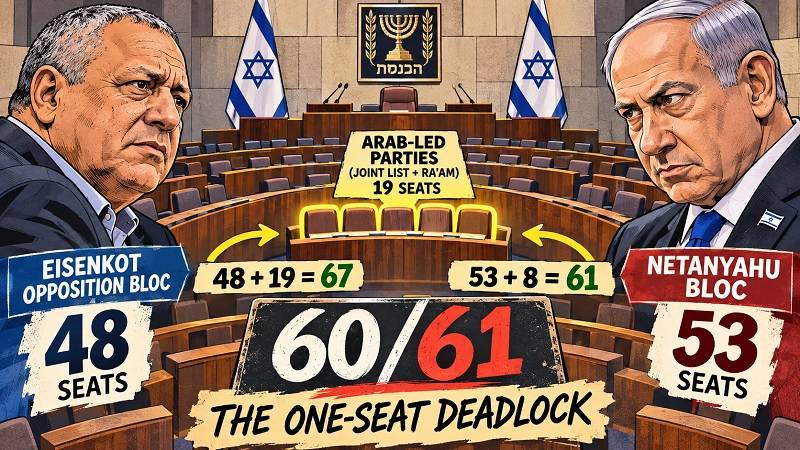
The maths is deceptively simple even for a maths idiot like me. The politics is terribly Zionistic and messy.
Yes, I am talking about the post-election government formation in the Zionist entity. Let’s begin with the maths.
I did an exercise with Zara, my 8-year-old granddaughter. With a flair for numbers, she likes doing mental calculations. So I asked her how many seats a party would need to form the government in a 120-seat house. She said 61. I then asked her that if X bloc had 48 seats and they needed to reach 61, how many seats they would need. She said, “13.” “And if you can get 19 seats?” I asked. She said, “67.” I then asked her that if X block got 19 seats from Y but lost 7 seats from Z, would it get to 61. She took a few more seconds than before but got it right. “They will get to 60,” she said, “and that will be one short.”
Zara understands numbers. But at her age, she can’t really get Zionist politics or the evil that resides in that creed. That will come to her by and by. This article is an attempt to inform the reader not just about the maths (more appropriately, arithmetic) but the forces at play within the Zionist entity, pushes and pulls that are begotten of Zionism, the grand larceny that was helped by the Western colonial powers and has caused such horrific death and destruction in the past 100 years, a process that would unfortunately draw even more blood before the cancer of Zionism can be destroyed and the region can reclaim peace.
The best way to go about it is to begin at the beginning, who was contesting against whom and whether the departure of that war criminal Benjamin Netanyahu would make any difference.
The contest began among three broad electoral groupings: Netanyahu’s bloc; Gadi Eisenkot’s alliance and Arab parties (Joint List and Ra’am), what are called 48-ers, Arabs left in the Zionist entity after the Nakba (catastrophe). Coined in August 1948 by the Christian Syrian historian and intellectual Constantin Zurayk, the word was the title of his pamphlet, Ma’na al-Nakba (The Meaning of the Disaster).
The terms of the contest were/are also rather simple: Netanyahu is trying to hold on to power by the skin of his teeth; the Eisenkot bloc wants to get rid of him. The 48-er parties also want Netanyahu gone but they are not under any grand illusion that much would change. They fight for Arab rights but they hope that with Netanyahu gone, they could perhaps link up with some elements within the Eisenkot bloc to create more space for the Arabs within the Zionist entity.
I will come to more details in a bit but let’s now look at the blocs, the parties therein, their seats and what their leaders stand for. This is of course a bird’s eye-view.
The Gadi Eisenkot Opposition Bloc has secured a total of 48 Seats, 13 short of the magic number of 61. Here’s the breakdown:
Yashar (Hebrew for Straight) is the newest party and is led by Gadi Eisenkot himself. Eisenkot is a former chief of the Zionist occupation force, generally referred to as the IDF. He is Moroccan by lineage and that makes him the first-ever Sephardi Jew to receive a mandate to form a government.
A word about Sephardim. They are the Jews who left the Iberian Peninsula after the Reconquista, centuries-long struggle by Christian kings to oust Muslims from Spain. Jews were even more unwelcome and when Grenada, the last bastion fell, the Jews also left in droves and settled in today’s Morocco, Algiers, Tunisia and even Europe. While they are also of eastern, Judeo-Levantine lineage like the Mizrahi, they identify themselves as Sephardi.
Yashar is the flagship party of the centrist opposition alliance, its ideology is centrist, anti-corruption and security-focused liberalism. The party has 21 seats.
Together (B’Yachad) is led by Naftali Bennett, a wealthy high-tech entrepreneur, a former military officer and former prime minister, who was Netanyahu’s protégé but broke away from him. There’s not much difference between Netanyahu’s and Bennett’s Zionist approaches. The Together faction is a strategic merger of Yair Lapid’s centrist Yesh Atid party and Bennett's right-wing Bennett 2026 party. Its ideology is rightwing national conservatism and political reform. The party holds 12 seats.
The Democrats (Democratim) is led by Yair Golan, a retired Major General and former Deputy Chief of Staff who fiercely defends liberal democracy. This faction represents a direct merger of the historic Labour Party and the leftwing Meretz Party. Operating inside the opposition alliance, it is centre-left and espouses social democracy and liberal Zionism. It has 8 seats.
Yisrael Beiteinu is led by Avigdor Liberman, a Moldova-born former defence minister. The party has a robust secular rightwing base and Liberman strongly opposes religious and Arab factions. A member of the Zionist opposition alliance, he is a rightwing secular nationalist. The party holds 7 seats.
The Benjamin Netanyahu Bloc has 53 seats.
Likud is led by Netanyahu himself. The longest-serving prime minister, he is a rightwing strategist and his career spans military service to political rabble-rousing to economic liberalisation and complex legal battles. He fancies himself as the anchor of the rightwing alliance peppered with national liberalism. The party has 27 seats.
Otzma Yehudit is led by Itamar Ben-Gvir, a far-right lawyer and firebrand who rose from the radical fringe to senior ministerial roles by advocating hardline security. Embedded firmly within the Netanyahu alliance, he espouses the far-right Kahanist ideology and ultranationalism. The party holds 7 seats.
A word about Kahanism. Kahanism is an extremist, ultra-nationalist religious Zionist ideology based on the teachings of Rabbi Meir Kahane, who founded the Jewish Defence League and the outlawed Kach party. The ideology advocates transforming the Zionist entity into a strict theocracy governed by Halakha (Jewish religious law) and calls for the forced expulsion or stripping of the rights of non-Jews, particularly Arabs, whom it views as existential enemies.
United Torah Judaism (UTJ) is led by Yaakov Asher, a seasoned politician and former mayor of Bnei Brak focused on preserving religious welfare. A longstanding religious partner in the Netanyahu alliance (he has abstained from recommending him this time) the party’s ideology is Haredi (ultra-orthodox) Ashkenazi. The party holds 7 seats.
Shas is led by Aryeh Deri, a veteran political operator and co-founder of Shas who remains a crucial kingmaker for ultra-Orthodox communities. Part of the religious nationalist alliance backing Netanyahu, its ideology is Haredi Sephardi and Mizrahi ultra-Orthodoxy. The party holds 6 seats.
Religious Zionist Party (aligned with Zehut) is led by Bezalel Smotrich, an ultranationalist lawyer representing the West Bank settler movement who opposes secular state reforms. A key component of the far-right flank in the Netanyahu alliance, its ideology is religious Zionism and hardline ultranationalism. The party holds 6 seats.
The third bloc comprises the Arab-Led parties with 19 seats.
The Joint List is led by Yousef Jabareen, an academic, legal scholar, and civil rights advocate championing Arab-Palestinian national rights. Independent of both major Zionist blocs, its ideology is Arab-Palestinian nationalism and left-wing anti-Zionism. The party has secured 11 seats.
Ra’am (United Arab List) is led by Mansour Abbas, a dentist by training who pioneered a pragmatic shift towards securing state budgets for Arab municipalities. Ra’am is also independent of both major alliances but it is ideologically Islamist and social-conservative. The party has 8 seats.
Netanyahu is short by 8 seats; Eisenkot by 13. Arab parties hold the balance. Both Zionist blocs, were they to approach the 48-ers in theory, could form the government. Problem: the 48-ers want Netanyahu out so they won’t endorse him, though Abbas did give outside-the-government support to Netanyahu last time before withdrawing it. The Arabs have endorsed Eisenkot, which is why the Zionist entity’s president has called on him to form the government.
So, what’s the issue? Eisenkot has got their support and can form the government. Except, it’s not so simple and it begins with Eisenkot’s own four core principles:
Jewish and Democratic State: Any coalition partner must formally recognise Israel as a Jewish and democratic state; Declaration of Independence: All participating factions must fully commit to the foundational values of the Zionist entity’s Declaration of Independence; Universal National Service: Participating parties must show a strict commitment to implementing mandatory national or military service for all citizens; Dismantling Hamas: Partners must recognise Hamas as a terrorist organisation and commit to dismantling its military and governing capabilities.
How does Eisenkot build a coalition supported by Ra'am and the Joint List when the Joint List is anti-Zionist and cannot fulfil 1, 2 and 4 of his core principles? Ra’am will go along but that only gets him 8 more seats. Then there is Avigdor Liberman of Yisrael Beiteinu. Even if we assume that Eisenkot could get all 19 seats of the 48-ers, Liberman would withdraw support and Eisenkot would lose his 7 seats because Liberman is rabidly against sharing a coalition with the Arabs. That throws Eisenkot back to 60 seats, one short of the magic number.
Another possibility is for Eisenkot to reach out to some parties in the Netanyahu bloc, including Bezalel Smotrich, UTJ and Shas. Except, none of the three fulfils the third point of his four core principles: compulsory military service for all. Shas, UTJ and Smotrich vigorously oppose forcing Yeshiva (Jewish seminary) students into military service. That violates Eisenkot's nonnegotiable principle of universal draft equality. Liberman is also opposed to the ultra-orthodox.
[NB: there’s some indication that Liberman might be softening his position on the ultra-orthodox, especially on the issue of compulsory military service.]
Eisenkot wrote on X that “Now is the time to form a national emergency government. I will do everything to ensure we are worthy.” But unless he down-blends some of his core principles, he will not be able to form a majority government. So far he has not given any indication that he is prepared to do that. His other option would be to placate Liberman by making the latter accept outside-the-government support from the 48-ers so that the first order of business is taken care of: namely, Netanyahu’s ouster. He could likely sell it to Liberman.
If that does come about, he will be forming a minority government which would need external support on the legislative and policy agenda on an issue to issue basis. Legislation would become extremely cumbersome, could constantly hit snags and even bring the government down.
But if Eisenkot does manage to form a government, even a fragile minority government, he would have gotten rid of Netanyahu (a big assumption). In that event, even if his government falls at some point, he would remain the prime minister in an interim capacity going into another election cycle and hope to improve his own party’s showing.
Would Netanyahu’s ouster impact regional security? Not really. While he is rabid, Eisenkot is not really any different when it comes to national security. As the creator of the twin concepts of mowing the grass and the Dahiya doctrine who also opposes the so-called two-state solution, Eisenkot won’t change the Zionist entity’s security policy. He has also talked about Jewish sovereignty from the river to the sea. Nor is he a dove on Lebanon or Iran. For the Palestinians nothing is likely to change.
In that respect, the Zionist entity’s elections are about the same as the recent United States elections. Democrats winning the Congress may be good for the US internally but for the most part the US foreign policy remains the same. Ditto for the Zionist entity.