

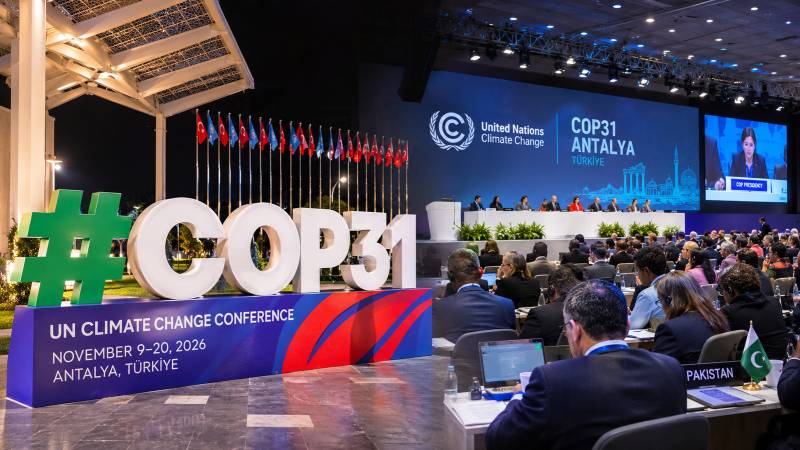
The UN Climate Change Conference (COP31) in Antalya, Türkiye, concluded on November 22 without an overarching political agreement. Despite two additional days of negotiations, countries remained divided over fossil fuels and climate finance. For the Global South, the fundamental issue remains the unequal distribution of responsibility for climate change and the cost of addressing its consequences. Having participated in several sessions at COP31, I was struck by the disparity between the scientific and technological capacity to address climate change and the political and financial commitment to tackling it.
The outcome in Antalya contrasts sharply with the optimism surrounding the Rio Earth Summit of 1992. With the end of the Cold War, sustainable development emerged as a shared global priority under UN leadership and with US backing. The Paris Agreement and Sustainable Development Goals (SDGs) of 2015 reinforced this international consensus. Pakistan contributed to this endeavour through Dr Tariq Banuri, the founding executive director of the Sustainable Development Policy Institute (SDPI), who contributed to the work of the Intergovernmental Panel on Climate Change (IPCC), jointly awarded the Nobel Peace Prize with Al Gore in 2007.
COP31 was intended to translate previous commitments into action. However, the European Union and several other countries rejected the proposed Antalya Pact over the absence of an explicit reference to transitioning away from fossil fuels. For developing countries, an equally significant setback was the failure to agree on the proposed annual adaptation financing target of $120 billion by 2035. European countries, particularly France and Germany, have traditionally championed global climate action. Yet their leadership on emission reduction has not been matched by adequate financial support for developing countries. The wars in Ukraine and Iran, disruptions in energy supplies, rising military expenditure and economic stagnation have altered Western priorities.
According to the OECD, official development assistance declined by 23.1 per cent in real terms in 2025. While the economic and security concerns of Western countries are understandable, developing countries should not have to bear their consequences. Much of Western prosperity was built through carbon-intensive industrialisation. The principle of common but differentiated responsibilities, recognised at Rio, reflects this historical imbalance. Article 9 of the Paris Agreement requires developed countries to provide financial resources to assist developing countries with mitigation and adaptation.
Yet the annual climate financing commitment of $100 billion made at Copenhagen in 2009 was first met in 2022, two years behind schedule. At COP29 in Baku, developed countries agreed to take the lead in mobilising at least $300 billion annually by 2035. The growing reliance on loans and private investment risks diluting their financial responsibilities.
While renewable energy projects may generate commercial returns and carbon credits, protecting vulnerable communities from climate disasters and rebuilding destroyed infrastructure require substantial public financing. Pakistan's experience illustrates this problem. Despite contributing less than one per cent of annual global greenhouse gas emissions, the country faces recurring climate disasters. The floods of 2022 affected 33 million people, caused over $30 billion in damage and economic losses, and created recovery and reconstruction needs of $16.3 billion.
As a member of the Planning Commission of Pakistan, I was personally involved in the preparation of the Post-Disaster Needs Assessment, undertaken by the government in collaboration with the United Nations, World Bank, Asian Development Bank and European Union. The assessment provided the basis for Pakistan's Resilient Recovery, Rehabilitation and Reconstruction Framework (4RF), presented at the international conference in Geneva in January 2023. However, much of the international financial response involved loans, including the repurposing of existing development financing.
Requiring developing countries to borrow money to address the environmental consequences of Western industrialisation perpetuates historical patterns of economic dependency. For countries already struggling with high debt servicing costs, this is neither equitable nor sustainable.
Redirecting development resources towards disaster recovery undermines progress towards the SDGs. Climate finance should be additional to development assistance, not come at the expense of education, healthcare and poverty reduction. The 2022 floods in Pakistan helped mobilise international support for the longstanding demand of developing countries for a dedicated loss and damage fund to address the consequences of climate change that mitigation and adaptation cannot prevent.
The establishment of the fund at COP27 in Sharm El-Sheikh was a major achievement of the Global South. Yet its financial commitments remain below $1 billion, less than one-thirtieth of Pakistan's damage and economic losses from the 2022 floods alone. Requiring developing countries to borrow money to address the environmental consequences of Western industrialisation perpetuates historical patterns of economic dependency. For countries already struggling with high debt servicing costs, this is neither equitable nor sustainable.
The Global South must also reduce its technological dependence on industrialised countries. Pakistan's rapid expansion of solar energy, facilitated by affordable Chinese technology, illustrates the potential of South-South cooperation. Discussions at several sessions in Antalya highlighted similar opportunities in climate adaptation, disaster preparedness, circular economy and water, energy and food security. Scientific and technological networks of the Global South, such as the Commission on Science and Technology for Sustainable Development in the South (COMSATS), can facilitate knowledge sharing, technology transfer and capacity building.
Developing countries must retain their right to industrialisation while benefiting from advances in clean energy and resource efficiency. South-South cooperation can facilitate this process but cannot substitute for the financial and technological obligations of developed countries. The failure of the Antalya Pact raises legitimate questions about the utility of annual climate conferences involving tens of thousands of participants. COP31 did achieve some progress through technical decisions and voluntary initiatives, including cooperation on electrification.
Nevertheless, the UN climate process provides the Global South with a platform to collectively assert its interests. The establishment of the loss and damage fund would not have been possible without sustained advocacy by developing countries. In political terms, Antalya has further exposed the contradiction between the universal values espoused by the industrialised West and its reluctance to assume an equitable share of the financial cost of climate action.
Ahead of COP32 in Ethiopia, the Global South must consolidate its negotiating position around predictable and additional climate finance, grant-based funding for loss and damage, affordable adaptation finance and equitable access to climate technologies. The Global South must approach future climate negotiations with a collective demand for the fulfilment of internationally recognised obligations, rather than seeking assistance at the discretion of developed countries. Climate finance is a matter of justice, not charity.