

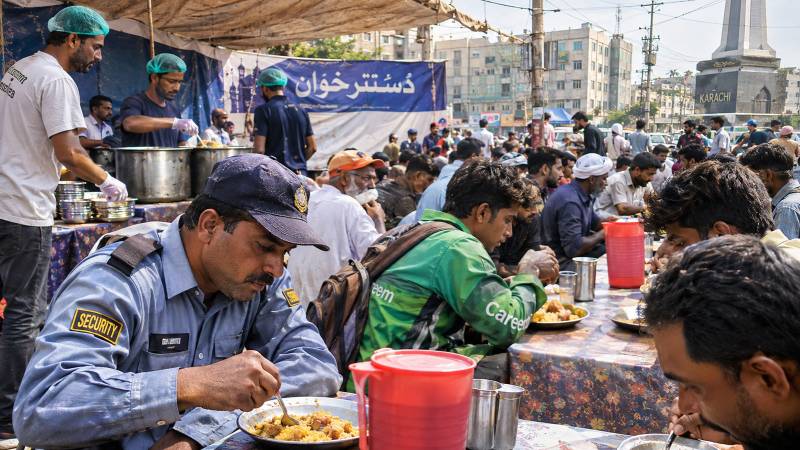
A disturbing trend has recently emerged on social media, where some activists and self-proclaimed social commentators have started blaming charitable organisations that provide free meals at dastarkhwans across Karachi for the city's rising street crime. Their argument is that these facilities encourage people to commit theft and robbery because they can get food without paying for it. This claim is not only baseless but also reflects a complete disconnect from the realities of ordinary working people.
Before making such accusations, those criticising these welfare initiatives should visit a dastarkhwan, sit there for a while and observe who actually comes to eat. They will find security guards, labourers, daily-wage workers, delivery riders, office assistants and other hardworking citizens. These are not people sitting idle or looking for an easy way out of life. They are individuals who work long hours but struggle to make ends meet in an increasingly expensive city.
Consider the situation of a security guard earning Rs25,000 to Rs30,000 a month. From this modest income, he has to pay rent, electricity and gas bills, manage his children's school fees, arrange transport and provide food for his family. After meeting these expenses, how much is realistically left? For such a person, having breakfast or lunch at a free dastarkhwan is not an act of dependence; it is a practical way to manage an otherwise unbearable financial burden. Why should society make him feel ashamed for accepting a meal that someone has generously provided?
There is also a basic question that those linking free food with street crime need to answer: why would someone involved in mobile-phone snatching, motorcycle theft or armed robbery risk exposing himself at a public dastarkhwan? These facilities are often located in busy areas, where CCTV cameras, volunteers and other people are present. Is a criminal, who knows that his face could be captured on camera, really going to put himself under unnecessary scrutiny just to save the cost of a meal? Someone involved in organised theft or robbery is generally pursuing money, valuables and a lifestyle beyond the means of an ordinary worker. It is irrational to suggest that such people are committing crimes because free meals are available.
If anyone genuinely believes that criminals are using these facilities, they should present evidence rather than make sweeping allegations against everyone who eats there. A person should not become a suspect simply because he cannot afford to buy his own meal. Street crime is a serious law-and-order issue that requires effective policing, investigation, accountability and action against criminal networks. Charitable kitchens are not responsible for the failure to control crime, and blaming them only distracts attention from the real problem.
A person should not become a suspect simply because he cannot afford to buy his own meal. Street crime requires effective policing and accountability, not accusations against charitable kitchens.
Another argument frequently heard is that if someone is receiving free food, the organisation should ask that person to work in return. But charity is not an employment contract. When we help someone in need, do we first demand labour or a service in exchange? The purpose of charity is to provide relief without humiliating the recipient. A welfare organisation is not running a recruitment centre; it is trying to ensure that a person does not go hungry. There is a difference between creating employment opportunities and feeding someone who needs a meal.
The same principle is followed in many parts of the world. Dubai, for example, has charitable food initiatives that provide free meals to people who need them. Does the availability of free food mean that crime should automatically increase there? Of course not. The provision of food and the prevention of crime are two entirely different matters. One is a humanitarian service, while the other is a responsibility of law-enforcement agencies and the state. Connecting the two without evidence is simply an attempt to create a controversy where none is justified.
What is even more concerning is the possible damage such social media campaigns can cause to welfare organisations. I understand that JDC Foundation has suspended its dastarkhwan operations at various locations in Karachi for an extended period, reportedly following the controversy and criticism surrounding such initiatives. If this decision is linked to the pressure created by these campaigns, it should make us think seriously about the consequences of irresponsible online commentary. These dastarkhwans were not merely places where food was distributed; they were a source of support for thousands of people who depended on them for meals. Their closure or suspension means that the people who genuinely needed this assistance are the ones who suffer.
There is a real danger that other organisations operating free dastarkhwans may also decide to shut down their services if they are repeatedly targeted by accusations and online campaigns. If that happens, who will lose? Certainly not the people making videos and posts from the comfort of their homes. The people who will suffer are the security guards, labourers, daily-wage earners and families who rely on these meals. Those who have never had to worry about arranging their next meal may not understand what losing such a facility means to someone living on a limited salary.
Social media influencers and activists must understand that their words carry consequences. Criticism is a right, and no charitable organisation should be above accountability. If there is evidence of wrongdoing, misuse of donations or illegal activity, it should be investigated and exposed. But criticism must be based on facts, not assumptions, personal frustration or the desire to gain popularity through controversy. Before launching a campaign against a welfare initiative, people should visit the location, speak to beneficiaries, understand the organisation's work and examine the facts.
Our society already faces inflation, unemployment, poverty and serious law-and-order challenges. At a time like this, we should be encouraging individuals and organisations that are trying to reduce the burden on ordinary citizens. We should be asking how more people can be fed, how more welfare kitchens can be established and how deserving families can receive support. Instead, we seem to be finding reasons to discourage those who are doing something positive.
Karachi needs more people willing to feed the hungry, not more voices trying to stop them. If someone is providing a free meal to a security guard who has spent the night protecting a bank, a hospital, a school or an office, that person deserves appreciation. Feeding a hungry human being is an act of humanity. It must not be turned into a social media controversy or treated as a cause of crime without a shred of evidence.