

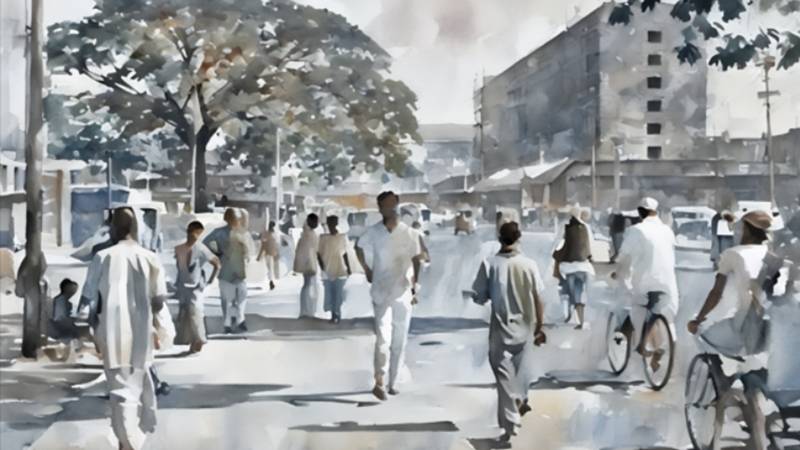
When Pakistan gained independence from the UK, it consisted of two “wings” that were separated by a thousand miles of Indian territory. West Pakistan and East Pakistan had their own culture, including language, food, dress and sports. And they had their own topography and climate.
The only thing in common was that most of their inhabitants were Muslims. Even in that dimension, the percentage of Muslims in West Pakistan was around 97% versus 75% in East Pakistan.
West Pakistan neighboured Iran and Afghanistan on its west, India on the east and China in the north. It bordered the Persian Gulf in the south and was relatively close to the Gulf Arab states. East Pakistan was surrounded by India on all sides and had the Bay of Bengal in the south. It was relatively close to China in the north and Myanmar (“Burma”) on the east.
The population of East Pakistan was higher than the population of West Pakistan and the relative size was preserved over time.
West Pakistan was more economically developed than East Pakistan. Most of the industry was located there. Karachi, the capital city, also lay in the West. Later, during the Ayub era, it was moved to Islamabad in the north. Rawalpindi was the seat of the Pakistani army, which was dominated by residents of West Pakistan. The military personnel were drawn mostly from West Pakistan. The army had several divisions, and all were in the West except for the 14th Infantry Division. Similarly, the bulk of the air force and navy units were in the West, and both services were headquartered in the West.
Compounding the problem, the civil service, an elite institution inherited from the British, was dominated by residents of West Pakistan.
For all these reasons, the East felt discriminated against, an emotion that was exacerbated when MA Jinnah, the Governor General, made Urdu the national language.
Reliable data on the annual growth rate of GDP per capita data for West Pakistan and East Pakistan (now Bangladesh) from exactly 1947 onward is hard to find, but historians and economic researchers have reconstructed a consistent picture using Pakistani government archives, UN data, and later World Bank estimates.
Here is the broad trend:
From independence in August 1947 through the 1950s, East Pakistan’s per capita income was slightly lower than West Pakistan’s, in part because it had a weaker industrial base. West Pakistan had a stronger industrial base, large irrigation projects, and was the recipient of large amounts of government assistance and foreign aid. East Pakistan remained heavily dependent on its agricultural sector and had lower levels of government investment. By the mid-1950s, the gap in per capita income had widened and West Pakistan’s per capita income was about 30% higher than East Pakistan’s.
In 1968, Ayub Khan wrote: “How long will this partnership [between East and West Pakistan] last, I do not know." Within three years, history had answered him
During the 1960s, which was the period of the Second and Third Five Year Plans, West Pakistan experienced rapid growth in GDP, estimated at 6–7%. This was driven by industrialisation and the “Green Revolution” in agriculture. It also benefited from US aid. East Pakistan showed more modest economic growth, stemming largely from jute exports, but it lagged behind in manufacturing and infrastructure investment.
By 1970, per capita GDP in West Pakistan was about 60–70% higher than in East Pakistan according to most estimates (e.g., ~US$160 in East vs ~US$240 in West at constant 1970 prices).
At independence, East Pakistan’s GDP per capita was 94% of West Pakistan. By 1960, the fraction had dropped to 0.76. By 1970, it had plummeted to 0.67.
By the time the Fourth Five Year Plan (1970-75) was issued, the Government admitted that East Pakistan was lagging behind the West. The plan intended to rectify the growing economic imbalances, while also targeting industrial growth, agriculture, and social development.
It acknowledged that “The disparity in per capita income of East and West Pakistan also increased during the period because the agricultural break-through was limited to West Pakistan… The Fourth Plan must seek to integrate social change with economic progress.” Noting that a growth rate of a little over 4 per cent had been achieved during the 1960s in East Pakistan, the plan sought to accelerate this growth rate to 7.5 per cent but acknowledged that “it will require a tremendous effort.”
But it was a proverbial case of doing something that is “too little, too late.” The people of East Pakistan felt like they were second-class citizens, economically, politically and militarily. According to notable Pakistani economist Parvez Hasan, “the growing divergence in the lifestyles of the well-to-do in the two wings sowed the seeds of political discontent among the Bengali intelligentsia.”
Matters came to a head in 1971 when the military government of General Yahya Khan decided to annul the results of the 1970 general elections, in which the Awami League, based entirely in the East and headed by Sheikh Mujib, had secured an absolute majority in the National Assembly. As far back as 1968, the Government headed by Field Marshal Ayub Khan had sensed that trouble was brewing and arrested Sheikh Mujib on charges of sedition in what came to be known as the Agartala Conspiracy Case.
Ayub died in 1974. Decades after his death, his diaries covering the period from 1966 to 1972, were published. In his diaries, he said that the people of Pakistan were gullible, and the politicians were crooked. It was his commentary on the crisis in the East that was far more revealing.
In May 1967, he wrote that the people of East Pakistan, “are consciously Hinduising the language and culture. Tagore has become their god. Everything has been Bengalised, even the plate numbers on vehicles are in Bengali. A man from West Pakistan feels like a foreigner in Dhaka. Consciously or unconsciously, they are moving towards separation and exposing themselves to absorption by Hinduism.”
In early 1968, he wrote: “How long will this partnership [between East and West Pakistan] last, I do not know." Within three years, history had answered his question.
What happened after East Pakistan broke away? A new nation called Bangladesh was created. How did it fare, economically and politically? Where does it stand today in the world economy? I will address those questions in my next column.