

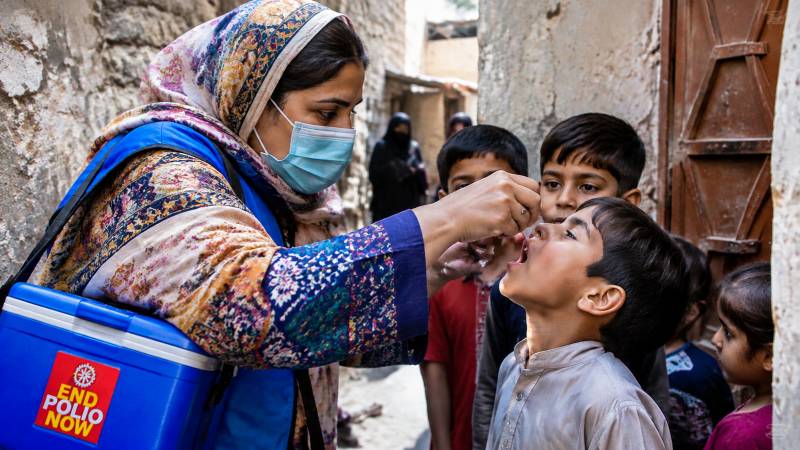
Every time Pakistan begins another polio vaccination campaign, I find myself asking the same uncomfortable question: how many more campaigns will it take before we can say that the virus is no longer circulating in our country? Our vaccination teams work in difficult conditions, public money is spent, thousands of health workers are mobilised and parents are repeatedly urged to bring their children forward. Yet wild poliovirus continues to find a way to survive.
This is particularly difficult to accept when we look at India. The country reported its last case of wild poliovirus in January 2011 and was certified polio-free in 2014. Bangladesh has also maintained its polio-free status. Pakistan and Afghanistan, however, remain the only countries where wild poliovirus is still endemic. The comparison is not meant to diminish the work of our frontline teams. It is meant to ask why a programme with so much experience, expertise and support has not yet achieved its central objective.
India was not an easy country to eradicate polio. Its huge population, crowded cities, remote communities, poverty and difficult geography presented challenges familiar to us in Pakistan. India’s progress did not come from a single campaign or a miracle vaccine. It came from sustained political commitment, repeated vaccination of children, close monitoring of areas where coverage was weak, community mobilisation and a surveillance system capable of detecting the virus even when no paralytic case was being reported.
From time to time, one hears the argument that India succeeded because it kept greater national control over its health programme and did not allow international organisations to dictate its priorities. This argument needs to be treated carefully. There is no sound basis for claiming that India achieved eradication by excluding the World Health Organization. WHO provided important technical support, including surveillance expertise. The more useful lesson is that international partners can make a major contribution, but the programme must remain nationally owned, locally understood and firmly accountable to the people it serves.
Pakistan’s difficulty is not simply that parents refuse vaccination, nor is it that our health workers are not trying hard enough. The reasons are more complicated. Some children are repeatedly missed in mobile and underserved populations. Families move between districts and across borders. Routine immunisation remains uneven in some communities. Misinformation and mistrust can lead to refusal, while insecurity and attacks on vaccination teams make access dangerous. These problems require different solutions; repeating the same message or announcing another round of vaccination cannot, by itself, resolve them.
Pakistan’s polio problem is no longer simply a question of vaccine availability or the number of campaigns conducted; it is a question of governance, accountability and public trust.
We also need to understand what surveillance tells us. Most poliovirus infections do not cause paralysis. A child may be infected and transmit the virus without developing the familiar symptoms of polio. For that reason, the absence of reported paralytic cases is not enough to prove that transmission has stopped. Environmental surveillance, particularly testing sewage samples, is essential. Laboratory analysis and genetic sequencing help investigators identify where the virus is circulating and whether infections in different areas are connected.
The continuing epidemiological links between poliovirus strains detected in Pakistan and Afghanistan show why the two countries cannot treat this as separate national problems. People travel across the border, families move for work and safety, and the virus does not recognise political boundaries. Both countries need reliable information-sharing, coordinated vaccination activities and practical arrangements to reach children on either side of the border.
In my view, Pakistan must now judge the programme less by the number of campaigns conducted or doses administered and more by the children who remain unprotected. Each missed child should be understood as a programme failure that needs investigation, not merely added to a statistic. District teams should know where these children live, why they were missed, whether the same households are being revisited and whether local leaders and trusted community members are helping to build confidence.
There must also be clear accountability at every level. Political leaders need to maintain attention on polio between campaigns, not only when national announcements are made. Administrators must act on local data. Health professionals should communicate honestly and respectfully with parents. Security arrangements must protect vaccination workers, and the families who are hesitant should be heard rather than dismissed. Trust is not created through slogans; it is earned through consistent, respectful contact and reliable public services.
Pakistan has many of the essential ingredients: an effective vaccine, experienced health professionals, capable laboratories, surveillance expertise and support from international partners. What remains difficult is ensuring that these resources reach every child, every time, especially in communities that have been missed repeatedly. That is ultimately a question of governance, service delivery and public confidence as much as it is a question of medicine.
India has shown that polio eradication is possible in a country facing enormous public-health and social challenges. We should study its experience without assuming that every measure can simply be copied. Pakistan must develop solutions that reflect its own geography, population movement, local politics and security realities. But we should not accept continued transmission as inevitable. After so many years of effort, the public deserves a frank assessment of what is working, what is failing and who is responsible for correcting it. The question is no longer whether polio can be eradicated. The world has demonstrated that it can. The question Pakistan must answer is much more direct: why are children still being missed, and what are we going to do differently to reach every one of them?