

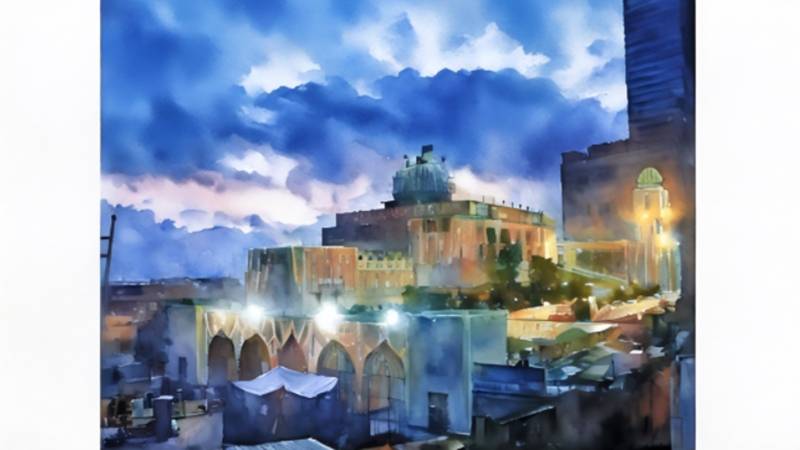
Karachi is a city of relentless motion. A megacity of over 20 million, it is full of the energy of commerce, the chaos of traffic, and constant aspiration. It’s a place of glass-fronted high-rises, sprawling industrial estates and flyovers. Yet for many of its residents, the city finds its rhythm in the city’s countless shrines, Sufi dargahs, from the most prestigious neighbourhoods to the densest slums. Many readers would normally associate a thriving shrine culture with the big cities of Punjab, including Lahore and Multan.
But in Karachi, the shrines are not mere relics of a bygone era; they are living, breathing institutions that shape the city’s culture, its economy, and the very soul of its people.
At the centre of this spiritual geography stands the most iconic of them all: the shrine of Abdullah Shah Ghazi. Perched on a hill overlooking the Arabian Sea in the upscale Clifton area, his white dome is a landmark visible for miles. He is revered as the city’s patron saint, the one who protects Karachi from cyclones and calamities. Legend holds that he arrived in the 8th century, bringing the message of Islam and standing as a bulwark against dark forces. For the millions who visit him, he is more than a historical figure; he is a living protector, a wali (friend of God) whose blessing is a tangible force in their lives.
To understand Karachi, one must understand this relationship between the saint and the city. In a place often fractured by ethnic politics, economic disparity, and sectarian tension, the shrine emerges as a rare unifying force. On any given evening, you will see a rich man’s car parked next to a rickshaw. A Baloch fisherman, a Pashtun day labourer, a Sindhi poet, and a Punjabi businessman will all be seated on the same marble floor, heads bowed in unison. The shrine does not ask for their identification cards, their bank statements, or their sect. It offers solace to all, creating a fragile, temporary refuge where the city’s harsh social hierarchies dissolve at the doorstep of the saint.
The most significant event is the Urs, the death anniversary of the saint, which is celebrated as a wedding – his union with the Divine. At Abdullah Shah Ghazi’s shrine, the Urs is a days-long spectacle. The entire area transforms. The primary ritual is the offering of the chadar, a ceremonial cloth draped over the tomb. But this is just the centrepiece.
The real cultural tapestry is woven around it. Qawwali music, the hypnotic, devotional music of the Sufis, is the soundtrack of the Urs. For hours on end, groups of musicians sing poetic verses of divine love and longing, their powerful voices and rhythmic clapping pulling devotees into a state of ecstatic trance. It is not uncommon to see people – men and women in separate sections – begin to sway and spin, entering a haal (spiritual state). This public display of emotion, so at odds with the reserved decorum of everyday life in the city, is not just accepted but welcomed as a sign of spiritual grace.
The city's youth, increasingly globalised through the internet and media, sometimes view shrine culture with ambivalence. For some, it represents a superstitious past, at odds with their modern, more rigidly textual, understanding of religion
Alongside the music is the practice of dhamaal, a whirling, ecstatic dance performed by devotees. It is a physical manifestation of their devotion, a letting go of the self that is both mesmerising and powerful. In a city where stress is a constant companion, these rituals provide a sanctioned, communal form of catharsis. They are a pressure valve for the urban soul.
But the culture of the shrine isn't confined to grand festivals. It permeates daily life. People make mannat, vows to the saint, promising an offering in return for a wish fulfilled—the recovery of a sick child, success in an exam, a visa to a foreign country. The offerings are as diverse as the city itself: a pot of sweet rice (zarda), a length of fine cloth, or simply a few rose petals. This practice of mannat creates a deeply personal, transactional relationship between the devotee and the divine, mediated by the saint. It is a way for individuals to feel a sense of agency in a city that can often feel overwhelming and impersonal.
The Economy of Faith: Business in the Shadow of the Dome
Where there is faith, there is commerce. The shrine culture of Karachi is a significant, if often informal, economic engine. The area surrounding a major shrine like Abdullah Shah Ghazi’s is a vibrant micro-economy built entirely around the needs of the pilgrim.
This economy is multi-layered. At its most basic, you have the vendors selling the necessities of devotion: rose petals and garlands, incense sticks, prayer mats, and packets of dates to be distributed as charity. Then there are the small stalls offering sustenance to the visitors: cups of steaming tea, cold drinks, simple meals and sweet treats.
The food economy around shrines is a particular specialty. It is often simple, hearty, and affordable, catering to the masses. But it holds a special significance. The act of feeding others, known as langar, is considered a sacred duty. Many devotees fulfill their vows by sponsoring a large communal meal for hundreds, even thousands, of people. This is not a profit-making enterprise but an act of charity. However, it supports a whole sub-economy of cooks, helpers, and service providers.
Beyond these immediate vendors, the shrine economy supports a host of other services. Auto-rickshaws and taxis line the routes, ferrying pilgrims. There are small shops selling religious paraphernalia – amulets (taweez), prayer beads, and depictions of the saint. For the poor and the migrant, the shrine area often provides a first point of entry into the city’s economy. It offers informal employment and a chance to earn a livelihood in the protective shadow of the saint.
This creates a fascinating paradox. In the midst of a globalised, capitalist megacity, the shrine sustains older forms of economy, rooted in faith and community rather than corporate logic.
Food is not just a commercial commodity around shrines; it is a central pillar of the cultural and spiritual experience. The connection between Sufism and food in South Asia is an old oine. The shrines have long been centres where the hungry were fed, regardless of faith or background.
In Karachi, this tradition continues with powerful resonance. The most iconic shrine food is the deg. These are massive, cauldron-like pots in which food for the communal meal, or langar, is cooked. To be offered food from a deg is to receive a blessing. The sight of these enormous pots, stirred with giant ladles, is a spectacle in itself. The food itself is usually simple: a rice dish, perhaps with lentils or a bit of meat. But its taste is transformed by the context. It is food as grace, a tangible expression of the saint’s generosity flowing through the community.
In a city increasingly dominated by fast-food chains and expensive cafes, the shrine’s langar stands as a powerful symbol of equality and community. Sitting on the floor and eating from a shared plate, the banker and the beggar partake in the same meal. It is a radical act of social levelling in a deeply stratified city, a reminder of a shared humanity that transcends the brutal economics of everyday life.
A Clash of Worlds? Modernity and the Changing Urban Landscape
The relationship between Karachi’s rapid urbanisation and its shrine culture is not always harmonious. The city is changing at a breakneck pace, and the spaces of the shrines are often caught in the middle.
The shrine of Abdullah Shah Ghazi sits on some of the most expensive real estate in the world. The land around it in Clifton is a prime target for developers looking to build luxury apartments and shopping malls. This creates immense pressure on the physical space of the shrine and the informal economies that depend on it. There is a constant tension between the spiritual value of the land and its staggering commercial value.
Karachi has faced security challenges, the open, accessible nature of shrines has made them targets for extremist violence. The tragic bombing at Abdullah Shah Ghazi’s shrine in 2010 was a reminder of this vulnerability. In response, security has been tightened. Walls, barriers, and metal detectors have been installed. While necessary, these measures have inevitably changed the experience. The once completely open and free-flowing space is now more controlled, more regimented. It has, to a degree, become securitised, reflecting the anxieties of the modern city.
The city's youth, increasingly globalised through the internet and media, sometimes view shrine culture with ambivalence. For some, it represents a superstitious past, at odds with their modern, more rigidly textual, understanding of religion. For others, it is a cherished part of their heritage.
Despite these pressures, the shrines have shown a remarkable capacity to adapt and endure. They are not static museums but living organisms. They incorporate modern technology: announcements over loudspeakers, live-streamed Qawwali sessions and digital donation systems.
In the cool, quiet shade of Abdullah Shah Ghazi’s tomb, close to but strangely removed from the chaos of Clifton, one finds a different Karachi. It is a Karachi that moves to the rhythm of prayer and poetry, not just the market. It is a city where a migrant from a distant village can find a sense of belonging, where the rich and poor can kneel as equals, and where the timeless human needs for hope, healing, and community are met
The shrine culture is the city’s subconscious. It is a deep layer of meaning beneath the concrete and glass. It reminds Karachi of its past – from fishing village to port city connected to the thriving Sufi Islamic traditions of Sindh and beyond. As long as the white dome of Abdullah Shah Ghazi watches over the sea, the beating heart of the old city will continue to pulse within the body of the new.