

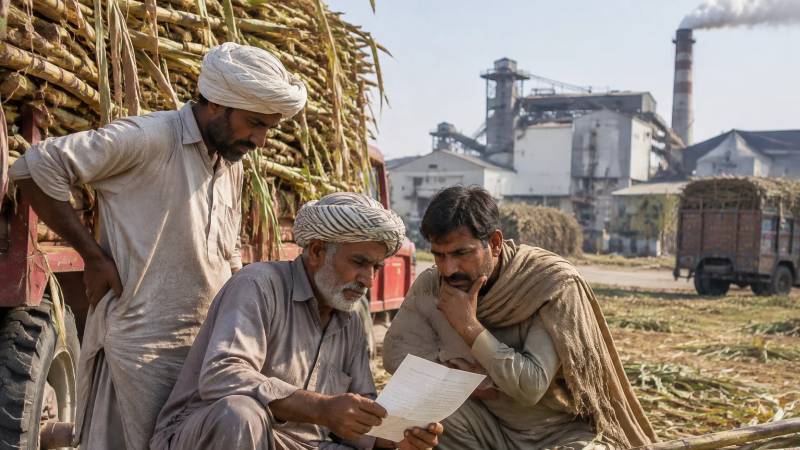
The farmer has already paid to grow the cane. The mill can still decide when to take it, what to offer and how long to make him wait for his money. That imbalance should have been the starting point of Pakistan’s sugar reform. Instead, the federal cabinet has approved a policy that leaves cane prices to the market and calls for removing restrictions on new mills and on the expansion of existing ones. The IMF wanted deregulation. The Pakistan Sugar Mills Association publicly demanded it. The industry pressed for this freedom and got it. What freedom has the farmer gained at the mill gate?
Look at who owns the mills. The industry expanded rapidly in the 1980s. The Competition Commission’s historical review counted 26 mills added during that decade, bringing the total to 60. Existing mills grew bigger too. A licence could be worth money before a single boiler was installed. The commission described how political patronage shaped the award of licences and how some recipients treated them as tradable assets. In its review of the sector around 2009, it reported that parliamentarians and their extended families owned more than half of the roughly 80 mills it counted. Those interests were represented on both sides of the aisle.
That ownership put mill interests inside the institutions making policy for the industry. The 2020 sugar inquiry documented export subsidies going to groups including JDW, RYK, Fatima, Sharif and Omni. The cabinet’s decision to end export subsidies is welcome. The harder test is whether a provincial government will enforce a payment deadline or act on a grower’s complaint when the mill concerned has political influence of its own.
The old price controls often failed growers. A notified price offered little protection if the mill could make deductions or keep the farmer waiting for his money. The new policy promises growers the freedom to sell to any buyer. In a cane belt, the buyer has to be within affordable reach. A better offer fifty kilometres away can disappear in the cost of transport. Once the cane is cut, it begins to deteriorate. The grower has to decide whether refusing the nearby mill’s offer will cost him even more. The mill knows what it costs him to walk away.
Take an illustrative six-acre holding yielding 750 maunds an acre. Every Rs50 cut in the price per maund takes Rs225,000 out of the grower’s receipts. The seed, fertiliser, irrigation and labour have already been paid for or bought on credit. The factory gets the same cane for Rs225,000 less. The household has that much less to pay off its debts and put the next crop in the ground. In Muzaffargarh, that next crop may be wheat. A mill that delays taking cane keeps the field occupied. A mill that delays paying for it may leave the farmer without money for wheat seed even after the field clears. If there is still time to sow, the grower may have to go back to the arhti for another advance. If the sowing window has closed, the money can arrive in full and the farmer will still have lost something the mill cannot return.
As restrictions on sugar mills are lifted, questions over farmer compensation, political influence, coordinated buying and depleting groundwater expose the economic and environmental costs of reform.
Punjab already requires mills to pay growers directly into their bank accounts within fifteen days of delivery, and its rules provide for interest on late dues. In March 2023, the Cane Commissioner issued notices to 27 mills over more than Rs29 billion in overdue payments. The question is who pays for the wait. The mill has his cane and keeps the cash. He borrows to pay labourers, buy seed and run his household while the factory has the use of his money. An uncollected entitlement cannot service a loan.
Islamabad can set the terms for exporting sugar. A federal cabinet decision cannot amend the Punjab law that governs when a mill must pay for its cane. Punjab already has the discretion to leave the cane price to negotiation, and the federal government says the province has agreed to implement deregulation. The fifteen-day deadline still applies. The IMF benchmark explains why Islamabad drove the policy. It is Punjab that must answer the grower when his money is late.
This season’s crushing dispute shows how little control the grower has over the calendar. Punjab notified 15 November as the start date. A Pakistan Sugar Mills Association official told Dawn that only one mill started on time. The millers had a fair point about being given barely a day to get their boilers running. Their association also asked for more time, immediate permission to export sugar and full deregulation. The government and the mills could negotiate the date. The grower had a crop in the field and a wheat season that would arrive on its own schedule.
Reports on the cabinet decision refer to transitional arrangements for this crushing season and separately describe safeguards on weighing, sucrose testing and late payment. They give little detail on how the transition will work. A man who committed his land, labour and borrowed money months ago cannot go back and plant something else. When will a mill take his cane? How will the price be set? Who will get his money released if the deadline passes?
The mills have faced competition proceedings over how they act together as buyers and as sellers. As far back as 2009, a Competition Commission inquiry identified evidence suggesting that mills coordinated cane purchase prices and divided buying territories. In a separate case in 2021, the commission imposed Rs44 billion in penalties on the millers’ association and its members. That decision found that mills shared sensitive stock information, agreed on export quantities and coordinated bids for public tenders. The penalty order was later set aside because the chairperson had used a casting vote to break an evenly split bench.
In November 2025, the commission issued show-cause notices to ten Punjab mills in a case that went straight to the farm gate. It alleged that the mills agreed to pay Rs400 a maund for cane and to begin crushing on 28 November, thirteen days after the notified date. The notices set out allegations the mills were entitled to contest. They also put a question to the government. If the next mill has agreed to open on the same day and offer the same price, where is the farmer supposed to take his cane?
The policy puts more weight on negotiation in a market where the mill can wait and the farmer cannot. Unless mills have to compete for his cane, they can use that bargaining power to buy the same crop for less. And when payment deadlines go unenforced, the factory keeps the use of the money it owes while the farmer pays to borrow elsewhere. A cheaper crop and the use of the grower’s cash are two gains to the mill. The farmer pays for both.
A new mill can give growers another buyer. It can also increase demand for cane and the water needed to grow it. Punjab has weighed those consequences before. In 2016, ruling on appeals from a 2013 Lahore High Court judgment in the Punjnad Sugar Mills litigation, the Supreme Court upheld Punjab’s restrictions on new mills and expansion of existing capacity. The judgment records why Punjab acted. More cane in the southern cotton belt could displace cotton and wheat and increase groundwater pumping in areas where canals flow for only part of the year. Before Punjab changes its restrictions, it should answer the question that led it to impose them. What has changed in the water account?
Look at Rahim Yar Khan. The Punjab Irrigation Department’s monitoring table puts the district’s average depth to groundwater at 10.02 feet in 2004, 11.03 feet in 2014 and 20.36 feet in 2024. The water table fell more than nine feet in the last decade alone. Before a new factory goes up or an existing mill adds a crushing line, Punjab should require its promoters to show how much extra cane they expect to buy, where it will be grown and where its irrigation water will come from. The mill owner can calculate the return on a bigger crushing line. Farmers drawing from the same aquifer will bear the cost if that calculation leaves water out. A government licence to expand a factory creates no additional water.
Judge the reform by what changes for the grower. Give him a receipt he can verify, with the weight, rate and every deduction recorded. Make weighing and sucrose testing independent. Publish what each mill pays and how promptly it pays. Enforce the fifteen-day deadline and recover interest when a mill misses it. Act on evidence of coordinated buying while the grower still has cane to sell. Disclose who ultimately owns each mill so the public can see whose interests are at stake when the rules are written and enforced. And when mills cite the price of sugar to explain what they can afford to pay for cane, disclose what they earn from molasses and bagasse as well. The grower supplies the whole crop. Every day the mill delays buying, the farmer finances the wait. Every day it withholds payment, he finances the factory. Why should the farmer finance the sugar industry’s freedom?