

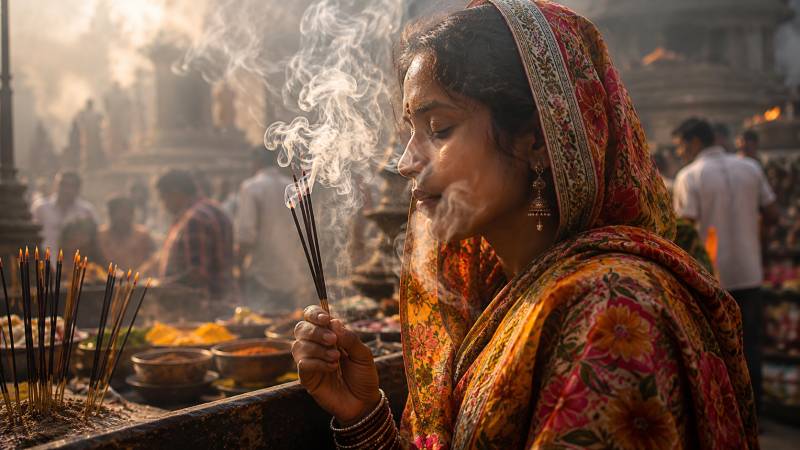
In the long history of thought, smell has existed like a quiet fugitive, always present, always influential, yet rarely acknowledged with intellectual seriousness. Philosophers across ages were seduced by the apparent stability of sight and the noble clarity of sound. They constructed metaphysical architectures around the visible and the audible, imagining truth itself as something that must be seen or heard to be known. Smell was a trespasser, too fleeting to be trusted, too bodily to be elevated.
Yet the very characteristics that made smell suspect in philosophical discourse, namely its volatility, its intimacy, and its permeability, are precisely what render it one of the most revealing dimensions of human existence.
Smell is the sense that does not ask for permission. It arrives, infiltrates, lingers, transforms. One does not merely perceive a smell; one is immersed in it. A fragrance makes a world; a stench dismantles one. In this way, smell governs our lives not through clarity but through atmosphere, not through argument but through absorption.
Modern scholarship has begun to recognise what ancient cultures often intuited, that smell is neither primitive nor peripheral but foundational. It participates in the architecture of memory, in the choreography of emotion, in the construction of social boundaries. It organises our moral and aesthetic intuitions long before we articulate them. And in many parts of the world, most famously in South Asia, the nose is not only a sensory organ but a cultural compass.
To understand smell is to understand the invisible forces that bind and divide communities, sanctify rituals, designate purity and pollution, and shape horizons of desire and repulsion. It is to see that civilisations breathe ideas just as much as individuals do.
The Difficulty of Naming the Invisible
Smell resists the precision that philosophical systems often demand. Language, which offers a rich taxonomy for colour and form, falters when called to describe scent. We resort to metaphors, such as smoky, floral, and earthy, not because the smells themselves resemble these categories but because our speech must cling to the nearest material anchor. Smell is not easily isolated; it is relational, always drawing us into the atmosphere that generates it.
This linguistic poverty reveals a deeper truth: smell refuses abstraction. It insists on context, on memory, on embodiment. A fragrance may prompt recollection with a force unmatched by any image or sound. A single whiff can return a person to childhood, to a long-closed home, to a moment of grief or elation. The past, dormant in the folds of memory, can suddenly animate itself through the faintest aromatic trace.
New aromatic substances—oudh, musk, ambergris—flowed into India, reshaping perfumery and deepening the region’s integration into global sensory economies
That smell can open such profound corridors of experience is precisely what makes it the most intimate of the senses, and simultaneously the most social. Smell creates atmospheres of belonging. It tells us who is familiar, who is foreign, what is sacred, what is defiled. It is a sensory border, but unlike walls or fences, it is porous, travelling, diffusing, implicating. In the Indian subcontinent, this permeability becomes a cultural principle: the air one inhabits is never just natural but ethical, aesthetic, and cosmological.
Sensory Philosophies of South Asia
The civilisations of South Asia have long cultivated a sophisticated philosophy of smell. Rather than relegating the olfactory to the margins, they integrated it into metaphysical systems, ritual life, ethical discourse, and social structures. Their sensory hierarchies did not merely classify experiences but encoded entire worldviews.
Hindu thought associated smell with the element earth, the foundation of material existence. Smell here is the most basic of sensory encounters because it is closest to the ground of being itself. This grounding explains why fragrances feature so prominently in ritual offerings. Incense, sandalwood paste, camphor: these are not aesthetic embellishments but acts of cosmological alignment. To release a fragrance is to stabilise a world, to participate in a cosmic order that connects the divine with the sensory.
Jain philosophy, in contrast, approached smell with moral austerity. The binary division of fragrant and non-fragrant reflects not a lack of sophistication but a deliberate ethical economy. Smell is acknowledged but stripped of indulgence; it becomes a field in which restraint is a mode of liberation. To resist olfactory seduction is to discipline desire, to loosen the bonds that tie the soul to material entanglement.
Buddhist traditions, more empirical in their sensibilities, classified smell according to natural sources and their effects on the mind. What matters is not the metaphysical status of a scent but the quality of attention it engenders. A pleasant fragrance can cultivate mindfulness, while an unpleasant one offers an opportunity to observe aversion. For Buddhism, smell is an instrument of awareness, a tool for training perception.
Across the subcontinent, sensory hierarchies reflected cosmologies. They did not simply rank the senses but imbued them with metaphysical weight, with each sense a miniature model of how the world is ordered, how the body is situated in it, and how the self navigates ethical and spiritual landscapes.
Olfactory Foundations of Ancient Indian Life
If South Asia’s religions provided the philosophical infrastructure for smell, ancient Indian society built upon it an elaborate cultural edifice. Fragrances were ubiquitous, not out of indulgence but out of significance. They sanctified temples, defined personal grooming, facilitated healing, structured social identity, and propelled long-distance trade.
The division between purity and pollution, among the most enduring concepts in Indian cultural life, was articulated through the sense of smell. Pleasant aromas signified sanctity, moral uplift, and spiritual alignment; foul smells indicated impurity, decay, and disorder. This dichotomy extended into domestic rituals, public behaviour, and bodily practices. Bathing became not merely hygienic but ethical. To purify oneself was to attune the body to cosmic order.
Yet this moralisation of smell also hardened into social differentiation. Certain occupations, particularly those dealing with death, waste, or animal remains, were marked as polluting. Leatherworkers, tanners, scavengers—these professions bore not only economic stigma but olfactory stigma. Their labour linked them, in the public imagination, to impurity itself.
Here, smell became a kind of social destiny. One inherited not merely the profession but the atmospheric world associated with it. Smell, in this context, was no longer a sensory phenomenon but a social ontology.
To ask how smells shape South Asia is to ask how the most elusive aspects of life come to define the most durable structures of culture
Simultaneously, the world of fragrance flourished in aesthetics and medicine. Ayurveda developed an intricate understanding of how aromatic herbs, oils, and resins affect bodily balance. Perfumes derived from flowers, woods, and spices became essential components of personal care. Homes were adorned with garlands and scented lamps. Smell did not merely ornament life; it structured it.
The economic implications were equally profound. Fragrances became a currency of international trade. Incense, spices, aromatic woods, and oils travelled along maritime and overland routes, shaping cultural contacts and commercial empires. The air of India became a coveted commodity.
Islamic Transformations of the Subcontinent’s Olfactory Landscape
The arrival of Islamic traditions introduced new layers of meaning, practice, and refinement to the subcontinent’s sensory culture. Islam carried with it a profound appreciation for fragrance, not merely as an adornment but as a spiritual medium.
The perfuming of bodies, mosques, and sacred spaces reflected an understanding of smell as a pathway to inner purification. The air surrounding a place of worship was not incidental; it had to speak the language of sanctity. Rosewater, attar, and incense played essential roles in cultivating atmospheres suitable for prayer, reflection, and communal gathering.
Burial practices further embedded fragrance into ritual life. Perfuming the deceased with rosewater or aromatic oils was an act of reverence and a symbolic gesture toward the soul’s purity. The boundary between the living and the dead was softened by scent, which mediated the transition with dignity and grace.
Beyond ritual life, Islamic influence cultivated a refined quotidian olfactory sensibility. Homes were scented, guests welcomed with subtle perfumes, and garments imbued with aromatic oils. This everyday refinement contributed to a broader cultural aesthetic centred on hospitality, elegance, and inward composure.
Trade networks expanded dramatically through Islamic channels. New aromatic substances—oudh, musk, ambergris—flowed into India, reshaping perfumery and deepening the region’s integration into global sensory economies.
Islamic India did not replace earlier olfactory cultures but layered itself upon them, producing an extraordinary depth of sensory tradition.
Colonialism and the Reconfiguration of Smell
When colonial rule arrived, it brought with it a radically different sensory ideology. European hygiene norms, rooted in Enlightenment rationality and industrial urban planning, regarded indigenous smellscapes as chaotic and even unclean. The colonial project was not merely administrative; it was olfactory.
European officials described Indian urban environments in terms of stench, disorder, and sensory excess. Local customs, such as open markets, communal living, and ritual gatherings, were reinterpreted as evidence of civilisational decline. The air itself became a site of judgment, a justification for intervention.
Yet the colonial reconfiguration of smell did more than impose new standards of cleanliness. It reinforced and intensified social divisions, particularly those associated with caste and labour. Occupations already stigmatised for their olfactory associations were further marginalised. Leatherworkers, waste handlers, and other groups deemed “polluting” were subjected to intensified surveillance, segregation, and moral condemnation.
Colonial science, with its veneer of objectivity, lent these judgments a dangerous legitimacy. Descriptions of communities often emphasised the odours of their labour, converting sensory prejudice into scientific principle. Entire populations became identified with stench, reinforcing both caste and racial hierarchies.
Urban planning, too, became a politics of smell. Efforts to eliminate “offensive” odours often resulted in the displacement of marginalised groups to the peripheries of cities. Smell became a cartographic tool, structuring space according to sensory desirability. The geography of the nose mapped the geography of power.
Globalisation and the Commercialisation of Atmosphere
In the contemporary period, globalisation has introduced new sensory dynamics. Traditional practices involving incense, oils, and rituals have not vanished; they have been commodified. Markets in South Asia now mass-produce fragrances once crafted in small artisanal contexts. The spiritual and communal significance of smell has been partially transformed into commercial value.
Yet globalisation also produces hybrid atmospheres. Synthetic fragrances mingle with traditional attars; urban pollution mixes with domestic incense; multinational perfumery coexists with ancient rituals. The olfactory world becomes increasingly layered, increasingly complex.
What emerges is a new sensory condition: the mixture of global standardisation and local memory. Individuals navigate between industrial scents and ancestral aromas, between artificial freshness and ritual smoke. The nose becomes a site of negotiation between the modern and the traditional, the imported and the inherited.
Waste, Marginality, and the Sensory Politics of Modern Cities
In today’s megacities, the politics of smell reveals itself most starkly in waste worlds. These landscapes, where humans, animals, and microbes coexist, form multispecies ecosystems structured by stench. The smell of waste has become a marker of marginality. Communities that labour in these environments are often physically and socially distanced from those who enjoy sanitised urban spaces.
The sensory experiences of waste workers, including overwhelming odours and tactile encounters with refuse, carry cultural weight. They reinforce social stigma, linking individuals to the materials they handle. Even as modern policies attempt to beautify cities through visual metrics of cleanliness, they overlook or obscure the olfactory realities borne by those who maintain urban life.
The result is a sensory inequality: some inhale fragranced air, others the fumes of survival. The atmospheric differences are not merely aesthetic; they are ethical. Smell becomes the medium through which a society expresses who must endure discomfort so that others may enjoy comfort.
Toward an Atmospheric Philosophy of Civilisation
To take smell seriously is to rethink the fundamental categories through which we understand culture. It is to see that civilisations do not only build monuments, write scriptures, or legislate laws, but also cultivate atmospheres. They shape the air, saturate it with meaning, and distribute it unequally.
Smell is the invisible infrastructure of social life. It governs intimacy, regulates distance, constructs hierarchies, sanctifies rituals, and animates memory. It is an archive that cannot be preserved yet never disappears.
South Asia offers one of the richest case studies in this atmospheric inheritance. Its olfactory worlds, shaped by Hindu cosmologies, Jain austerities, Buddhist pragmatism, Islamic refinements, colonial disruptions, and global transitions, form a vast sensory palimpsest. To study these worlds is to study how a civilisation breathes, how it purifies, how it segregates, how it sanctifies, how it desires, and how it dreams.
Smell, in the end, is not a minor sense. It is a philosophy waiting to be written, an anthropology waiting to be understood, a politics waiting to be revealed. Every society is, at heart, an olfactory composition, a mixture of sanctity and stench, memory and aspiration, intimacy and exclusion.
To ask how smells shape South Asia is to ask how the most elusive aspects of life come to define the most durable structures of culture.
For to breathe is never merely to live. It is to inherit a world.