

The 2023 census shows that 38.8 % of Pakistan’s 241.5 million people live in urban areas, including the mega cities of Karachi and Lahore. Yet this is not a complete picture. I will explain. The census definition of urban is limited to provincially incorporated metropolitan and municipal corporations, cantonments, and big and small-town committees. By this definition, there were 6445 urban places and only 14 were 0.5 million or more in population, ranging from Karachi (14.3 million) to Sukkar (0.5 million).
Yet if we apply physical, social, and economic criteria of urbanism, we find that 59 out of 135 districts in Pakistan would qualify as urban. Balochistan, territorially the largest province but sparsely populated ( 12.3 million population in 2023), has only Quetta (more than a million) districts meeting the urbanism criteria. The rest of the 33 districts have a low-density rural population. The other three provinces and the federal territory of Islamabad are areas where the majority of districts meet the criteria of urbanism.
An urban settlement has a concentration of population with high density, heterogeneity of activities and people, and a core of built-up area. A density of 400 persons per sq.Km or 1000 persons per sq. Mile has been found to be a baseline constituting an urban area. Censuses of the US, India, and Canada as well as the UN Population Division use this density as a measure of defining urban areas. Even the literature on urban ways of life holds density as a critical measure of urbanity. Louis Wirth (1938) is the seminal theorist, who postulated three variables as the defining characteristics of urbanism, namely size, density, and heterogeneity. Though questions of social class differences and modern modes of living and communication have introduced notions of fragmented city and multicultural cities, density remains a critical indicator.
A density of 400 persons per sq.Km precipitate needs for water and drainage infrastructure, paved streets , waste disposal, playgrounds and land use regulations, for example. Rural settlements growing in population reaching this density threshold have been variously called Ruralopolis, Desakota, urbanisation by implosion or urbanisation from within. Applying this criterion, large parts of Pakistan can be classified as urban.
The pervasive urbanity of Pakistan can be observed from the accompanied map based on the 2023 census. On the map blobs of pink/red colours indicate cities of 1001-5000, and more than 5000 persons per Sq.Km density, respectively. Among them are Karachi, Lahore, Rawalpindi/Islamabad, Peshawar, Malakand and Charsada, Quetta, and others.
Pakistan has largely reached the threshold of a predominantly urban country by population density, with three of its four provinces — Punjab (621), Khyber Pakhtunkhwa (402), and Sindh (395) persons per sq. km — nearing or exceeding 400 persons per sq. km.
The yellow-coloured band of districts with a density of 501-1000 persons per Sq.Km. Stands out, covering most of the Indus Plain. It begins in the south from Badin district, and veers westward, covering Tando Muhammad Khan up to Kashmore near the border of the Punjab province. The band of high-density districts continues in the Punjab from Rahim Yar Khan, Vehari, and Sargodha and ends up at Attock. Across the Indus River in Khyber Pakhtunkhwa (KP), districts of Nowshera, Kohat, and in the north Haripur and Shangla. These are areas of high density without major cities.
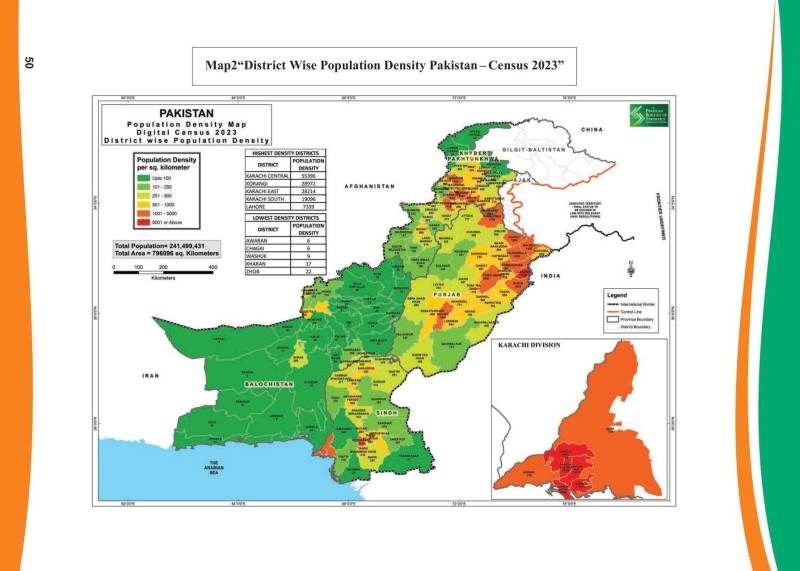
Map source. ( Islamabad: Pakistan Bureau of Statistics: “7th Census of Population and Housing 2023. Key Findings Report” P.50)
Pakistan has largely reached the threshold of a predominantly urban country by population density, with three of its four provinces — Punjab (621), Khyber Pakhtunkhwa (402), and Sindh (395) persons per sq. km — nearing or exceeding 400 persons per sq. km.
Applying two screening criteria, i) census defined urban population less than 25% and ii) total population ranging from 0.5 to about 2.0 million, there were 35 districts in three provinces, 19 in KP,10 in Punjab, and 6 in Sindh, which had a population density of 400 persons per Sq, Km. These are districts, whose urban level density was largely the outcome of the concentration of population in the countryside. They are urbanised by the density criteria. It may be noted that districts of high density but with a large share of the urban population have not been counted.
Here are some striking examples of high density largely rural districts. In Sindh, Kashmore (density 478), Mitari (559),Mirpur Khas (574) and Naushahro Feroze (604) are among such districts. In Punjab, Nankana Sahib(738),Khanewal (774), Vehari (786),Mandi Baha Uddin (684) Narowal (835) are some examples of high density largely rural districts.
KP province had in 2023 many districts of low proportion of urban population, but high densities, some even in the northern hill and tribal areas. Notable examples include districts, Bannu (689), Haripur (681), Lower Kohistan (529), Bajur (998), Swabi (1228), and Lower Dir (1042).
The conclusion of the above discussion of densities in predominantly rural districts is that most of the Indus plain has reached population densities to qualify it as urban. Southwest Punjab , deserts of Sindh and Balochistan are the exceptions.
Apart from the evidence from the census and map, there are visual indicators of villages ,homestead and shops spilling across the landscape. Travel by roads, not limited access motorways, from Lahore to Jhelum, Faisalabad to Sargodha, Mardan to Mangora or Attock to Peshawar, one sees fields sprinkled with houses, villages spread into farmlands and factories, hotels, restaurants , stores , auto shops lining roads.
From Sahiwal to Lahore and westward up to Jhelum, the GT road is like the main street of a long city. Even in the much-admired Swat and Kaghan valleys, roads are lined with houses, hotels, shops, and eateries. Houses can be seen high up on the sides of mountains. Most of these roadside views can also be seen in YouTube videos posted by individuals of their travels in these parts of the country.
This diffused urbanisation is a time bomb that, if not addressed, will eat up farmland, create extreme water shortages, pollute the environment, and make living in most of the country perilous.
What are the implications of these densely populated rural areas for their spatial and social organisations?
Urbanised countryside, problems, and prospects
To begin with, the above findings point to the urgency of population control. With 3-4 million children added every year, Pakistan’s arable land is being eaten away by settlements. The Malthusian nightmare is staring at Pakistan. Reducing the growth of the population should be the priority. With regret, l have to say that this problem is low down on Pakistan’s politico-military rulers’ agenda.
Most of rural Pakistan is organised as villages and hamlets. The increasing population density of these areas promotes development of shops , roads, paths and other non-farm activities. As a consequence, it breaks up farms and swallows up irreplaceable agricultural land.
Densification also means that the concentration of septic tanks or pit latrines saturate the leaching fields, polluting land, and underground aquifers. The underground water levels fall rapidly with the concentration of motor and hand pumps. Paths, streets, and roads should be upgraded and regularly maintained. All in all, collective urban services, including water supply, drainage, waste disposal as well as fire, land use, traffic, and building codes, are required for residents’ safety and convenience. These needs herald urbanisation. They may happen or not, usually not, but they become a public necessity.
With increased and concentrated population, commercial and small industrial establishments become viable. Bakeries (Tandoors) , eateries, grocery, milk and butcher shops, variety stores, auto workshops, tea houses and repair and craft establishments emerge. They tend to be drawn along roads and in big villages begin to form rudimentary central commercial areas.
These activities bring new occupations and promote non-agricultural skills in the local labour force. The cash economy takes hold. The remittances from rural migrants to cities and abroad contribute to the building of new homes and upgrading of the old. These changes in the physical makeup of rural areas are very visible. Overall in Pakistan, only 28% of housing units are now completely Katcha (made of mud) in rural areas, but in Punjab, they are just 11%, and in KP 28%.
Corresponding to the economic and spatial changes, social structure begins to change. New social classes begin to be formed and mobility increases. Two technologies, mobile phones (96% of households have a mobile phone) and motorcycles ( offering mobility to a whole family in many cases) have helped bring rural residents closer to city life. The mobility and circular migration to cities are implanting rural/ethnic enclaves and customs to cities and more significantly urban expectations in the rural areas.
Managing the countryside's urbanisation
Problems of cities and the inadequacies of the programs to address them are well known. Those are undoubtedly huge and have remained on the national agenda for most of the country’s history. Without meaning to underplay those, in this article, l want to draw attention to how those issues and challenges now extend to most of the countryside beyond Karachi, Lahore, Peshawar, and other notable cities. This diffused urbanisation is a time bomb that, if not addressed, will eat up farmland, create extreme water shortages, pollute the environment, and make living in most of the country perilous.
In conclusion, l want to point out a broad strategy, not a programme, to deal with this challenge. First, it must be a decentralised approach of decision -making based on empowering people and community initiatives. It should not be based on top- down programmes and specifically not entrusted to deputy commissioners and PWD.
Second, reinvigorate public action by transparency to people. The existing but moribund structure of Union Councils averaging 25000 persons, may be reformed to serve as the base for local initiatives in water management, sewerage and waste collection/disposal, roads and path cleaning and maintenance. The attempt should be to make local communities as self-contained much as possible.
With looming water shortages, climate change, and land shortages in villages for housing, and even cemeteries, the emphasis should be on ‘leap over’ technologies of the 21st century, which tend to be based on bioengineering and reduction of demand, and not primarily on expensive civil works.
For example, composting of degradable waste, waterless toilets (which Gates foundation has invested millions to help design) that now are available even on Amazon, should be adapted for local habits by mobilising CSIR ,Universities and other Pakistan’s scientific organisations. They should be promoted along with roof top solar panels to make every house self-contained in essential services. Appropriately promoted, they will spread commercially by private markets, as is beginning to happen in the case of solar electric generation.
There will be a need for regional (Tehsil/Taulka) systems of roads, traffic control and building, fire ,landfills and replenishing of fast depleting aquafers with harvesting, cleaning and injecting rainwater into sub-soil.
Another urgent need is the protection of farmland. The sprawl of homes on farms must be discouraged as each home or Dera in fields takes land for paths and spills grey water into fields far beyond a house.
These are just a few examples of the planning problems that must be addressed at the local level. A new conception of urban planning must be forged. There have been innumerable master /district spatial plans tapping foreign aid, but most of them have only fuelled land speculation. Urban Planning should focus on the provision of public services and controls by involving people in the community development model.
I am aware that our national politics and public attention are focused on the establishment and politicians’ immediate interests. Yet the purpose of this article is to arouse their responsibilities in this urban crisis spiraling over most of the country.