

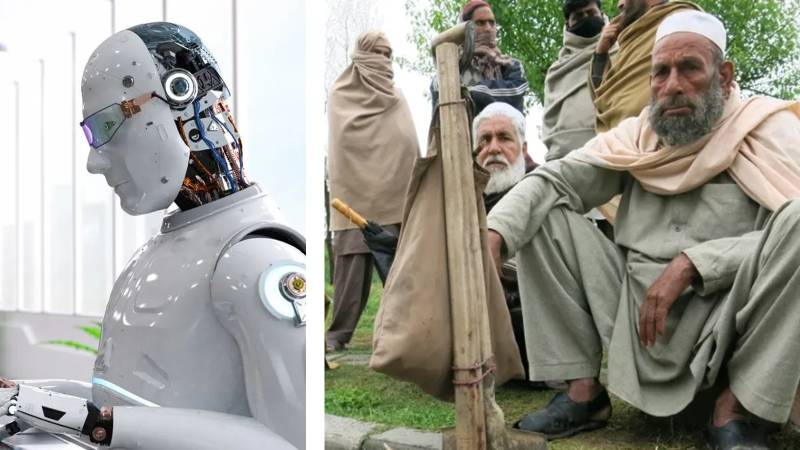
In the gleaming tech hubs of the West, artificial intelligence is hailed as the next industrial revolution. Back home in Pakistan, however, workers in factories, shops and fields already feel the tremors. A recent study warns that roughly one in six Pakistani jobs (about 17% of the workforce) is at “high risk” of being automated. Globally, labour experts have painted an alarming picture. In the United States, for example, some analysts estimate up to 15% of jobs (over 23 million workers) could be displaced by AI-driven machines and software in the coming years. Developing economies like Pakistan are especially vulnerable. Economists note that low and middle-income countries still rely heavily on routine manual and clerical work, which are the tasks that machines do best.
Factories Under Siege
In Pakistan’s factories and workshops, the hum of machines is getting louder and more high-tech. Industry insiders report that even traditional textile mills and assembly lines are quietly upgrading to AI-driven equipment. Automated looms can weave fabric at speeds and precision no human could match, and new robots can “pick and stitch” garments on the fly. One commentator warns that this trend threatens the backbone of Pakistan’s industrial employment. “AI-enabled technologies like predictive maintenance and robotic stitching risk making millions of low-skilled garment workers obsolete,” Sheraz Choudhary of the Stratheia think-tank notes.
While the government unveils a new National AI Policy, critics say it lacks concrete plans to protect millions of vulnerable workers from displacement
A recent Islamabad policy study puts it bluntly: as much as 60% of Pakistan’s workforce (especially those in textiles, agriculture, transport and office roles) could be replaced by machines. In the textile industry alone ( Pakistan’s largest factory employer), systems that save money and improve accuracy are beginning to arrive. Multibillion-rupee mills in Karachi and Faisalabad reportedly pilot computer-vision systems that inspect cloth and even automated robots to move spindles. For now, these remain few, but industry experts say the writing is on the wall: efficiency gains from automation are simply irresistible to profit-driven firms. If rollout continues, traditional line workers may find their roles disappearing faster than Pakistan can retrain them.
Service Sector Disruption
The threat is hardly confined to factories. In offices, banks and shops across Pakistan, white-collar and semi-skilled service jobs face similar perils. In customer service and back-office operations, a fast-growing sector as call-centres and BPO firms expand AI tools, are already nibbling away at tasks once done by humans. In practical terms, this means that banks and telecoms, which employ many Pakistanis in front-line roles, can increasingly automate routine inquiries or account processing with software. Tellers and data-entry clerks may be the first to go as banks deploy self-service apps and intelligent kiosk systems.
Meanwhile, the retail industry is quietly modernising. Large supermarket chains and fast-food outlets have begun piloting self-checkout systems and inventory robots. E-commerce platforms, meanwhile, have automated warehouses in other countries, and Pakistani sellers are under pressure to follow suit. If logistic firms introduce driverless trucks or drones (as is happening globally), the estimated 200,000 Pakistani truckers and delivery workers could face ruin.
Meanwhile, the retail industry is quietly modernising. Large supermarket chains and fast-food outlets have begun piloting self-checkout systems and inventory robots. E-commerce platforms, meanwhile, have automated warehouses in other countries, and Pakistani sellers are under pressure to follow suit. If logistic firms introduce driverless trucks or drones (as is happening globally), the estimated 200,000 Pakistani truckers and delivery workers could face ruin.
Policy Void and the New AI Strategy
Until recently, Pakistan had almost no coherent framework to manage AI and automation. Major labour laws were written for the 20th century; there was no official plan for retraining displaced workers or regulating algorithms in the workplace. This vacuum has only recently begun to be filled. In August 2025, the government unveiled Pakistan’s first National Artificial Intelligence Policy. The 2025 AI Policy is ambitious in rhetoric: it pledges a new National AI Fund, R&D subsidies, and aims to “train one million people in related skills by 2027” It also sets up high-tech centres of excellence in Karachi, Lahore and Islamabad, and promises ethical guidelines for AI use.
For some observers, however, the policy is long on buzzwords and short on labour protection. It focuses on creating an AI “ecosystem” and aligning with international standards, but says little about the millions of truckers, clerks and farmhands likely to lose work. Critics warn that this is too top-down: Pakistan risks a “jobless growth” trap without a parallel plan for human capital. As one policy analyst cautions, “If AI is allowed to spread without a coordinated skills response, Pakistan may enter a phase where economic gains accrue to capital owners and tech-savvy elites, while the majority see their employment prospects vanish.”
The choice for Pakistan is stark: harness artificial intelligence for inclusive growth or face a wave of destabilizing job losses
Those close to the new strategy note that it does mention education and inclusion, but only in broad terms. There is talk of scholarships and public awareness campaigns, yet no concrete safety nets (unemployment insurance, wage subsidies) to catch displaced workers. One think-tank expert bluntly argues that Pakistan must “treat AI not merely as a technological upgrade, but as a catalyst for human capital development”. In practice, this means dramatic scaling-up of technical training, vocational institutes and basic STEM education. Some have even suggested mobile “skill labs” and AI curricula in Urdu and provincial languages to reach more learners.
Socio-Economic Fallout: Unemployment, Inequality and Migration
What happens if Pakistan does nothing? Economists and development agencies offer a grim forecast. A surge in automation could throw millions into unemployment overnight. Pakistan’s labour force is already large and growing – without new job creation, unemployment and underemployment will spike. The government’s own surveys show roughly one-quarter of working-age Pakistanis are either jobless or in underpaid, insecure work. Add AI-driven layoffs to that mix, and the poverty rate could climb further. For context, the World Bank recently reported that in 2023-24, some 13 million Pakistanis were pushed into poverty by economic shock. Automation without social safeguards could easily reverse the modest gains of recent decades.
One very real risk is widening inequality. As automation boosts productivity and corporate profits, those gains may not trickle down. The World Bank and the International Labour Organisation have warned broadly that “delayed interventions in labour markets undergoing automation tend to increase inequality, erode public trust, and reduce the absorptive capacity” of the economy. In Pakistan, the urban elite and tech investors could see hefty gains from AI in finance or exports, while ordinary workers see stagnant wages or job loss.
Another looming problem is brain drain. Pakistan loses skilled graduates to the Gulf states, Europe and North America every year. If young Pakistanis face bleak prospects at home, with no jobs commensurate with their education, emigration becomes even more tempting. By some accounts, hundreds of thousands of Pakistani students and professionals sought work abroad in 2023 alone. This outflow could intensify if the local economy offers only low-skill, low-pay roles or nothing at all. In turn, losing talent weakens Pakistan’s capacity to build its AI industry or solve homegrown problems. It becomes a vicious cycle: a shrinking educated workforce handicaps innovation, stunting job creation in new sectors.
Finally, social stability is at stake. Mass layoffs and stalled wages among young adults can fuel unrest. Pakistan’s experience with inflation and energy crises has already led to protests; adding job scarcity to that tinderbox could provoke more social turmoil. Rural unemployment might drive migration to slums, while urban hunger breeds discontent. Policymakers fear that without cushioning measures, like retraining, public works or social benefits, automation shocks could threaten the nation’s fragile economic and political balance.
Pakistan may need to update labour laws for the 21st century. For example, by defining workers' rights in automated or gig jobs, and strengthening unemployment insurance. Some experts suggest incentives for “semi-automation” (keeping humans in the loop rather than complete robotic replacement) and encouraging industries that can create jobs at scale. Others call for targeted support for the most vulnerable groups: grants or loans to women-led tech training, for instance, or irrigation of broadband in rural areas so villagers can access online learning.
In all of this, timing is critical. As one analyst put it, “it is not how fast AI will spread, but how intelligently Pakistan gets ready for it that will define the situation”. With the proper preparations, blending innovation with inclusion, Pakistan could turn the AI wave into an opportunity, upgrading its economy and creating new industries. The next few years will tell whether Pakistan harnesses automation for growth, or finds its people left behind by a labour market remade by machine.