

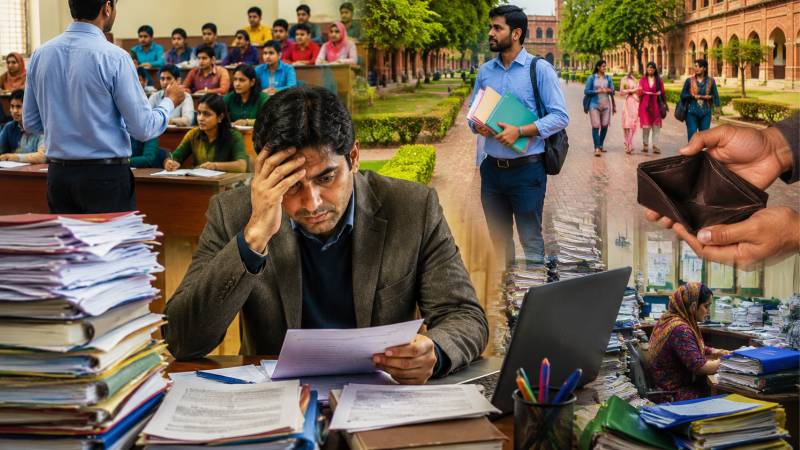
Pakistan's higher education sector presents a picture of expansion and promise. New universities continue to open their doors, and enrolment figures are on the rise. Beneath this optimistic surface lies a reality that receives far too little attention: the growing dependence on visiting faculty and the precarious conditions under which these teachers are expected to work. These teachers are neither interns nor novices. Most hold Master's, MPhil, or PhD degrees. They bring qualifications, experience, and a genuine commitment to the classroom. Job security is what they do not bring, however. Permanent positions remain few, and competition for them is fierce. For the vast majority, the only available route into teaching is through temporary, contract-based appointments as visiting instructors, lecturers, or assistant professors. Higher education has ceased to be a pathway to stability and has become instead a prolonged exercise in uncertainty.
The numbers confirm this unease. According to the Pakistan Bureau of Statistics, the unemployment rate among degree holders in 2024-25 stood at 11.2 percent. For women with degrees, that figure rose sharply to 24.1 percent. These statistics are a sobering reminder that academic credentials, once a reliable ticket to the middle class, are no longer sufficient. In such an environment, visiting faculty positions do offer a lifeline. The conditions attached to that lifeline are often unbearable, however.
One of the most persistent grievances is the irregular and delayed payment of salaries. Many public and private universities compensate visiting teachers on a per-lecture or per-credit-hour basis. A few institutions pay monthly or disburse salaries twice a semester. The norm, unfortunately, is deferment. Teachers are told, usually at the time of hiring, that their compensation will be released after the semester concludes. No specific date is given, and no assurance is offered.
The waiting then begins. The semester ends, examinations are held, answer scripts are evaluated, results are submitted, and yet the salary does not arrive. One month becomes two, two become four, and in some documented cases, the delay stretches to a year or more. In May 2025, Dawn reported that visiting faculty members at Quaid-i-Azam University had not received their dues since the autumn semester of 2023. Some had been waiting for nearly two years. This is not an isolated lapse; this is a systemic failure of institutional accountability. Let us pause to consider the logic here. The teacher has completed every assigned task. They have prepared lectures, mentored students, graded assignments, and submitted results on time. They have honoured their end of the agreement. Why, then, should the institution be exempt from honouring its own?
The teacher, like any other professional, has financial obligations: rent, utility bills, school fees for children, and daily household expenses. Their salary is not a gratuity; it is a right.
The problem runs deeper than delayed wages, however. It is structural. If a university requires a particular subject to be taught semester after semester, year after year, then that need is, by definition, permanent. Why, then, is the position not made permanent? Why must qualified professionals be made to reapply, renegotiate, and renew their contracts indefinitely? Both the public and private sectors need to confront this question honestly. To argue that this is about cost saving is to admit that institutional convenience is being prioritised over human dignity.
Clarity and consistency in policy are needed, first and foremost. At the time of appointment, the terms of payment must be explicitly stated, including the exact date by which the salary will be transferred. Disbursement must occur within a fixed, reasonable timeframe once the semester concludes. Institutions that habitually default on these obligations must be subject to oversight and, if necessary, penalties. Temporary hiring, if it is to continue, must be conditional on the guarantee of timely payment.
The convenient opacity of institutional policy is also worth noting. Some universities retreat behind their own regulations as if they were fortifications, responding to every complaint with the refrain that existing policy must be followed. When that policy forces qualified teachers to wait months or years for their rightful earnings, it ceases to be a policy and becomes a shield for negligence. No policy is beyond question, particularly when it inflicts hardship on those who serve the institution most directly.
The role of the teacher in national development is beyond dispute. Every professional, whether in medicine, engineering, law, or public service, has passed through the hands of a teacher. If we cannot offer those teachers financial security and a dignified existence, our aspirations of becoming a developed nation ring hollow. A society that undervalues its educators cannot realistically expect to progress.
Visiting faculty arrangements may not be the ideal model for university instruction. The rights of those employed under them must be safeguarded as long as they remain a fixture of our higher education system. Timely compensation, clear contracts, and transparent terms must be provided. No teacher should have to begin each month wondering whether their salary will arrive at all. Those who dedicate their lives to shape the minds of the next generation deserve better. They deserve certainty, respect, and the simple assurance that their work is valued. Our universities, both public and private, must recognise this not as a favour, but as a fundamental obligation. The future they are helping to build must also include a future for themselves.