

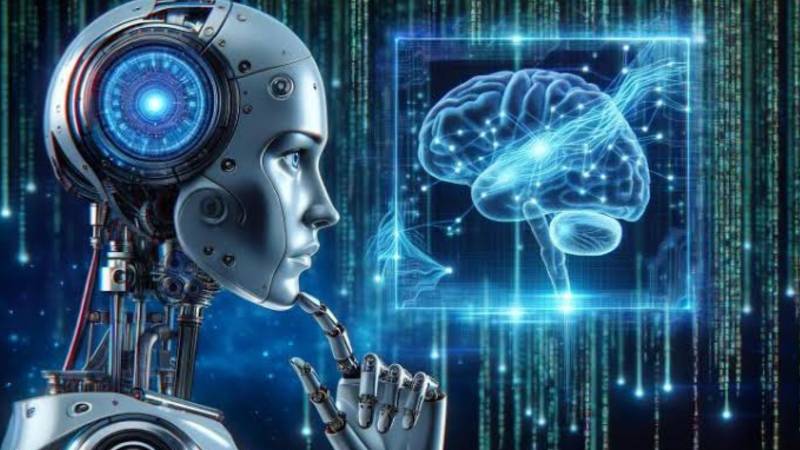
In a recent piece for the New York Times, prominent columnist Bret Stephens issued an impassioned and uncompromising plea: never write with artificial intelligence. His warning extends beyond asking AI to produce an entire article. Do not let it draft your emails, structure your notes, suggest an opening line, or assist with any part of the writing process. His concern is not merely plagiarism or the loss of originality, but cognitive degradation. Writing, he argues, is the daily exercise that builds our “intellectual muscle.” To outsource it to a machine is to step onto an escalator toward collective mental decay and post-literate passivity. When a senior journalist at a newspaper of that stature issues such an absolute warning, it understandably deserves attention. But attention is not the same as accuracy.
Stephens's concern is understandable, but his argument rests on a fundamental flaw: it confuses the manual friction of drafting with the act of thinking itself. Mindless copy-pasting of machine-generated text can certainly produce hollow communication and erode individual expression. No AI-generated text can capture every nuance of an issue on its own. I have tested this repeatedly and have rarely found an output convincing enough to use without substantial scrutiny and revision. But AI also has capabilities that are genuinely valuable: it can help polish a draft, surface information on an unfamiliar subject, expose a logical or historical error that a writer has missed, and challenge an argument from perspectives the writer may not have considered.
Demanding a complete prohibition on such tools ignores a broader pattern in human history. Every major technological advance has disrupted an existing human capability, sometimes making an old skill partly or entirely redundant, while opening possibilities that were previously difficult or impossible.
Consider the camera. When photography emerged, critics feared that it would destroy the discipline of portrait painting. It certainly made literal visual reproduction redundant. Yet the camera also freed artists from the burden of mechanical reproduction and helped push visual art into new territories. Impressionism, Cubism and abstract art were not simply substitutes for photography; they represented different ways of seeing. Today, cameras can capture detail far beyond what a painter could reproduce, but visual art has not disappeared. Its purpose evolved.
The electronic calculator offers a different but equally revealing example. It made manual calculation largely redundant, changing how everyone from shopkeepers to schoolchildren handles numbers. We may have surrendered some facility with mental arithmetic, but we gained the ability to perform calculations at an entirely different operational scale. A modern shopping mall manages tens of thousands of daily transactions; that commerce would grind to a halt if cashiers still relied on manual sums. A single clerk, swiftly scanning barcodes, can process thousands of customers a day. We lost one mechanical skill and gained the capacity to build and manage systems of far greater complexity.
Mindless copy-pasting of machine-generated text can certainly produce hollow communication and erode individual expression.
AI-assisted writing presents a similar shift. It can automate part of the drafting process, but that does not eliminate the need for rigorous human thought unless we allow it to. Cognitive ability is not necessarily tied to the physical struggle of arranging words on a blank page. It is fueled by curiosity, judgment and the willingness to question what appears in front of us. Instead of treating AI as a ghostwriter that thinks for us, we can treat it as a sparring partner in an argument: a Socratic interlocutor that helps us ask harder questions.
In my own writing practice, I routinely use AI to stress-test ideas. I interrogate its responses, challenge its logic, question its assumptions and demand verification before accepting a factual claim. Sometimes the most useful response is not the one that gives me an answer, but the one that exposes a question I had not considered. Through that back-and-forth, an argument can become sharper and more resilient than it might have been if developed in complete intellectual isolation.
I explored a related dynamic in an earlier column on Abraham Wald's analysis of survivorship bias during the Second World War. Wald's insight came from looking beyond the evidence that was visible and asking what was missing from it—the aircraft that had not returned. The lesson extends beyond statistics. A conclusion based only on what is visible can be profoundly misleading.
AI presents a related challenge. It can synthesize enormous amounts of existing information and identify patterns with extraordinary speed, but we cannot assume that it will reliably identify every blind spot in its own reasoning. The missing element may be an unasked question, an overlooked assumption, contradictory evidence, an unchecked source or an alternative explanation. Identifying what is missing remains a responsibility that cannot simply be delegated. The human user must interrogate the output rather than mistake fluency for truth. That is the deeper danger facing modern discourse: not the existence of the technology, but human passivity.
People have always sought the easiest path to success through cheating, favoritism, social influence or unquestioned authority—long before large language models existed. Banning a tool will not make a passive mind active, just as staring at a blank document has never, by itself, made anyone a deep thinker.
The answer, therefore, is not to fear AI or retreat into an elite nostalgia for manual practice. It is to cultivate the discipline required to question the machine. That means encouraging deep inquisitiveness among our children, writers, researchers and readers alike; the same intellectual instinct Wald applied to his data.
Readers, too, should no longer accept written words simply because they appear in print or on a screen. They must interrogate arguments that lack evidence or logical rigor, whether those arguments were produced by a human being or a machine. Without a social habit of questioning, no technology can elevate our thinking for us. And this is where the argument for banning AI writing encounters a much larger problem. Humanity has never stopped developing technology merely because a technology carries grave risks.
Consider nuclear technology. Humanity knows exactly what nuclear weapons can do. The consequences of their use are not hypothetical: a nuclear exchange could produce destruction on a scale beyond anything experienced in human history. Yet humanity continues to live with nuclear technology, while also using nuclear science for electricity generation, medical diagnosis and treatment, scientific research and other peaceful purposes. We do not conclude that because the technology can produce catastrophic destruction, all nuclear technology must therefore be abandoned.
Indeed, humanity has repeatedly lived with technologies whose destructive potential is inseparable from their constructive possibilities. We build tools because tool-making is one of the defining characteristics of human civilization. The same human capacity that produces weapons also produces vaccines, satellites, computers, surgical instruments and technologies that protect lives.
The lesson is not that every technology is harmless. It is that technological progress inevitably creates both possibilities and dangers. The existence of danger alone has never been sufficient reason for humanity to stop inventing. What matters is whether human beings develop the judgment, institutions and discipline necessary to control the risks while preserving the benefits. AI is no exception. The question was never simply whether the tool is dangerous. The more important question is whether we are capable of using it without surrendering our responsibility to think.
Stephens is right to warn against intellectual passivity. But banning AI writing would address the symptom rather than the underlying problem. The real challenge is not to prevent machines from producing words. It is to ensure that human beings remain curious enough to question those words, skeptical enough to test them, and intellectually independent enough to reject them when they are wrong. The machine can write the sentence. The human being must still decide whether it deserves to be believed.