

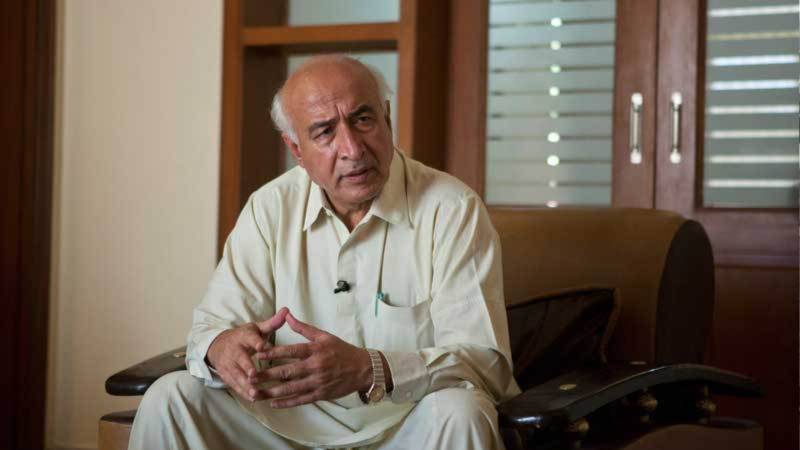
“My political journey began during President Ayub Khan’s era when I raised slogans against the ‘One Unit’ system and recited revolutionary poetry on stage,” Dr Malik Baloch said.
“During my tenure, significant progress had been made in negotiations with Nawabzada Brahamdagh Bugti, but we were not allowed to take the process forward. Had that process been allowed to continue at the time, perhaps today the situation of Balochistan would have been different,” Dr Baloch says.
Former Chief Minister of Balochistan and President of the National Party (NP), Dr Abdul Malik Baloch, has been an eyewitness to the political upheavals of the last four to five decades in Balochistan. He began his political career during his student life through the platform of the Baloch Students Organisation (BSO). He received his early schooling in his native area, “Singani Sar” Turbat, and later studied MBBS at Bolan Medical College (BMC).
From that time onward, he emerged as an active political worker. His interest in politics and his political passion were inherited; his father, elder brother, and other family members were associated with the cause of Baloch nationalism. The same political instincts were passed on to him, and to this day, he remains connected to Baloch nationalist politics and is considered a strong voice for Balochistan in national politics.
Entering Balochistan’s political arena nearly half a century ago, Malik Baloch has been elected to the Provincial Assembly five times, in 1988, 1993, 1997, 2013, and 2024, and from 2006 to 2012, he served as a Senator. Currently,y he is a member of the Provincial Assembly of Balochistan anthe d NP’s parliamentary leader. Alongside politics, he has a deep interest in literature, and his recent collection of short stories titled “Marisht” has been published.
In an interview with journalist Gohram Aslam, National Party’s president and Baloch nationalist leader Dr Abdul Malik Baloch said that during Ayub Khan’s era, he actively participated in the movement against the One Unit system under the platform of the National Awami Party (NAP), where he often recited poems at rallies and was at the forefront of slogan-chanting.
It should be noted that ever since discussions about the new Reko Diq agreement began, the National Party has launched a “Save Reko Diq” movement and announced nationwide protests
He said that when he first contested elections in 1988, student movements across the country were highly organised, and the Baloch Students Organisation (BSO) was a very active, grassroots and disciplined organisation. “We contested elections through the platform of the Baloch National Movement (BNM) and succeeded. At that time, politics was driven by ideology and social service. The idea of perks or money in politics did not exist. But as time passed, the establishment imposed its preferences, likes and dislikes, and their negative influence began to appear. Businessmen and parachute candidates entered politics, something we continue to suffer from today.”
Speaking regarding Reko Diq, the nationalist leader said, “Reko Diq is an asset of Balochistan. Even before the 18th Amendment, it was a provincial subject. The agreement that the current provincial government is about to sign does not include the consent of the people of Balochistan. If any agreement contradicts the interests of the people of Balochistan, we will launch a strong movement. Foreign companies are already plundering Saindak, and now the Reko Diq agreement is being kept hidden from the people, with plans to sell it off as well.”
It should be noted that ever since discussions about the new Reko Diq agreement began, the National Party has launched a “Save Reko Diq” movement and announced nationwide protests.
Answering a question, he said that when he was given a mandate by the All-Parties delegation to negotiate, substantial progress had been made, but later the establishment did not allow the process to move forward. “Nawabzada Brahamdagh Bugti was responding positively. I am grateful to him. But the process was made more complicated.”
In response to a question about Balochistan’s current issues, he said, “The situation in Balochistan is such that in 2018 and 2024, political parties were created overnight, and the public mandate was hijacked to bring favoured individuals into power. The federal government has never taken Balochistan seriously. The issue of Balochistan is both simple and extremely complex, but it requires understanding. For seventy-three years, Islamabad has neglected it, and as a result of these decades-long deprivations, this is the situation we are facing today. The core issue in Balochistan is the question of its right to self-rule. The genuine democratic mandate of the people must be accepted.”
It should be noted that recently, a PML-N delegation led by Rana Sanaullah visited the former Chief Minister of Balochistan at his residence in Turbat to seek support for the 27th Constitutional Amendment. However, following their party’s decision, National Party Senator Jan Mohammad Buledi and MNA Phulain Baloch voted against the 27th Amendment. Such a stance keeps the secession alive within political parties, and voting against such a bill is not easy for small nationalist parties, because it means you are openly opposing a pro-establishment amendment.