

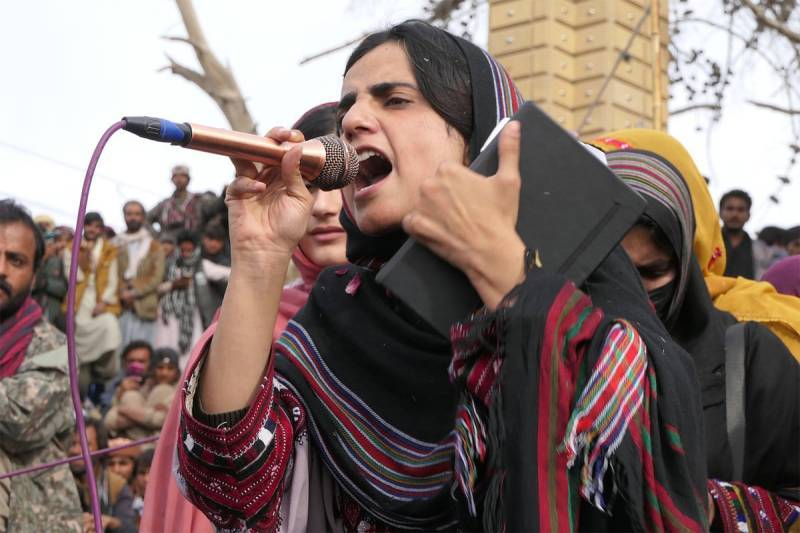
The recent arrests of Dr. Mahrang Baloch, a well-known Baloch human rights activist, and other members of her advocacy group in Quetta have awakened international attention to the continuous harassment suffered by the Baloch people of Pakistan. For decades, the province of Balochistan, rich in resources yet politically underprivileged, has served as a battleground for state terrorism, enforced disappearance, and systematic oppression. The arrest of Dr. Mahrang, a symbol of resistance and hope for thousands, does not stand alone but bears the brunt of an unfortunate and consistent pattern of silencing dissent and choking the Baloch cause for justice. The hour of sorrow is thus made heavier against the backdrop of an inhuman history of Balochistan for a community that has not known peace.
She is a trained medical doctor and a fearless voice nowadays for the Baloch rights after her very own family became victims of state atrocities. She is the daughter of Abdul Ghaffar Baloch, who went missing in 2009, and later found dead in body, he bore marks of torture. Abdul Qadeer Baloch, his brother, forcibly disappeared in 2017, and the family continues to live in grief for these terrible events. This is personal suffering, yet it is not one that Dr. Mahrang would allow to restrict her. She co-founded the Baloch Yakjehti Committee (BYC), which campaigns against enforced disappearances and extrajudicial killings.
Like her, abuse under the draconian anti-terrorism laws of Pakistan mistreated her, arresting her on Saturday [22/3/2025]. It tells how much the state can criminalise dissent, and for the Baloch people, her imprisonment also signifies their last dreams eradicated in that a leader who could speak truth to power is now silenced, with an uncertain fate. The Baloch see her not just as an activist but as a daughter of the soil fighting for their survival.
Internationally highlighted because of the gruesome human rights violations in the region, the Balochistan crisis indeed provides an opportunity for unique opportunities for oppression. In the 58th Session of the United Nations Human Rights Council, Niaz Baloch, a representative of the Baloch National Movement (BNM), stated that the repression of the Baloch people is systematic. He contended that political organisations such as the Baloch Students Organisation-Azad (BSO-A) and BNM are frequently targeted, with member activists subjected to arbitrary detention and harassment and silenced. State-sponsored repression is prevalent in Balochistan where dissent has historically clashed with the state's interests in a region that has for decades witnessed conflict over rights to autonomy, resources, and allegations of being increasingly marginalised by the Pakistani state.
At the heart of the crisis lies the supposed use of enforced disappearance as an instrument of state oppression. Niaz Baloch mentioned some recent cases where enforced disappearance was practiced, such as the abduction of Beeberg Zehri, a Baloch Yakjehti Committee leader, and his brother Hammal Zehri, a scientist. Enforced disappearance cases have also been documented against Ilyas Baloch, a psychiatrist and academic with more than a dozen members of the Qambarani family. Arrests, including those of human rights activist Saeeda Baloch and reportedly her sister, serve as an example of how widespread these tactics have become. These disappearances are not random but articulate a conscious policy to create fear and incapacitate networks that uphold Baloch's rights.
Dr. Mahrang's activism was not simply limited to the pursuit of justice for the disappeared but also entailed an undertaking to save Baloch's identity
Exacerbating the situation are reported extra-judicial killings of state-backed forces. The killing of Shah Jahan Baloch, the brother of a missing BSO-A leader, is cited by Niaz Baloch as an example of collective punishment targeting families of activists. Such killings, he stated, are part of a designed policy to instill terror into the Baloch population and to repress organised resistance. These acts have nurtured a culture of impunity in which security forces operate freely, rendering family lives traumatised and in ruins.
The very particular nature of the Baloch conflict relates to the geopolitical and also economic aspects. Balochistan becomes important for China in its 'Belt and Road Initiative': its China-Pakistan Economic Corridor (CPEC), which, according to locals, continues to take away the resources of the region without adding benefits for its people. Most resistance movements against these state-sponsored underground projects are widely termed counterterrorism.
Pakistan's government refuses to recognise such systematic abuse. As stated, all actions against Balochistan are only against separatist insurgency and nothing more. Critics say such a statement justifies valid grievances and keeps the cycle of violence continuing.
Recordings of anti-historical betrayal against what is termed Balochistan have been amply established. The militarily occupied territory has henceforth remained in Pakistan since 1948. Since then, this area has persistently endured neglects and exploitation. Very much, the natural gas, minerals, and Gwadar Port appear to bring a good economy to Pakistan, although it is still regarded as the poorest of the provinces. It has little infrastructure, education, and health service in the area of its citizens who labor to provide resources for the benefit of others.
Keeping state-sponsored violence in such a manner has often been termed as Baloch genocide, predominantly by the activists. Thousands of students, several intellectuals, and political figures have either been abducted since the beginning of this century until now by security agencies. Very frequently, his body has been found with torture marks after a while at some desolate place. The number of forced disappearances is thought to be over 7000, more than what official records show, and even this figure could be far higher. For many years, the families of the missing people have been crying out on the streets with arms extended, holding wrinkled images, waiting for the day of reckoning.
The latest arrest is indicative of the latest wave of assaults on the Baloch activists; the activists continued to be loud in their protests and campaigns on social media. It was a historic march under Dr. Mahrang from Turbat to Islamabad last December when she demanded a justice resolution for the extrajudicial murder of a Baloch detainee, Balaach Mola Bakhsh. Thousands carpeted the streets while police were mercilessly beating some and arresting others, followed by a blackout. The police fired rubber bullets and tear gas shells at the protesters and beat them mercilessly while imposing opinion censorship, conveying that even peaceful dissent would not be tolerated.
For Baloch, grief is not an emotion but a lifestyle: a constant companion in their battle for life
The life of Farzana testifies to the thousands of families bearing their own turbulent, inward suffering due to enforced disappearances in Baluchistan and beyond. Such mothers have become the very image of the infinite agonies of Balochistan. They wait for decades in search of answers: every day ticking away as hope diminishes, they merely see those seemingly interminable years of limbo as worsening paths for their already ravaged health, both corporeal and mental. The children grow up without fathers; wives remain without closure as widows without a body to bury. The psychological torment is intergenerational. It has wove itself into the very fabric of Baloch society with a spirit of despair.
Dr. Mahrang is also one from such a family. After losing her father and brother, she had to take responsibility for her mother and the rest of her sisters. She has been trying to juggle a medical career and an activist life. Arresting her would leave her family exposed, and they have every reason to fear as they know that such a fate befalls most Baloch women activists in custody who are subjected to gross sexual violence and intimidation.
Globally, the plight of Baloch rarely registers. Pakistan is a U.S. ally in the "War on Terror" and a partner of China in the China-Pakistan Economic Corridor (CPEC), so the government would not be held to account. Western nations and international bodies conspicuously kept silent in favour of strategic interests over human rights. Even so, On repeated appeals from the United Nations for investigations over the atrocities suffered in Balochistan, nothing has been done.
Oppression in Balochistan is not limited to physical violence. Balochi-language media is censored and cultural festivals are banned. Schools in the province teach their narratives of Pakistani nationalism which denied the Baloch heritage, instilling sentiments of disassociation in the youth.
Dr. Mahrang's activism was not simply limited to the pursuit of justice for the disappeared but also entailed an undertaking to save Baloch's identity. The arrest is part of a more general strategy toward erasing Baloch as a people from extinguishing their voice, and history-or right to exist.
The arrest of Dr. Mahrang Baloch is a microcosm of the endless tragedy of Balochistan. It reflects a state which views its own people as enemies and a world which turns a blind eye to their sufferings. For Baloch, grief is not an emotion but a lifestyle: a constant companion in their battle for life.
Yet, the darkest hours resist easy surrender. The Baloch resistance continues-a spirit undaunted by decades of oppression. The courage of Dr. Mahrang, as with so many others, is a testament to their biological will. But this resilience alone cannot stop their suffering. The international community must break its silence and demand accountability because Baloch is not a number but a living soul who deserves justice, dignity, and peace among the rest of the citizens of the world. Until then, their cries will go unheard and lost in the oblivions of winds washed by the march of indifference.