


Human beings are mere mortals, all of them. They come and go; transitory dwellers of earth. If anything in the public sphere is indispensable, it is the systems. When systems breakdown, vacuum is created where constitutions become meaningless, customs are trampled upon, and accountability evaporates. It is only these political voids that provide the opportunity for strongmen to take command through gun, and feel that they are essential for the system, hence indispensable. History, as depicted below, proves that by wrecking the systems, these dictators, who are mostly usurpers, destroy their own nations.
Sulla, a gifted and successful Roman general, marched on Rome in 88 BC, wrapped up democracy and became a dictator. He thought that he had become indispensable for Roman republic. Actually, he put an end to that republic, ushering an era of social anarchy, intellectual stagnation and civilizational collapse. The leaders that followed were Julius Caesar, Pompey, Caligula, Tiberius, Nero, Commodus and the like; good for hedonism, orgies and extravagance only. They ushered Rome into a constant decline. The British, on the other hand, are wise and know what to do with the indispensable. They hanged the body of Cromwell, after he had led the reconquest of Ireland. In the previous century, they ousted Churchill in elections after he had led them in defeating Germany. The French too murdered the last of the Sun dynasty; a fate meted out to the Romanovs by the Russians.
Pakistan, too, had her share of self-proclaimed indispensable strongman. They lie in their graves unsung, despised and loathed; remembered only for the existentialist damage done to the country and to the social fabric of the nation. High offices don't enhance dignity; they increase responsibility; and respect is earned by how they discharge this responsibility. Leaders live, not in their secluded, guarded palaces, but in the hearts of the people. They speak through their actions; not through their Goebbels. Their judge is not the hired media or rented crowds but the pages of history, and history is brutally unforgiving. These who are favoured by heavens to be leaders of men and nations, have to decide for themselves; whether they want to live well or die well.
Cuscuta is a leafless parasitic creeper vine, called Amarbail in Urdu. Ever since reading about it as a teenager in the Nasim Hijazi novel Insaan Aur Devta, where it is mentioned as a simile for the Brahmin class, this author has never lost its adverse implications for society. The vine doesn’t make its own chlorophyll, instead depends on its host for its nutrition. A single branch thrown on a tree is sufficient to kill the latter. As the rootless vine begins to grow on the tree, casting a healthy green web, the tree that it thrives on begins to dry up. The deadly parasite eventually becomes indispensable for the green look of the tree it lives on. The same is the case of the politico-religious oligarchy that has been sucking out life of our nation it thrives on. As the poor become poorer, the indispensable blood suckers keep enhancing their privileges. Free electricity, free rides on government or military owned aircraft, free foreign trips, free Hajj, free security, free housing, free servants, free medical and free food. Everything free for them while the poor on whom they live off, have no schools, no food, no medicines, no security, no clothes and no shelter as they struggle to raise their families.
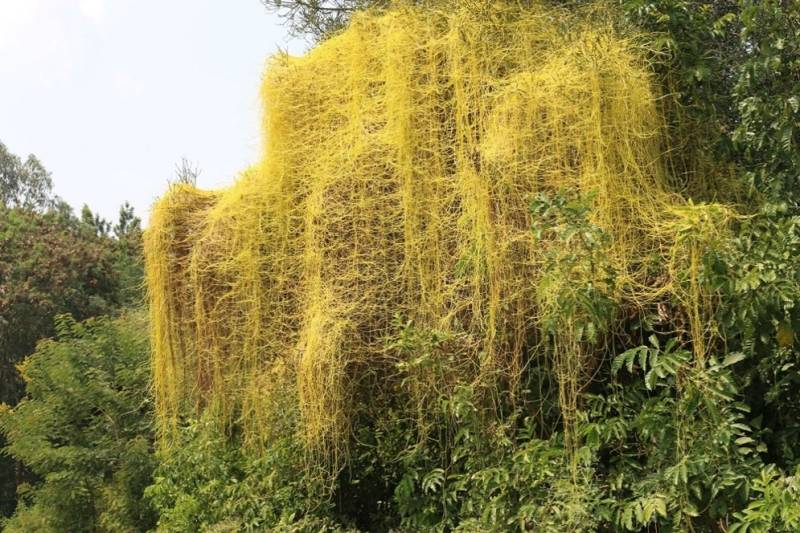
Cuscuta is incapable of having any sympathy for the tree it lives on and eventually kills through its blood sucking tentacles. It has to be slashed branch by branch and torn away shred by shred to let the tree breath again. That is true for any ruling elite that captures a nation through force of arms and subjugates it for its own well-being. It has no empathy for the poor masses whose life it has sapped. This elite class doesn’t give up power at its own and has to be hounded out to free the society it lives on. People have to struggle to forcibly remove this exploitative class, as eminently demonstrated by Bengali youth. Otherwise, the nation faces a meltdown.
Indispensability and egoism are twin sides of the same coin. Egoism is sense of power and superiority to the point that others appear insignificant, dispensable and expendable. People are egoistic when they believe in their primacy, infallibility and perfection over everyone around them. Because it is concerned with an individual’s own perceptions about his/her own self, it therefore boils down to their own limited capacity to handle their achievements. Folk wisdom understands this phenomenon. It is said that fruit laden trees bend towards ground; barren trees stand tall pointing to skies; and that empty pots sound the loudest.
Those who are not conscious of their impermanence, actually do not digest their success well, extrapolating it beyond its true dimensions. Great scientists never did that. Maxwell was a model of humility. Newton, Faraday, Einstein, Planck, Heisenberg and other great theorists who did great pioneering work, realized that their achievements would have materialized even without them as the ground work for these had already been done by others and someone else would sooner or later would have developed their theories. In the absence of Newton, Calculus would have been invented by Leibniz alone. Einstein’s field equations for general relativity would have been known as Hilbert equations, after the mathematician who presented them a few days before Einstein did. Quantum Mechanics was served by many great minds because their time had come. Even for Law of Gravitation, Hooke had proposed before Newton that gravity obeyed inverse square law. Science develops through baby steps, and when the idea is ripe enough, a subsequent scientist formulizes a law or a theory. Interestingly, philosophers, scientists and social-thinkers are humble, and never fall in to the fallacy of being indispensable. It is the political dictators and military leaders who, because of the physical power they attain over their nations or their troops, and the spiritual leaders who because of the holy spell they cast over their followers, begin to harbour notions of their indispensability.
Hubris, arrogance, egoism and narcissism are near synonyms; and all point to character flaws that lead to psychotic sense of indispensability. In families, it harms unity; in society, it hurts harmony; in institutions, it arrests growth and in nations, it terminates stability. Nations have to be cognizant of leaders with this propensity.