

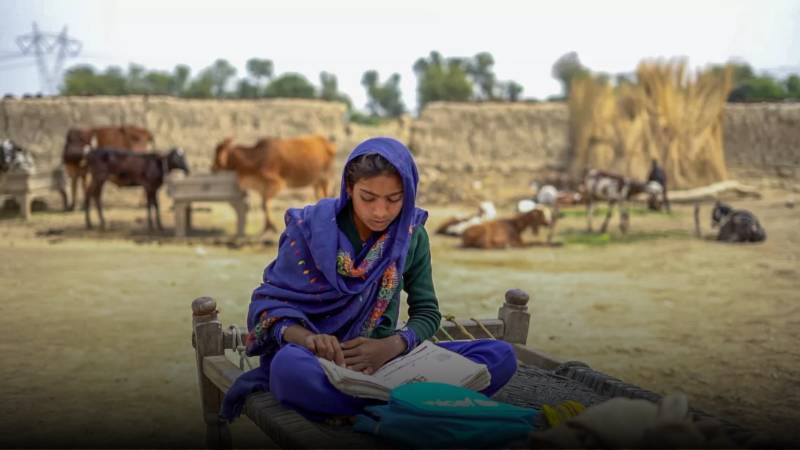
COVID-19 and the floods of 2022 and 2025 arrived in quick succession, testing whether rural schooling in Pakistan could recover from repeated shocks. In 2020, there was fear of a generation being left behind. Months without lessons, routines, or a teacher’s presence seemed certain to produce irreversible loss.
The latest round of the Learning and Educational Achievement in Pakistan Schools (LEAPS) project, carried out in 108 villages in 2024, tells a more tempered story. The study, conducted for the Asian Development Bank by Tahir Andrabi and Tomoya Murakawa, shows that the length of school closure during COVID-19 did not determine village learning levels two years after reopening. Where learning did fall, it was due to families’ ability to provide children with study time and continued support. That distinction matters because it shifts the focus from missed months in class to the everyday conditions that make learning possible.
The study revealed that by 2024, learning in selected rural settlements had largely recovered, but the gains were uneven. Public school children, often from poorer households, suffered more than those in private schools, widening an existing gap. Girls consistently outperformed boys, including in mathematics, a trend that deserves protection. Short-term remedial efforts after reopening showed little effect, suggesting that recovery came mainly through steady schooling rather than scattered fixes. Private schools, being closer to families, adapted faster, while public schools struggled with the added burden of household income loss, which reduced children’s study time and readiness to learn. Overall, both sectors improved, but inequality persisted.
The study further established that teaching is also changing. The teacher workforce is now more female, younger, and, in many places, more local, especially in private schools. The private sector’s employability slowed between 2019 and 2021 but bounced back in 2022, indicating that demand for schooling persisted even through the shock years.
Into this fragile recovery came the floods of 2022 and 2025. Floods damaged school buildings, displaced families, and erased household assets and livelihoods. Classrooms turned into shelters, teachers were unable to reach schools, and families focused on survival. The immediate effect was clear. The deeper risk is that disruption hardens into permanent loss through repetition, dropout, and child labour. If we treat floods and pandemics as isolated emergencies, we will miss how they accumulate and how their effects amplify inequality.
Put reading, writing, and arithmetic at the centre of recovery. Make basic education a visible priority in emergency and reconstruction plans
We must move from diagnosis to action. The study shows that learning fell where families were hit hardest and that short fixes did not last. It also shows that girls have made gains and that private schools stayed closer to families and adapted faster. To address these challenges, we need a simple, practical plan that keeps basic learning going under stress, protects recent gains, and builds capacity in the places most at risk.
With two decades of experience working to strengthen foundational learning among vulnerable communities, I have identified a set of practical measures that can address persistent challenges and accelerate progress. These reflections are grounded in long engagement with schools, teachers, and families, and point to the kinds of focused efforts that can make a lasting difference in how children learn.
Put reading, writing, and arithmetic at the centre of recovery. Make basic education a visible priority in emergency and reconstruction plans. Set clear goals for literacy and numeracy at each grade, publish short catch-up guides for teachers, and ensure school timetables reflect that priority by giving daily slots to foundational skills. Keep the plan simple enough that any school or centre can adopt it without additional bureaucracy.
Non-formal education should provide continuity when schools are closed, children cannot travel, or formal options are absent. It can serve as a bridge back to regular grades, but only if it follows clear rules. A short, unified syllabus focused on literacy and numeracy, simple placement tests, and quick recognition of progress are essential. Regulation must remain light so communities and small providers can act quickly, while a common curriculum and shared assessments ensure learning is comparable. Centres should register students, track attendance, and report results so districts know where support is needed.
Teacher capacity is central to recovery. Local young women can be trained to run non-formal centres, mentor younger girls, and support families. Training should be short and practical, focused on classroom routines, basic reading and maths, and handling mixed groups. Pairing new instructors with mentors who visit regularly, co-teach, and share simple tips builds confidence and sustains recent gains in girls’ learning while keeping support close to the classroom.
Feminising foundational learning is not a side agenda; it is the strategy that secures resilience, equity, and long-term transformation
Support must also be continuous and tied to results. Coaching cycles, where mentors model lessons and guide next steps, work better than one-off workshops. Teachers need simple tools for small group instruction and quick checks to spot children who are behind. Frequent sessions for struggling students, tracked every two weeks, help close gaps. A province-level framework of core skills and short assessments can align schools and non-formal centres, making progress visible and ensuring learning outside the classroom is recognised.
Keep operations light and budget-aware. These steps are choices about staff time, training, materials, and supervision that deliver learning quickly. Prioritise stipends for local non-formal instructors, workbooks and learning aids for small group teaching, and simple monthly learning trackers. These items yield faster learning returns than heavy infrastructure alone and keep children engaged during recovery.
Feminising foundational learning must be at the heart of recovery. The gains girls have made in recent years are real and must now be protected and extended. This means making girls’ attendance and learning explicit targets, ensuring sessions are held at safe times and places, and involving mothers and local women in outreach so that communities themselves anchor the change. Female teachers should be central to this effort, guiding younger girls and showing clear pathways from non-formal centres into formal grades without delay.
By placing girls at the centre of foundational learning, we do more than close gaps. We build a system where women lead, where communities see the value of girls’ education, and where progress is not fragile but durable. Feminising foundational learning is not a side agenda; it is the strategy that secures resilience, equity, and long-term transformation.
Finally, speak clearly and measure honestly. Share goals and results with teachers, parents, and local leaders in plain language. Show what is working and what is not, and make quick changes where needed. The real test is simple: can children read, write, and do basic maths, and are the weakest schools and centres catching up? That is what matters most.
The pandemic did not permanently derail learning in rural Pakistan, and recovery was underway by 2024. But the floods of 2025 risk undoing those gains unless we act decisively to protect basic learning. Education cannot be treated as an afterthought; it must be secured as a core public good during every crisis. By investing in non-formal options with clear rules, practical teacher support, targeted remediation, and local female leadership, we can not only recover lost months but also build a system that keeps children learning through future shocks. The task is clear: strengthen everyday systems, train teachers well, and empower young women to lead. That is how learning stays on track when the next disruption comes.