

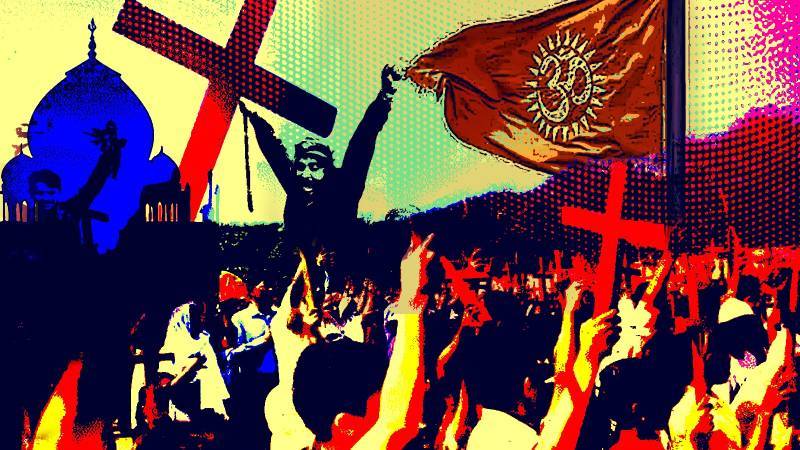
Across our society, a dangerous reality has taken hold: faith is being weaponised by those in positions of power. Religious leaders, social influencers, and high-ranking officials twist sacred texts to serve their agendas, presenting personal opinions as divine truths. Their words, often swallowed whole by devoted followers, ignite a dangerous mob mentality. The consequences are dire—violence, the erosion of laws, and a social fabric stretched to its limits.
But the true crisis lies in the creation of a parallel justice system, where self-appointed arbiters of faith impose their interpretations above the rule of law, threatening both justice and the essence of religion itself. While faith has long been a source of moral guidance and community, its distortion has led to tragic outcomes. Recent incidents—from lynchings over blasphemy accusations in South Asia to religious extremism influencing judicial verdicts in various nations—demonstrate the global reach of this issue.
A History of Misuse
This misuse of religion is not new. History is riddled with examples—crusades, witch hunts, and modern extremism—where sacred rhetoric masked personal or political agendas. Today, charismatic leaders cloak biases in scripture, claiming divine authority to judge right from wrong. Their followers, driven by devotion or fear, adopt these distorted doctrines as gospel, bypassing reason.
Consider the tragic case of Mashal Khan in Pakistan, a university student falsely accused of blasphemy and lynched by a mob in 2017. Investigations later revealed that the accusations were fabricated, yet his life was lost to a crowd fueled by manipulated religious sentiment. Similarly, in India, lynchings over alleged cow slaughter have been justified under religious rhetoric, with vigilante groups bypassing legal institutions.
What begins as a sermon can escalate into social persecution, with mobs punishing those deemed “in violation.” Innocent lives are lost, and teachings of compassion are buried under hatred.
Using faith to justify violence, suppress dissent, or impose one’s will—sows division, hatred, and injustice, undermining both faith’s integrity and the rule of law
The Rise of Parallel Justice
The danger peaks when these interpretations morph into a rival justice system, dismissing courts and laws designed to protect us. Consider a person accused of offending religious norms: they escape a mob’s wrath, but the state struggles to shield them. The fervor fueling the crowd seeps into the judicial process—judges hesitate, courts waver, and rights crumble under pressure. When religious edicts override legal verdicts, the state’s authority collapses, leaving justice at the mercy of the loudest voices.
In cases like that of Asia Bibi, a Christian woman in Pakistan sentenced to death over false blasphemy charges (later acquitted after a global outcry), we see how legal systems can be manipulated under religious pressure. Such cases underscore how fragile justice becomes when faith-based emotions overshadow legal principles.
This parallel justice fractures society, pitting neighbor against neighbour, faith against faith, and emotion against reason. Leaders peddling these distortions reap power, loyalty, and wealth in this world, promising divine favor in the next. The cost is a nation where the legal system—the bedrock of fairness—becomes a bystander to chaos.
Faith vs. Fanaticism: Drawing the Red Line
This isn’t just a legal failure; it’s a betrayal of faith’s purpose. Religion, at its core, promotes compassion, justice, and social harmony. Many religious leaders actively oppose extremism, reminding followers that faith should inspire peace, not violence. Yet, when faith is distorted to validate personal actions, condemn others, or elevate any group as a self-appointed elite, it becomes dangerous. It must not become a judge, jury, and executioner.
Crossing this line—using faith to justify violence, suppress dissent, or impose one’s will—sows division, hatred, and injustice, undermining both faith’s integrity and the rule of law.
Breaking the Cycle
Breaking this cycle is no small task, but it is essential for the survival of a just and equitable society. Locking up the accused for safety is a stopgap, not a solution. Courts cannot ignore the mob’s roar without risking legitimacy. And the public? Too often, they’re caught in manipulated belief.
Yet, paths exist. Education can empower people to question distortions, revealing faith’s true essence. Legal reforms—such as anonymous judicial panels or external oversight—could shield judges, ensuring verdicts are rooted in law, not sentiment. Moderate religious leaders must reclaim scripture, countering narratives that justify violence. And the state must prosecute those inciting violence under piety’s guise, regardless of stature.
The stakes could not be higher. If we let this parallel justice fester, we lose our laws and values to a shadow system ruled by the few. It’s time to reject these distortions, protect the accused, and restore faith as a guide—not a weapon. For the sake of justice, unity, and the sanctity of faith, we must act now—before the fabric of our society unravels completely.