

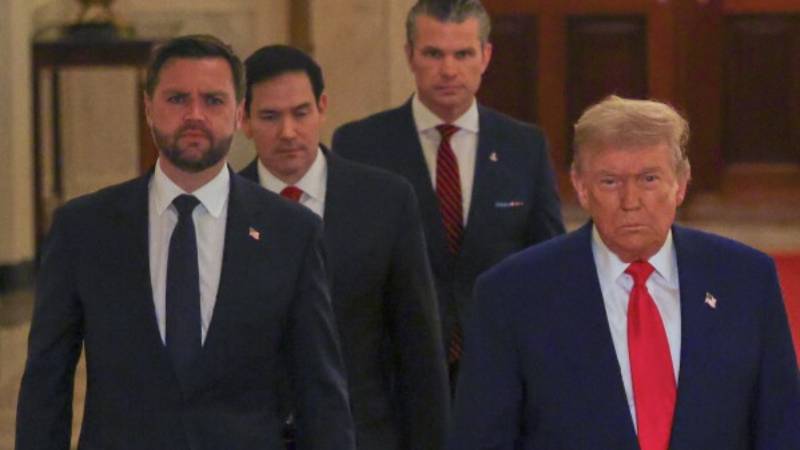
US Secretary of State Marco Rubio has urged China to intervene and prevent Iran from closing the Strait of Hormuz, a critical global shipping lane. His remarks follow a report by Iran’s state-run Press TV, which stated that the Iranian parliament had approved a proposal to shut the strait. However, the final decision rests with the Supreme National Security Council. A disruption in oil supplies through the Strait of Hormuz could have severe economic repercussions. China, as the world’s largest importer of Iranian oil and a key ally of Tehran, is seen as having significant influence in the matter.
In a compelling article titled “America’s Allies Must Save Themselves: How to Pick Up the Pieces of the World Order Trump Is Breaking,” published in Foreign Affairs in June 2025, former Australian Prime Minister Malcolm Turnbull delivers a sobering message to America’s allies: the United States, once a bedrock of global stability, has become an unreliable partner. He attributes this shift to America’s deepening domestic political polarisation and Trump’s disruptive foreign policy, which he sees as actively dismantling the liberal international order established after the Second World War.
A nation’s foreign policy must be anchored in its strategic interests. For decades, Pakistan has walked a diplomatic tightrope—deepening its strategic partnership with China while simultaneously engaging with the United States, the world’s preeminent power. This relationship with Washington has been anything but stable, marked by fluctuations and, in recent years, a near-total freeze. Some media voices have lauded recent developments as a triumph of Pakistani diplomacy. However, such optimism may be premature and grounded in a poor understanding of current events. Much of the renewed engagement is less a result of Islamabad’s manoeuvring and more a reflection of Donald Trump’s unpredictable approach to foreign policy.
Donald Trump’s swift mediation of the 2025 ceasefire blended personal ambition with geopolitics, aiming to burnish his dealmaker image, which has suffered due to a lack of progress in Ukraine. However, Trump’s push for broader Kashmir talks risks oversimplifying a complex dispute. Past US efforts have failed. Pakistan must cautiously harness US support, mindful of America’s fickle priorities.
Trump's newfound affection for Pakistan—hosting the army chief and heaping praise on its regional role—is, in part, a classic wedge strategy. It's about leverage: using Pakistan to tighten pressure on India, pulling it away from Russia, and securing better terms in trade negotiations. Trump’s style is unconventional; this isn’t a long-term strategic reset—it’s tactical brinkmanship.
Understanding Trump is no easy task. Here is an attempt to explain what is happening.
On 21 June 2025, US warplanes launched a major offensive against Iran, targeting its nuclear facilities at Fordow, Natanz, and Isfahan. President Donald Trump declared the sites "obliterated", touting the mission as a decisive blow against Iranian nuclear ambitions. Iran responded swiftly with coordinated missile salvos aimed at Tel Aviv and Be’er Sheva. Air raid sirens blared as civilians rushed for shelter and both military and civilian sites came under fire.
Trump’s decision contradicted his campaign pledge to avoid foreign wars like those in Iraq, Libya, and Afghanistan, and quotes Iran expert Karim Sadjadpour as calling the strikes “unprecedented”
In Gaza, Israeli forces intensified operations in Rafah and Khan Younis, flattening entire neighbourhoods. Hospitals are overwhelmed, reporting acute shortages of medicine, food, and clean water. Aid convoys remain blocked at border crossings, while international envoys scramble to avert a full-scale regional war.
The New Yorker notes that Trump’s decision contradicted his campaign pledge to avoid foreign wars like those in Iraq, Libya, and Afghanistan, and quotes Iran expert Karim Sadjadpour as calling the strikes “unprecedented”. NPR similarly reports that the attacks marked a stark departure from Trump’s long-standing promises to keep America out of Middle East entanglements.
Amid the destruction, prominent human rights observers have raised their voices. One of the most outspoken is Professor Avi Shlaim, an Iraqi-born Jewish historian and Emeritus Professor at Oxford University. A member of the “New Historians” school, Shlaim has long challenged official Israeli narratives. He has condemned Israel's Gaza campaign as genocidal, citing systematic targeting of civilian infrastructure, siege tactics that cut off essential supplies, and mass displacement of non-combatants. According to Shlaim, such actions violate international law and betray the ethical principles upon which Israel was founded.
As missiles fall and humanitarian crises deepen, the spotlight once again turns to the personal and political partnership between Donald Trump and Benjamin Netanyahu—a duo whose bond is not only ideological but familial.
Donald J. Trump, born in 1946 in Queens, New York, built his fortune in real estate before becoming a reality television figure and then President in 2016. His foreign policy broke with establishment norms, embracing a nationalist “America First” approach. Yet on the Middle East, he delegated key decisions to his son-in-law, Jared Kushner.
Jared Kushner, born in 1981, inherited both wealth and ideological commitments from his father, Charles Kushner—a prominent real estate developer and staunch supporter of pro-Israel causes. In the mid-1990s, as a teenager, Jared welcomed then-Israeli opposition leader Benjamin Netanyahu into the Kushner home in Livingston, New Jersey. He even gave up his bedroom for Netanyahu during the visit—a gesture of respect that marked the beginning of a long personal relationship. This early encounter laid the groundwork for a unique axis of loyalty that blurred the lines between family, business, and diplomacy.
Kushner’s 2009 marriage to Ivanka Trump—who converted to Judaism and embraced Israeli traditions—further deepened this nexus. The two families shared intimate religious celebrations, including Passover seders at both Mar-a-Lago and the Prime Minister’s residence in Jerusalem. These personal rituals translated into geopolitical moves that would come to define Trump’s Middle East legacy.
Benjamin Netanyahu, born in 1949 in Tel Aviv, is the son of noted historian Benzion Netanyahu. After spending part of his youth in the United States, he earned a degree from MIT and served in Israel’s elite Sayeret Matkal unit. Netanyahu entered politics through diplomacy, representing Israel in Washington and at the United Nations. In 1996, he became the youngest Prime Minister in Israeli history. He returned to office in 2009, more ideologically entrenched than ever, with a focus on territorial expansion and hardline security.
From his first days back in power, Netanyahu prioritised the expansion of Jewish settlements in the West Bank and resisted calls for renewed peace talks with Palestinians. He championed unilateral control over contested territories and rejected international pressure for a two-state solution.
In 2017, Trump fulfilled one of Netanyahu’s deepest political aspirations by officially recognising Jerusalem as Israel’s capital and relocating the US embassy there. The move sparked massive protests in Palestinian territories and condemnation across the Arab world. Behind the scenes, Jared Kushner managed the timing of the announcement, reportedly overruling Israeli security officials who feared the backlash.
Two years later, in 2019, Trump endorsed Israeli sovereignty over the Golan Heights—another long-sought goal of Netanyahu’s, solidifying his claim to expanded borders while sidelining Palestinian concerns.
The crown jewel of this trilateral collaboration came in 2020 with the Abraham Accords, a series of normalisation deals between Israel and several Arab states, including the UAE, Bahrain, Sudan, and Morocco. Though spearheaded by Kushner, Netanyahu played a crucial role. He delayed the public announcement to align with his domestic political calendar, ensuring he could maximise support from Israel’s right-wing voters.
95% of Jewish Israelis in a January 2024 Tel Aviv University poll backed the military’s actions, with 58% saying "too little" force was used
But Netanyahu’s vision of regional integration came at a steep cost. His refusal to engage credibly with Palestinian leadership, his push for annexation of West Bank territories, and his support for permanent military presence in Gaza drew sharp rebukes from the international community.
Since October 2023, Gaza has endured devastation at a scale unseen in decades. Entire city blocks have been erased by Israeli airstrikes. Basic supplies—water, fuel, electricity—are blocked by land and sea. Professor Avi Shlaim argues these actions constitute genocide. He points to the mass killing of civilians, destruction of hospitals and schools, and deliberate starvation tactics as examples of collective punishment, in direct violation of the Geneva Conventions.
While the humanitarian crisis rages, Netanyahu has faced another storm at home. His 2023 judicial overhaul, which aimed to curb the powers of Israel’s Supreme Court, sparked massive nationwide protests—the largest in the country’s history. Critics warn the reforms erode Israel’s democracy, placing unchecked authority in the hands of the executive.
Meanwhile, Jared Kushner’s involvement in the region has taken on increasingly controversial dimensions. In late 2023, his Saudi-backed investment firm, Affinity Partners, poured $110 million into Israel’s Shlomo Group—a conglomerate active in sectors including auto sales, real estate, and infrastructure, some of it linked to occupied territories. Observers say this raises troubling ethical questions: Netanyahu’s policies fuel instability that opens the door to lucrative private deals, while Kushner's dual roles blur the boundary between diplomacy and self-interest. His family's donations to pro-settlement groups only deepen the concerns.
Trump’s 21 June airstrikes on Iran were framed as necessary to prevent nuclear proliferation. But independent analysts doubt the long-term effectiveness of the operation, noting that Iran’s nuclear infrastructure is both dispersed and hardened. Iran’s rapid retaliation laid bare vulnerabilities in Israel’s missile defences—vulnerabilities critics blame on Netanyahu’s neglect of civil defence funding in favour of military expansion.
The fallout is spreading. Gulf states, previously optimistic about normalisation with Israel, are now reconsidering. Saudi Arabia has quietly paused talks, unwilling to be seen backing a state engaged in what many now call war crimes. However, we are living in polarised times. Polls show strong Israeli support for military operations in Gaza: 95% of Jewish Israelis in a January 2024 Tel Aviv University poll backed the military’s actions, with 58% saying "too little" force was used. A February 2025 Israel Democracy Institute poll found 74% supported a Rafah operation.
In the US, the political response is fractured. Isolationists like Rep. Marjorie Taylor Greene denounce further involvement in what they call “foreign entanglements”. Yet neoconservatives and pro-Israel lobbies continue to support Trump’s aggressive stance.
Former President Bill Clinton offered a blunt assessment of Netanyahu’s war aims, saying during an appearance on The Daily Show:
“Netanyahu has long wanted to fight Iran because that way he can stay in office forever and ever. I mean, he’s been there most of the last 20 years.”
He also emphasised the importance of the US protecting its allies in the region, while simultaneously advocating for restraint.
“We have to convince our friends in the Middle East that we’ll stand with them and try to protect them,” Clinton stated. From a teenage bedroom in New Jersey to war rooms in Tel Aviv and the Oval Office, the Trump–Netanyahu partnership has steered a course that threatens to engulf the Middle East in flames. They have sought to change maps, redraw alliances, and launched bold strikes. But as Gaza burns, international law is flouted, and democracy in Israel is under siege, the cost of their alliance is coming into stark relief.
The question now is whether their next move will bring peace—or plunge the region deeper into chaos. Their legacy will depend on it.