

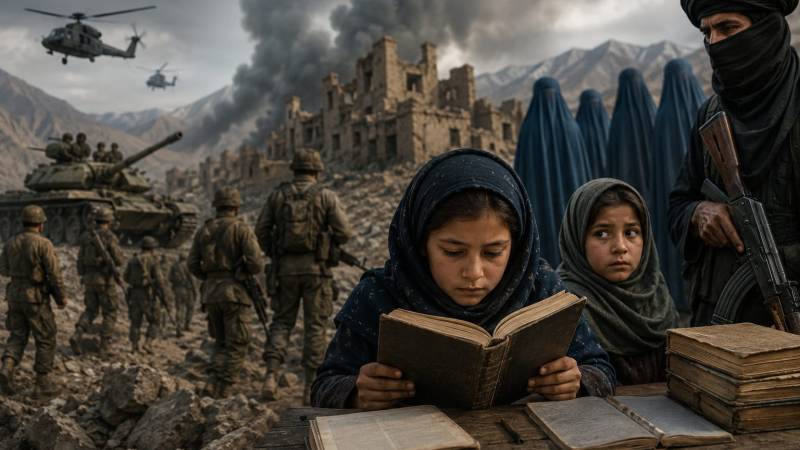
There are countries that suffer wars, and there are countries that suffer wars and the slow, deliberate murder of their own future. Afghanistan is the second kind. For forty-seven years — since the Soviet invasion of 1979 tore the country from its own trajectory — Afghanistan has not merely bled for itself. It has bled for the whole world. It has been the launching pad, the training ground, and the graveyard for ideologies that outlived their patrons and returned, again and again, to haunt Kabul, Kandahar, New York, London, Paris, and Moscow alike. Every decade has produced a fresh chapter of the same tragedy, and every chapter has ended the same way: with Afghan children, especially Afghan girls, paying the final price.
It did not have to be this way. And that is the cruelest part of this story — not that Afghanistan was fated to suffer, but that it was offered, more than once, a door out of the darkness, and that door was slammed shut from within.
When the Soviet Union entered Central Asia in the twentieth century, it left behind a complicated and often brutal legacy — but one undeniable outcome was mass literacy. Uzbekistan, Tajikistan, Kazakhstan, Turkmenistan, Kyrgyzstan: nations that emerged from Soviet influence with literacy rates above 98 percent, women doctors, women engineers, women teachers standing shoulder to shoulder with men in classrooms and clinics. Whatever one thinks of the political system that produced it, education was not optional there. It was universal.
Afghanistan sat at the edge of that same civilizational current and refused to drink from it. And when the Soviets withdrew and the Americans arrived two decades later with schools, scholarships, and rebuilt universities, the same resistance returned in a new uniform. This is one of the great missed opportunities of the modern era — a Himalayan blunder, if ever there was one. Two global superpowers, for all their competing motives, each tried in their own way to put a pen in the hand of an Afghan child. Both were turned away by men who understood, correctly, that an educated Afghanistan would be an Afghanistan they could no longer control.
That is the real story beneath the ideology. It was never truly about faith. It was about fear — the fear of a population that could read, question, and choose. An illiterate population is a compliant population. And a compliant population, tragically, is also a recruitable one. For nearly half a century, Afghan soil has functioned as a nursery for extremism precisely because its children were kept unlettered, unarmed with knowledge, and therefore defenseless against the men who came bearing guns instead of books.
What makes this tragedy unbearable is that it is committed in the name of a religion that commands the opposite. The very first revelation of the Quran was not a command to fight, or to veil, or to isolate — it was a command to read. “Read! In the name of your Lord who created,” the verse begins, describing a Lord who “taught by the pen, taught man that which he knew not” (Surah Al-’Alaq, 96:1–5). Islam's founding moment is a literacy lesson. Its scholarly tradition produced the great libraries of Baghdad, the observatories of Samarkand, the universities of Cairo and Córdoba, at a time when much of Europe could not read its own name. Muslim tradition has long held that seeking knowledge is an obligation upon every believer, man and woman alike, from the cradle to the grave — a pursuit that builds character, deepens faith, and serves humanity.
The Taliban's war on schooling is not a defense of Islam. It is a desecration of it. Every girl turned away from a classroom gate is a rebuke to the Prophet's own household, in which knowledge was cherished and transmitted through women as much as men. Those who claim to rule in the name of the Quran while padlocking its central commandment have not protected the faith — they have vandalized its image before the entire world, handing its enemies a caricature to point to and a tragedy to mourn.
The human toll of this ideology is not abstract. Since August 2021, Afghanistan has stood alone among the nations of the earth as the only country to bar girls and women from secondary school and university formally. More than 2.2 million adolescent girls are now locked out of classrooms, with roughly 400,000 more ageing into that exclusion every single year. University gates remain sealed to women entirely. Even where younger girls are still technically permitted into primary grades, the shadow of what awaits them at adolescence discourages families from enrolling daughters at all — a slow strangulation of ambition before it can even take a breath. And the teachers are vanishing too. The ranks of female basic-education teachers have fallen from roughly 73,000 to 66,000, a hemorrhage that threatens to hollow out even the primary system that remains nominally open. A nation cannot educate its daughters if it has no women left standing at the chalkboard.
The very first revelation of the Quran was not a command to fight, or to veil, or to isolate — it was a command to read.
Picture the Afghanistan that might have existed: universities in Herat and Mazar-i-Sharif filled with young women in medicine and engineering; a literacy rate rivaling its northern neighbors; a generation immune to the recruiters' promises because they had something recruiters cannot offer — a future. Instead, the world inherits another cohort of Afghan children who will grow up as their parents and grandparents did, denied the one weapon that could have ended this forty-seven-year cycle: knowledge.
And now the darkness has multiplied. What began as one movement's war on the pen has metastasized into a landscape shared by ISIS-Khorasan's barbarism, by the Tehrik-i-Taliban Pakistan bleeding a neighboring nation daily with bombs and bullets, and by a Taliban government still, even now, unwilling to open a single university lecture hall to its own daughters. These are not three separate fires. They are one fire, fed by the same fuel: a generation with no books, no classrooms, and no reason to believe the world has not already forgotten them.
This plea must go beyond Kabul—to the entire world. To the UN: make aid, recognition, and any official seat conditional on every Afghan child having access to school. To the EU: expand your proven remote learning to every province and village. To China: leverage your border influence and markets to tie trade to classrooms. And to every nation and individual: these children did not choose their rulers and should not inherit ignorance. Educate them—before roads, before politics, before recognition. The Quran commands "Read"—let that be answered, turning extremism's nurseries into classrooms of hope. Without united action, Afghanistan will remain a monument to a stolen future. The world must not let that future be taken forever.