

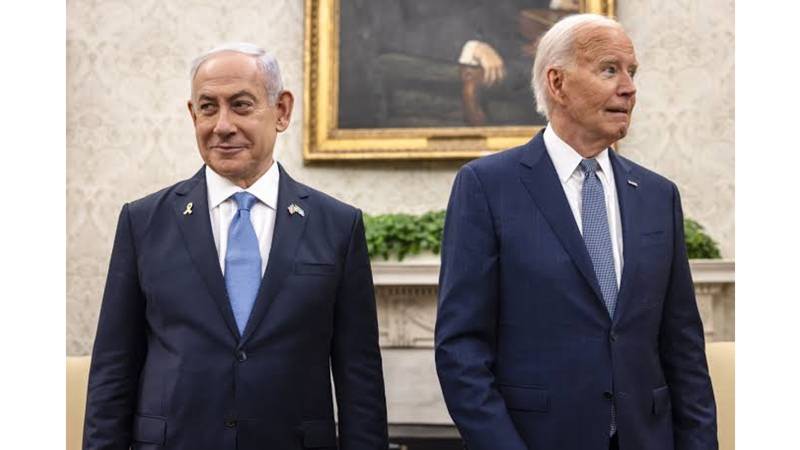
When Joe Biden entered the White House in January 2021, he promised to restore America’s moral standing in the world, defend democracy against authoritarianism, and repair the damage inflicted by the previous president. Four years later, he departed with Gaza devastated, America’s international credibility badly damaged, and the man he had defeated returning to the presidency.
Biden’s newly published memoir, Promise Me, America, provides a remarkable window into how this happened. It reveals a president who understood that Israel’s military campaign was inflicting enormous suffering on Palestinian civilians, repeatedly warned Prime Minister Benjamin Netanyahu about the consequences, and recognised that Netanyahu’s assurances could not be trusted. Yet Biden continued supplying Israel with weapons and diplomatic protection.
The central question is no longer what Biden knew. It is why he failed to act decisively on what he knew.
Biden’s account of Netanyahu’s moral character is devastating. He describes a leader driven by political survival, surrounded by extremists, and willing to make promises he had little intention of keeping. A recurring pattern emerged: Netanyahu would promise to reduce civilian casualties, only for another Israeli military operation to kill more Palestinians.
Biden writes that Netanyahu had no qualms about making promises he lacked the power or intention to keep. He criticises the Israeli leader for putting his short-term political interests ahead of Israel’s long-term security.
These are extraordinary admissions from a president who continued to regard Israel as one of America’s closest allies. The scale of destruction, in terms of lives lost and lives wounded, physically and emotionally, as well as in terms of buildings and infrastructure destroyed, was hardly a secret. Biden cannot claim in good conscience that he was not aware of it.
A Catastrophe in Plain Sight
In December 2023, Robert Pape, the distinguished University of Chicago political scientist and historian of strategic bombing, compared Israel’s bombardment of Gaza with the Allied bombing of German cities during World War II.
Pape’s research showed that the proportion of buildings damaged or destroyed in Gaza was approaching levels associated with some of the most devastating bombing campaigns in modern history. Dresden, whose destruction in February 1945 became an enduring symbol of the horrors of aerial warfare, was an obvious historical reference point.
By early 2024, entire neighbourhoods in Gaza had been reduced to rubble. Hospitals, universities, schools, mosques, and residential buildings had been destroyed or severely damaged. Hundreds of thousands of Palestinians had lost their homes. The civilian death toll continued to rise.
Biden was not dependent on newspaper reports to understand the catastrophe. As president, he had access to intelligence, diplomatic communications, and military assessments unavailable to ordinary citizens. Indeed, in December 2023, he publicly warned that Israel was losing international support because of its indiscriminate bombing. But the weapons continued to flow from America.
Washington was spending hundreds of millions of dollars to mitigate a humanitarian crisis while continuing to supply weapons used in the military campaign contributing to that crisis
To be fair, Biden faced a genuine dilemma. Hamas’s attack on the 7th of October 2023 killed approximately 1,200 people in Israel, and hundreds were taken hostage. Israel had a legitimate right to protect its population and respond to the attack, subject to international humanitarian law. But supporting Israel’s security did not require unconditional support for Netanyahu’s conduct of the war.
Washington possessed considerable leverage. Israel depended heavily on American weapons, military technology, intelligence cooperation, and diplomatic protection. Biden could have made continued transfers of offensive weapons conditional on compliance with humanitarian obligations.
Instead, his administration largely relied on private persuasion, repeated warnings, and assurances that were subsequently broken. In May 2024, Biden paused a shipment of heavy bombs as Israel prepared its assault on Rafah. But this limited measure did not fundamentally alter the relationship.
A president who understood that Netanyahu was disregarding his warnings continued to provide Israel with weapons for prolonging the war.
An Establishment Bound by Habit
The recently published book Crossing the Red Line: Biden, His Advisors, and Israel’s War in Gaza, by journalist Akbar Shahid Ahmed, offers an explanation for this extraordinary contradiction.
Drawing on extensive reporting and interviews with administration officials, Ahmed describes a foreign-policy establishment that treated support for Israel not as a policy choice to be evaluated against its consequences, but as an almost immutable obligation.
The book’s significance is reinforced by a powerful review by Ben Rhodes, President Barack Obama’s former deputy national security adviser, published in the 19th of November issue of The New York Review of Books.
Rhodes argues that Biden and his advisers behaved as though unconditional support for Israel was the only available option, even as the humanitarian catastrophe intensified. His assessment carries weight because he served inside the American national security establishment and acknowledges having participated in policies he now regards with considerable misgivings. Rhodes describes a deeply entrenched culture in which challenging Israel could expose American officials to political attacks, donor pressure, and professional consequences.
The result was a foreign-policy establishment that increasingly confused long-standing habits with strategic necessity. Ahmed’s account provides revealing examples.
After Biden warned that an Israeli assault on Rafah would cross an American red line, Israel proceeded with its military operation. The administration responded by pausing one shipment of heavy bombs while allowing most other military assistance to continue. Rather than reconsidering its strategy, officials defended the effectiveness of their pressure.
Another revealing episode followed the Israeli attack that killed seven workers from World Central Kitchen in April 2024. Biden responded with unusually strong public criticism. Israel subsequently permitted a temporary increase in humanitarian assistance entering Gaza.
For Rhodes, the episode demonstrated that American pressure could produce results. Yet the administration failed to draw the broader lesson that its leverage could be used more consistently. Instead, Washington pursued increasingly elaborate humanitarian measures while leaving the underlying military relationship largely untouched.
The most striking example was the temporary American-built pier intended to deliver humanitarian supplies by sea. The project cost approximately $230 million and encountered serious operational difficulties. It was an extraordinary undertaking to deliver food to a territory whose land crossings were subject to restrictions that American pressure might have helped alleviate.
The contrast was difficult to miss. Washington was spending hundreds of millions of dollars to mitigate a humanitarian crisis while continuing to supply weapons used in the military campaign contributing to that crisis.
Ahmed’s book also documents the growing disconnect between the administration and its domestic critics. As protests spread across American universities, officials frequently interpreted opposition to the war through the lens of support for Hamas or antisemitism.
Antisemitism was a legitimate concern, and some incidents warranted condemnation. But many demonstrators were protesting civilian deaths, American military assistance, and the destruction of Gaza.
By failing to distinguish adequately between these motivations, the administration alienated citizens whose concerns deserved serious engagement. The result was a widening gulf between Democratic leaders and important segments of their own electoral coalition.
Personal Loyalty Over Leverage
Perhaps the most revealing evidence of Biden’s personal attitude towards Netanyahu emerged this week.
On the 17th of November, The Jerusalem Post published what it described as a transcript of Biden’s final telephone conversation with Netanyahu, held on the 15th of January 2025, five days before Biden left office. According to the newspaper, Biden told Netanyahu that he admired him, praised his courage, and expressed personal affection for him. This was after fifteen months of devastating warfare in Gaza. The contrast with Biden’s memoir is astonishing.
In retrospect, Biden portrays Netanyahu as unreliable, politically self-serving, and unwilling to honour commitments to protect civilians. Yet in their final conversation, he reportedly praised the same leader.
Diplomatic courtesy is not necessarily an endorsement of every action taken by a foreign leader. The conversation also coincided with the announcement of a ceasefire and hostage-release agreement, providing a reason for a cordial exchange.
Nevertheless, the transcript raises troubling questions about the depth of Biden’s willingness to hold Netanyahu accountable. Was his criticism of Netanyahu fundamentally constrained by an emotional attachment to Israel and its leadership that he could never overcome?
Rhodes provides a revealing historical perspective. He recalls Biden’s long-standing affection for Netanyahu, even when the two disagreed sharply over policy.
That attachment may help explain why Biden repeatedly chose persuasion over coercive leverage. But foreign policy cannot be conducted indefinitely based on personal loyalty when the consequences involve the lives of millions.
Political Fallout and Historical Legacy
And then there is the question of Biden’s political judgement. The Gaza war divided the Democratic Party, alienated many younger voters, and provoked widespread protests on university campuses. Arab American and Muslim voters, particularly in Michigan, became increasingly disillusioned with the administration.
The political damage was compounded by Biden’s determination to seek re-election despite mounting concerns about his age and ability to campaign effectively. His disastrous debate performance against the Republican candidate in June 2024 eventually forced him to withdraw in favour of Kamala Harris.
She inherited not only Biden’s economic and immigration record, but also a Gaza policy deeply unpopular among important Democratic constituencies. And she only had a hundred days to conduct her presidential campaign.
Did Gaza cost the Democrats the election? It would be an exaggeration to attribute Harris’s loss to a single issue. Inflation, immigration, Biden’s age, and dissatisfaction with the political establishment all contributed.
But elections are decided at the margins, and Gaza was one of the issues that weakened enthusiasm for the Democratic ticket. The tragedy is that Biden’s decisions may have helped restore to power the very man he regarded as an existential threat to American democracy.
There is an even deeper historical irony. Biden’s memoir warns that America’s traditional commitment to Israel is weakening as younger generations question policies that their parents and grandparents largely accepted. He is right about the generational divide. But he seems unwilling to acknowledge that his policies helped widen the divide.
As argued in my previous column, Israel’s international standing has suffered enormously. Its military campaign has generated widespread condemnation, legal challenges, diplomatic isolation, and a profound deterioration in its reputation among younger Americans.
The US has paid a price as well. Its repeated declarations about human rights and the rules-based international order have appeared increasingly selective when measured against its policies towards Gaza. The implications extend beyond Biden’s personal legacy.
Rhodes argues that the Democratic Party must confront the institutional assumptions that shaped its Gaza policy. Otherwise, future Democratic administrations may repeat the same mistakes. That warning deserves attention.
A foreign policy that treats unconditional support for an ally as an unquestionable obligation cannot adequately assess whether that support advances American interests, protects civilians, or contributes to lasting peace. Nor can it easily distinguish between the security of a country and the political survival of its leaders.
Biden’s defenders argue that he worked tirelessly to secure humanitarian assistance, restrain Israeli operations, and negotiate a ceasefire. Those efforts deserve acknowledgement. But diplomacy must ultimately be judged by its results, not merely by the sincerity of its intentions.
When warnings are repeatedly ignored, promises repeatedly broken, and civilian suffering continues on a catastrophic scale, a powerful patron must decide whether to change its policy or accept the consequences. Biden chose largely to preserve the relationship. His memoir suggests that he still regards this as the correct decision. History may judge him differently.
He entered office determined to rescue American democracy. He left office having watched Netanyahu devastate Gaza while his opponent reclaimed the White House.
His domestic legislative achievements were substantial. But his legacy will also be shaped by his failure to use American power more effectively to restrain a humanitarian catastrophe.
The enduring question is not whether Biden cared about Palestinian suffering. He sure made that claim several times. But his policies belie that claim.
He knew. He protested. But when his protests failed, he would not act decisively. That may prove to be one of the most consequential failures of his presidency. History will judge him as a hypocrite par excellence!