

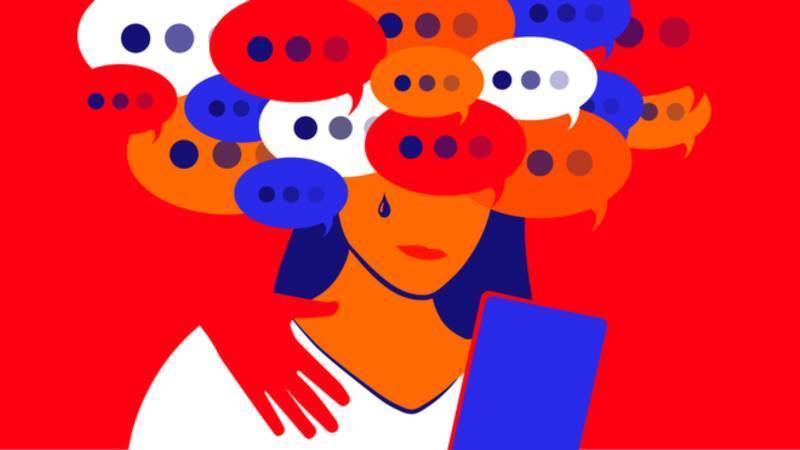
On Monday, I published a blog about harassment. By Tuesday, the comments section had become a masterclass in it. The blog was about "Good Morning" and "Good Night" messages, the ones that land on the phones of women like me: ageing, unglamorous, working quietly in Pakistan's social development sector. Written in Urdu, deliberately so, because uncomfortable truths that travel easily in English tend to get stopped at the border of our own language.
Published on HumSub on May 18th under the title "Good Morning Ji, Shab Bakhair: Aik Saada Sa Paigham, Aik Pechida Sa Masla", the responses it drew—more on Facebook and WhatsApp than on the platform itself told me the subject had landed somewhere real. Those responses came from Pakistan and well beyond it.
Pakistanis abroad were just as exercised, which says something worth stating plainly: misogyny travels with the passport. A Pakistani man settled in LA or Oslo carries the same assumptions about women's availability as one sitting in Lahore or Karachi. The globe is not becoming more equal. It is becoming more connected, which is a different thing entirely.
The blog was not about romance or sugar daddies or the corrupting influence of the West. It was about the senior man in your professional circle who texts at 7 am with a rose emoji and at 11 pm with a moon sticker, without ever once asking whether he was welcome.
I write about these things because, for over three decades, I have worked on gender-based violence prevention, response, research, policy, community work, and media advocacy. And let me be specific about those three decades: the smartphone is new; the behaviour is not. Before WhatsApp, there were landline calls at odd hours. Before that, unsolicited love letters slipped under office doors or into college notebooks. The technology changes. The entitlement does not.
The comments arrived in waves.
First came the deflectors. Different people, same script: open with a cultural proverb, blame Western influence for rotting an otherwise decent society, and land squarely on the conclusion that the real problem is women. Women who exploit professional spaces. Women hiding behind respectable platforms. Women who must be stopped. A blog about men who send uninvited messages at midnight had become, within 24 hours, a case against (jaali) female journalists.
Deflection. Denial. Dismissal. One ancient move, several fresh performances.
There is a term for this in psychology: DARVO (Deny, Attack, Reverse Victim and Offender). I had named it in the original blog. The comments demonstrated it almost immediately, which was useful, if exhausting.
There is no human resources department in an activist network. There is no paper trail for a deleted WhatsApp message. There is no witness to the 11 pm moon sticker
The Western culture framing deserves a moment because it does specific damage. It relocates the problem. The 7 am rose emoji was not sent by the West. It was sent by a Pakistani man, from a Pakistani phone, inside a Pakistani professional structure that has shielded him for years. What came from outside was not the behaviour. It was the vocabulary to describe it—and that, apparently, is what needs to be stopped.
Then came the well-meaning ones. Men who had skimmed the piece and arrived at tidy solutions: block him, change your number.
Women working in Pakistan's corporate and social development sectors know exactly why this stings. The man sending those messages is often also the man who funds your project, sits on the evaluation committee, or controls your next contract.
He introduced you warmly at last month's conference. His displeasure has consequences you can calculate in unpaid invoices. Telling a woman to block him hands her the entire burden. He moves on, undisturbed, to the next woman. Telling her to change her number is its own quiet cruelty—make yourself unreachable so that men who reach without permission are never inconvenienced.
Anyone who works seriously on these issues knows how hard harassment is to prove. Formal mechanisms exist for anti-harassment offices at provincial and federal levels, the Protection Against Harassment of Women at the Workplace Act, and their existence matters. But a law is only as strong as its implementation, and implementation requires institutional will that the informal sector simply does not have. There is no human resources department in an activist network. There is no paper trail for a deleted WhatsApp message. There is no witness to the 11 pm moon sticker. The formal system was built for offices. Most of us do not work in offices.
When women speak informally to peers, something harder happens. The discouragement is swift. The fear invoked is not always baseless—reputations do get managed; careers do get quietly damaged. But the comment that does the most harm is not about risk. It is about logic. Why would he harass you? He is a pious man. A family man. He has a beard. He has a beautiful wife.
As though harassment selects its perpetrators by appearance. As though a beard is a character reference.
And if the woman speaking is ageing, unmarried, or divorced, widows carry stigma too, though of a different weight—her complaint stops being about his conduct and starts being about her circumstances. She is not naming a pattern. She is, apparently, advertising a vacancy. Her credibility shrinks in direct proportion to her distance from a man's last name.
I know this from somewhere closer than research.
A decade ago, I experienced serious workplace harassment. Living through it cost me more than I had anticipated. I had a nervous breakdown. I do not say that for sympathy. I say it because I have always believed one thing: a nervous breakdown is better than a moral breakdown.
When I eventually wrote about it from a position of strength, the response came not from a stranger but from an accomplished gender expert, also the wife of a prominent figure. She did not ask how I was. She asked why I had written it, whether I had proof, and reminded me I could be held responsible. I felt threatened. And then she left a comment I have not forgotten: "Who could harass you anyway? You are not a docile woman."
The idea that harassment happens only to a certain kind of woman, quiet, compliant, appropriately small, is not fringe thinking. It lives inside professional circles, inside feminist spaces, inside the rooms where these conversations are supposed to be safe.
What stayed with me most from this week was not the hostile comments or the breezy advice. It was the women who did not read the blog (or pretended not to), did not share the blog, and the women who shared the blog without leaving a single word beneath it. They knew. They had all received the 7 am message. They had all done the calculation—how much does speaking cost, and can I afford it today and decided against it.
That silence is not peace. It is arithmetic.
Women like me write so that silence has somewhere to go. The comments will always deflect, deny, and dismiss. That is not a setback. That is, in its own way, the whole point.