

Victor Ofosu is a London-based international security expert, author, businessman, and independent researcher. His recent academic work challenges conventional military thinking and offers a new perspective on how sound can influence outcomes in war without relying solely on lethal force.
Mustansar Siam: What inspired you to explore the use of infrasound as a weapon of war? Was there a particular event, research gap, or personal experience that motivated this study?
Victor Ofosu: The current escalation of wars around the world is concerning. I understand that due to factors such as business interest, control over global security, emotions, and a lack of adequate leadership in our respective countries, the world cannot rid itself of war. War has become and will remain a constant issue in human development. Hence, I intend to discover a framework that will allow countries to engage in wars without human casualties, displacement of people and the mass destruction of property. From my perspective, infrasound, which I believe is the future of warfare, will serve such a purpose. That is a military engagement without mass destruction; the replacement of destructive weapons with infrasound warfare.
Mustansar Siam: You challenge the traditional reliance on lethal force in warfare. How do you envision sound replacing or significantly reducing the need for destructive weapons on the battlefield?
Victor Ofosu: The world is currently experiencing a dramatic shift in warfare. Significant innovations are taking place in military deployment, for example, a shift from deploying soldiers to the utilisation of artificial intelligence and robotics. Here, understand that although the future of warfare is becoming more strategic, sophisticated and complicated, we will also observe an unprecedented level of human casualties. I am therefore of the opinion that the development of infrasound as a weapon of war can assist in addressing the destructive nature of future escalation of wars. With the application of infrasound, we will observe zero destruction of property and human casualties. I understand that there are effects of using infrasound, such as its impact causing nausea, mood changes and depression; on the contrary, effects are less dramatic when compared with the use of nuclear weapons, guns and missiles. Most importantly, there are no casualties when employing such a strategy. I believe that if the researchers, academics and science communities embrace my research, the benefits in the future will outweigh the adverse effects of using infrasound.
Mustansar Siam: You propose a new definition of strategic communication based on psychological conditioning. What is your definition, and why do you believe psychology should be at the heart of strategic communication?
Victor Ofosu: In our daily exchange of human engagement, the exchange of information is not merely a process of storytelling, but humans communicate to elicit behaviour changes in the intended audience or the receiver. Furthermore, one must understand that war is fought to subdue the will of the opponent. That is, war is not fought to tell stories, as some academics, in their disposition, define strategic communication as storytelling aimed at persuading the target audience. I intend to refute such a definition and to develop a befitting framework which provides a coherent and concise understanding of the term strategic communication. Hence, I define strategic communication “as the purposeful flow of information to stimulate, condition and change the attitude, beliefs, and behaviour of the target audience.” My definition is underpinned by psychology; psychology is underpinned by the human mind, emotion, feelings and memories; this is expressed in the conditioning effect of information. Here, the role of strategic communication is to penetrate the opponent’s mind and to condition him to act favourably. My definition is supported by psychology, as I argue that strategic communication effectively changes the opponent's emotions, feelings, and memories; this process activates the desired effect on the battlefield.
I intend to discover a framework that will allow countries to engage in wars without human casualties, displacement of people and the mass destruction of property.
Mustansar Siam: How does Pavlov’s classical conditioning experiment apply to modern military strategy, especially when using infrasound as the neutral stimulus? Can you explain the mechanism you have in mind? Since infrasound is mostly inaudible, how would it be used to transmit subliminal messages or create conditioned responses in enemy forces? What role do memory and the brain’s hemispheres play in this process?
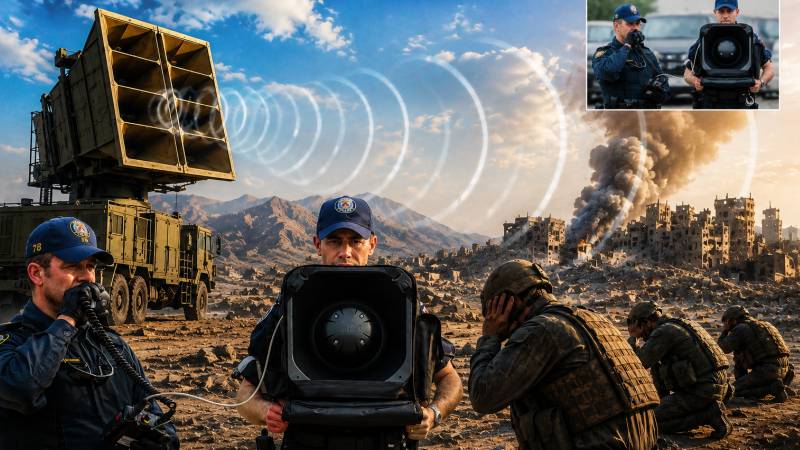
Victor Ofosu: The application of infrasound is currently a concept which requires further investigation and experimentation. However, I insist that when produced as a war machine, infrasound will perform as mentioned in my research. Subliminal information can be manufactured, as in the case of saving music on a music device. The difference here is that when the device is played below 20 Hz, making the message inaudible, it will achieve the desired effect in the targeted audience. On the battlefield, this process will be applied differently; it requires a vessel, which is the carrier, and attached to this vessel is the transmitter. The process is intended for a large population, not a small group. However, it can equally affect change in a small group. I argue that a drone can be used to carry the transmitter. When flown over the targeted location, the operator can transmit the messages below 20 Hz at the appropriate time. The effectiveness of this process is heavily reliant on Pavlov’s classical conditioning, thus, the utilisation of the neutral stimulus and an unconditioned stimulus. Infrasound can penetrate the skull and thus alter the functional connectivity in the brain. For example, it can alter areas in the right hemisphere of the brain, such as the amygdala and temporal gyrus. This process is significant, as the right brain controls movement, thinking, emotion, interpretation, and awareness.
Mustansar Siam: What specific effects on soldiers’ morale, emotions, cognition, and combat performance do you expect from the strategic use of infrasound?
Victor Ofosu: The effect on the soldier is dependent on the response expected by the applicant. Here, it can be observed that the message delivered will activate the expected conditioned response in the combatant. Ultimately, to win a war, the applicant of this tool will expect to alter the soldier's will to fight through eliciting a negative response to combat.
Mustansar Siam: In your opinion, what will be the role of infrasound in future conflicts? Will it become a standard tool in military arsenals, or remain a niche psychological weapon?
Victor Ofosu: I intend further to examine the application of infrasound on the battlefield. Perhaps my research will assist academia to accept my findings. Naturally, I expect some academics may be critical of my observation and may argue it is impossible to apply such a method in war. However, if man can launch a satellite into space, I believe that achieving my concept is not an impossibility. I hope that soon this process will replace military arsenals on the battlefield. The application of inaudible low sound frequency is indeed the future of warfare.