

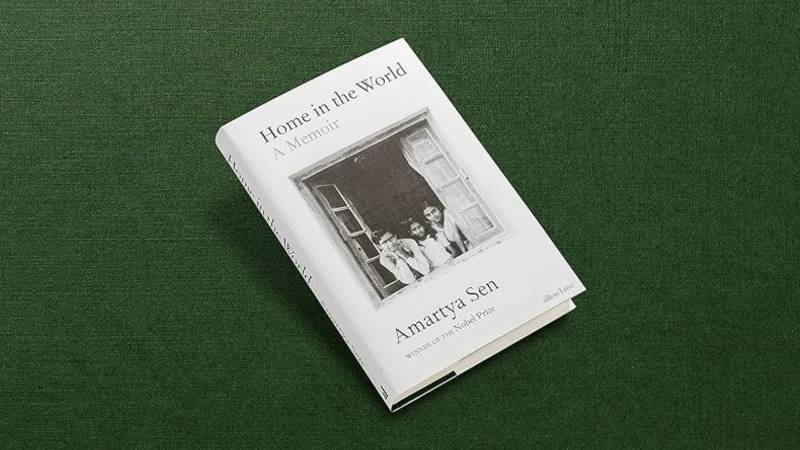
The decade between 1941 and 1951 was hugely transformative for the seven-year-old Amartya Sen, as indeed it was for colonial India and the world. In 1941, Amartya left St Gregory’s, a mission school in Dhaka, where he stood thirty-third in a class of thirty-seven.
His younger sister Manju and his parents, Amita and Ashutosh Sen, remained in Dhaka while he was sent to study at Rabindranath Tagore’s Santiniketan, and happily to live with his maternal grandparents, Kiranbala, his wise and compassionate Didima with a ‘scientific disposition’, and Kshiti Mohan, his beloved scholarly humanist Dadu.
At Santiniketan, Rabindranath aimed to impart the best of eastern and western education and, in Amartya’s words, foster ‘curiosity rather than competitive excellence’. Unlike St Gregory’s, ‘interest in grades and examination performance was severely discouraged’. The emphasis was on the freedom to think and on creativity. With excellent teachers and Santiniketan’s open-shelved library, Amartya had a blast.
Encouraged to think critically and argue, but with rigour, Amartya relished his encounters with Sanskrit and mathematics, with additional attention from Kshiti Mohan in the former and accomplished teachers in the latter.
Yet life revealed aspects of the human condition that no human being should experience, least of all a child. As a ten-year-old, Amartya witnessed the ravages of the Bengal famine of 1943, as he helped his Didima share their rations with the starving who cried for help at their doorstep, and when he saw the dead on the streets of Calcutta.
As an eleven-year-old on holiday from Santiniketan at Jagat Kutir in Dhaka with his parents, Amartya witnessed raw communal violence when an injured and bleeding stranger collapsed in their driveway. Amartya held in his arms Kader Mian, a Muslim man, and gave him water. His father drove Kader Mian to the hospital, where, sadly, he died. Such was the impact of this experience that throughout his life, Amartya has spoken and written about this incident.
What choices did the Muslim Kader Mian have when he went in search of work in a Hindu area, notwithstanding his wife’s pleas to the contrary? Indeed, with rising incidents of hate speech and other violent hate crimes across the world and in South Asia, Amartya Sen is right to remind us and raise the question: what drove the murderers to kill Kader Mian? What can we do to end such contemptible crimes?
Amartya was still at school in Santiniketan when the Second World War ended in 1945, after the United States dropped two atomic bombs on Hiroshima and Nagasaki on 6 and 9 August, respectively, causing cataclysmic destruction. Amartya recalls his empathy with the victims of the nuclear holocaust when undergoing radiation for a tenaciously self-diagnosed oral cancer while still a teenager at Presidency College, Calcutta.
Throughout his memoir, Amartya Sen presents hard evidence across centuries to demonstrate how, as ethical subjects, Hindus and Muslims used their ethical imaginations to live together in negotiated acceptance
Warmongers in India and Pakistan must watch archival footage of the aftermath of the bombing of Hiroshima and Nagasaki. The bombs in India’s and Pakistan’s arsenals are a hundredfold more destructive. In a quest for peace, the United Nations came into existence in October 1946, a chastening thought with so much of that order now in tatters.
In 1948, the much-flaunted but now largely ignored Universal Declaration of Human Rights promised a new dawn of hope. This was not ‘the stained dawn’ of Faiz’s famous lament on the unfolding of events in the wake of the Partition of the British Indian Empire in 1947, nor of the continuing darkness in Palestine and other parts devastated by wars driven by resurgent colonial conquest and greed.
In 1947, as the British quit India with hurriedly drawn borders of two carved-up nation states, millions of refugees crossed borders to flee communal bloodbaths. These occurred in a Hindu-majority India, albeit with secular claims, and a Muslim-majority Pakistan, with Jinnah, the founder of the nation, declaring that religion would have no place in the business of the state and that everyone would be free to practise their faith. Alas, today India’s secular claims, and Jinnah’s pluralist promise, have a hollow ring.
With Pakistan’s East and West wings separated by a huge chunk of India, Amartya’s home in Dhaka was in Muslim-majority East Pakistan, Bangladesh today. His parents had moved to Santiniketan in 1946. For Amartya and his family, this meant a farewell to a whole way of life, to Jagat Kutir and the fragrance of the flowers of the champa trees, to journeys along the great rivers of Bengal to ancestral villages where elders and children gathered for seasonal holidays and festivals. It was a loss shared by many, as millions crossed the blood-drenched borders of India and Pakistan, all too often in horrific circumstances as described in Saadat Hasan Manto’s hair-raising stories.
Independence has not brought a sense of closure and relief to the three states, including Bangladesh. Partition remains a contingent thorn in the flesh. Alas, there is an increasing cohort of people who define themselves not as neighbours joined at the hip, with centuries of shared histories of syncretic pluralism and celebration of difference, but rather as the Hindu or Muslim ‘self’, defined by a logic of separatism as each bays for the blood of the ‘other’.
Amartya Sen presents hard evidence across centuries to demonstrate how, as ethical subjects, Hindus and Muslims used their ethical imaginations to live together in negotiated acceptance. He rejects ideas that fuel general theories of a ‘clash of civilisations’ à la Huntington and makes a plea for an approach to the past, present and future with a vision for a shared humanist civilisation.
In many ways, Bengal, where the British began their imperial enterprise of plunder, was the nursery of the divide-and-rule policies that fuelled the two-nation theory and the continued hostility between Hindus and Muslims today.
Centuries of rule over Ireland is the paradigm for British colonialism, where religion was whipped up as a powerful vector to inject communal hatred. The Irish Roman Catholics in the Republic and Protestants in Northern Ireland, a part of the United Kingdom, have reached some peaceful arrangements after the Good Friday Agreement signed on Friday, 10 April 1998. This gives cause for hope, but occasionally an event flares up to remind us of the fragility of peace and the consequent importance of fostering communal accord and faith in our shared humanity.
Scholars discussing the Partition of colonial India often hold Muslims, and particularly Mohammad Ali Jinnah, responsible for the two-nation theory. Amartya Sen presents an alternative point of view and writes: ‘Bengal had a substantial majority of Muslims, and if the whole of it were to go to Pakistan, the comparatively privileged Hindus, who were dominant in civil and professional life and significantly richer on average, would lose their power and prominence.’
On his first walk from the YMCA to College Street, Amartya encountered a ‘massive constellation of bookshops of every kind, a million books calling for attention’. He adds, ‘I had a wonderful sense that I had come to the right place on earth’
Amartya cites the work of the historian Joya Chatterjee, who describes ‘the extent to which the privileged parts of the Hindu middle and upper classes worked for the partition of Bengal’. Elsewhere, Amartya writes of how his Dadu, ‘Kshiti Mohan, saw sectarian anti-Muslim history as playing a very nasty role in generating disaffection and violence and hardening the communal divisions in India’.
Given the challenges faced by both countries and the unthinkable fallout in the event of war, it would be wise for India and Pakistan to look to a peaceful future and bury the hatchet.
Amartya Sen was born into the modernist, pluralist socially progressive milieu of Santiniketan. His mother, Amita Sen, who died in 2005, was an alumna. From the 1920s, she danced and toured in leading roles in Tagore’s dance dramas under his direction. For self-defence, Amita trained in judo and karate. Rabindranath encouraged innovation and a fusion of eastern and western practices in the visual and performing arts, a trend that resonates to this day. The art historian Partha Mitter writes of Santiniketan’s role in fostering a cultural avant-garde.
Amartya writes with warm admiration of Syedda’s erudition and eloquence, particularly in Bangla. A frequent visitor to Amartya’s home, the polyglot wanderer and scholar Syed Mujtaba Ali (1904-1974), was appointed Professor of Islamic History and Culture at Santiniketan, where he was also teaching German.
Importantly, Rabindranath also emphasised knowledge of and from the East. In 1928, Professor Tan Yun Shan visited Santiniketan, and Rabindranath persuaded him to stay. Amartya refers to Professor Shan’s son, Tan Lee (1934-2017), as ‘certainly my longest-standing friend’.
With the continuing hostility between India and China, it is salutary for both to look back at the now-famous Cheena Bhavan in Santiniketan, set up by Professor Shan in 1937. The circulation of philosophical and religious ideas, as well as goods and people, between the two regions spans centuries. Between 2007 and 2016, Amartya Sen spearheaded the revival of Nalanda University, now hijacked by the BJP and the Hindutva brigade, an irony since the emphasis at Nalanda was on Buddhist philosophy.
In 1951, Amartya arrived at Presidency College with strong pluralist and anti-communal views. When offered accommodation in the ‘Hindu Hostel’, he did not ‘warm to the idea’ and thought that ‘communal divisiveness did not fit in with an independent secular India, or with the non-denominational Presidency College’.
Having witnessed so much bloodshed, he ‘resisted the idea of a place with a clear communal identification’ and found a room at the YMCA, where he relished conversations with students from different communities and backgrounds, all studying different subjects.
It was Amartya’s first time away from home, and he developed an abiding love for Calcutta, the ‘Big City’, Mahanagar, as in Satyajit Ray’s (1921-1992) magical 1963 film. Ray, who studied at Santiniketan between 1940 and 1941, wrote that he could not have made the films he did without his time there.
On his first walk from the YMCA to College Street, Amartya encountered a ‘massive constellation of bookshops of every kind, a million books calling for attention’. He adds, ‘I had a wonderful sense that I had come to the right place on earth.’
Amartya cites the ‘visionary historian’, Marxist Sushobhan Sarkar (1900-1982), on the founding of Presidency College in 1817 as Hindu College, and its later renaming as Presidency in 1855, as part of the Bengal Renaissance, which was ‘a basic intellectual awakening produced by a dialectical influence of the British on local traditions and practices’.
Sarkar’s use of the term ‘dialectical’, when viewed alongside ‘subaltern’ insights provided by another visionary historian, Ranajit Guha (1923-2023), offers a textured methodological approach to the analysis of historical change.
On leaving Presidency College, Amartya decided that he must learn from Bhabatoshbabu how to lecture, and from Tapasda how to question
Born into a zamindar family, Ranajit grew up observing the oppression of peasant farmers, horribly referred to as ‘praja’, servants, the majority of whom were either Dalits or Muslims, their existence regarded as a ‘stain of some primordial sin’.
Ranajit Guha’s first book, A Rule of Property for Bengal: An Essay on the Idea of Permanent Settlement, published in 1963, is an intellectual history of the 1793 Permanent Settlement of land distribution, ownership and revenue arrangements imposed by the East India Company in early colonial Bengal. Ranajit concludes that the measures adopted by the British produced a class of parasitical, exploitative property owners who used the proceeds for lavish lifestyles.
Guha’s later Elementary Aspects of Peasant Insurgency in Colonial India, published in 1983, is a seminal text of Subaltern Studies, a collective he founded in 1982. Ranajit borrowed the term ‘subaltern’ from the Italian Marxist Antonio Gramsci (1891-1937), who coined it to define an approach that necessitates looking at non-elite, marginalised sectors of society. It makes possible an analysis of social class, caste, cultural, economic, political, religious and gendered relations, in short, the contingencies imbricated in the events that coalesce to produce historical transformation and change.
Together with other Indian historians writing on India but based across the world, the subaltern approach undoubtedly changed what it means to be a historian. Furthermore, it resonates with Amartya Sen’s concerns in welfare economics, social choice theory and economic development, as well as his ideas on freedom and justice, and indeed with his universalist approach.
Amartya writes of his meeting with the decade-older ‘Ranajitda’ in 1958, of his admiration for the latter’s intellectual acuity, and of their friendship. In his early twenties, back from Cambridge, Amartya Sen joined the newly founded Jadavpur University to set up and head the Department of Economics. Ranajit was still a lecturer because of his membership in the Communist Party.
Amartya had gone to Presidency College, Calcutta, to read Physics and Mathematics, but with eyes and a mind wide open, his friend Sukhamoy Chakravarty persuaded him to study Economics and Mathematics.
At Presidency College, Amartya found ‘an astonishing cluster of superb scholars in a remarkable variety of subjects’, and it was firmly co-educational since 1897.
The teaching in economics was ‘outstanding’, but the two who stood out for Amartya were Bhabatosh Datta (1911-1997) and Tapas Majumdar (1929-2010), both economic theorists. Bhabatoshbabu was ‘probably the most lucid lecturer in economics’ Amartya has ever heard. He analysed with remarkable clarity extraordinarily complicated problems in theories of value and distribution. A brilliant man, he was not inclined to make research contributions of his own and was content to be an intellectual intermediary. Grateful for Bhabatoshbabu’s illuminating lectures, Amartya was more drawn to Tapasda’s approach, which was less respectful of prevailing tradition. Amartya became a regular visitor to his house. In later years, Tapas Majumdar brought out, creatively, how social choice theory can contribute to educational planning and development.
On leaving Presidency College, Amartya decided that he must learn from Bhabatoshbabu how to lecture, and from Tapasda how to question.
Of course, Presidency College was not just about formal teaching. The adda, the talking shop at the Coffee House, was an integral part of education. It was here that Amartya became aware of ‘the nefarious power of money in democratic practices around the world’.
In a milieu where political tolerance was regarded as a weakness of will, Amartya developed ‘a strong conviction about the constructive role of opposition and dissent’. It was here that, sympathetic as he was to the removal of inequality and injustice, he became equally suspicious of authoritarianism and political piety. He decided early in life that he could never become a member of a political party that required conformity.
It was here at Presidency College, in his first year, that an intellectual discovery came Amartya’s way. Sukhamoy found at Das Gupta’s bookshop Kenneth Arrow’s path-breaking study of social choice theory, 'Social Choice and Individual Values', published in 1951. He read it and passed it on to Amartya, who read it with rapt attention. This book informed, with discursive departures, much of his work in later life.
Among students and intellectuals in Calcutta, Amartya writes, ‘None could compete with Karl Marx for intellectual standing and stature.’ Marx, however, was not the central focus at Presidency or any other college in Calcutta. As he tried to understand the reason for the near-complete absence of Marx from the teaching of standard economics, Amartya thought the reason was Marx’s adherence to the ‘labour theory of value’.
To be continued…