

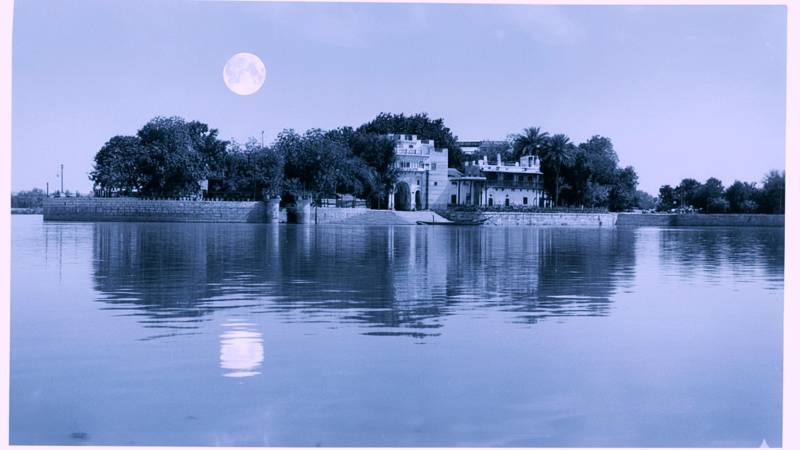
That night, under a full moon in the month of chet, I saw Sadh Belo. It was Saturday, 17 March 1995—the 1st of chet in the year 547 of the Sindhi calendar. To define that experience is impossible. Instead, I can only describe it as ecstatic and mesmerised—honestly, these two words barely capture what was so deeply felt. It is an experience that cannot be retold or rewritten; it must be lived. If a reader wishes to truly understand it, they must be at Sadh Belo on a full moon night in chet.
I was initially granted permission to visit on one condition: I had to leave the island before sunset, the time of puja. I agreed but soon gained the trust of the local caretakers. They allowed me to stay and assured me that after the puja ended, the boat would carry me back to the bank of the Indus River, to a patan (local river port) located in front of Sadh Belo.
My old notebook’s one entry about that night reads:
“The moon, a silent witness, lifted itself from the eastern edge of the horizon, bathing the island of Sadh Belo in a silvery light. Under its gentle glow, the ancient temples stood in meditation. As the orb climbed higher, their long shadows began to shrink, but their graceful shapes remained. The air was filled with the soft whisper of the Indus as it flowed by and the lonely, urgent cry of a lapwing. In that stillness, one could feel old buildings’ breathings murmurs. Perhaps, their gentle presence waits for a sympathetic soul to hear their timeless story.”
My trip came from the kind help of my friend Nazir Ujjan. I had notes and old clips, but other tasks kept me from my goal to write. My old habit of putting things off did hold me back, but this time, I beat it. I still wonder why a scene from so long ago still lives in my mind. Perhaps, some places exude a vibrant energy, drawn from their stunning locations and sacred nature. I believe Sadh Belo is one such place. You need no special gift to feel its grace. Just to be there makes you part of its beauty, where its walls meet the soft Indus, birds have sweet voices, and the air holds a holy song.
Now the Evacuee Property Trust Board tends to Sadh Belo, even though the void left by the Udasi mahants after the Partition still lingers
That night, a person stood before me. I could not see who he was—a sadu or yatri. He watched the moon rise and spoke soft words that I did not hear. His body held a deep and calm grace. He was less a man and more a living part of the old stone walls and the hushed riverbanks of Sadh Belo. In the grace of that devout man, I saw the very soul of Adal Soomro’s Sindhi poem made real.
ساڌٻيلي جو پوڙھو ساڌو سوچي ٿو
وڻ ٿا سوچن آخر ڇاھو سوچي ٿو
(An old sadhu of Sadh Belo thinks,
And the trees dream the thoughts he thinks.)
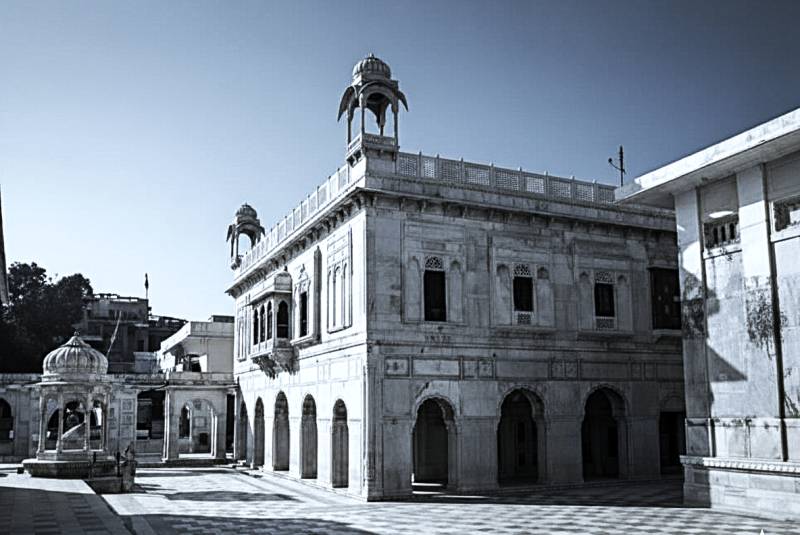
Allow me to introduce Sadh Belo. It is an island located in Sukkur, approximately 250 kilometres north of Karachi. When the city’s name ‘Sukhur’ is mentioned, many people may think of the Masjid Manzilgah incident, or of Sadh Belo itself that is situated on an island in the Indus River. Sadh Belo is complex of darbars and halls. It belongs to the Udasi sect, founded by Baba Sri Chand, the eldest son of Guru Nanak, after his passing in 1539 CE. The Udasi path teaches detachment from material wealth and family ties, with a focus on inner spirituality and self-realisation. Its followers travel extensively to preach the fundamental messages of Sikhism: the oneness of God, the equality of all humans, and truthful living. As a syncretic group, they aimed to bridge differences among various religious communities, especially Hindus and Muslims. However, the sect’s unique form of monasticism, which included the worship of Hindu deities like Shiva, Vishnu, Surya, and Ganesha, made them unique among other sects.
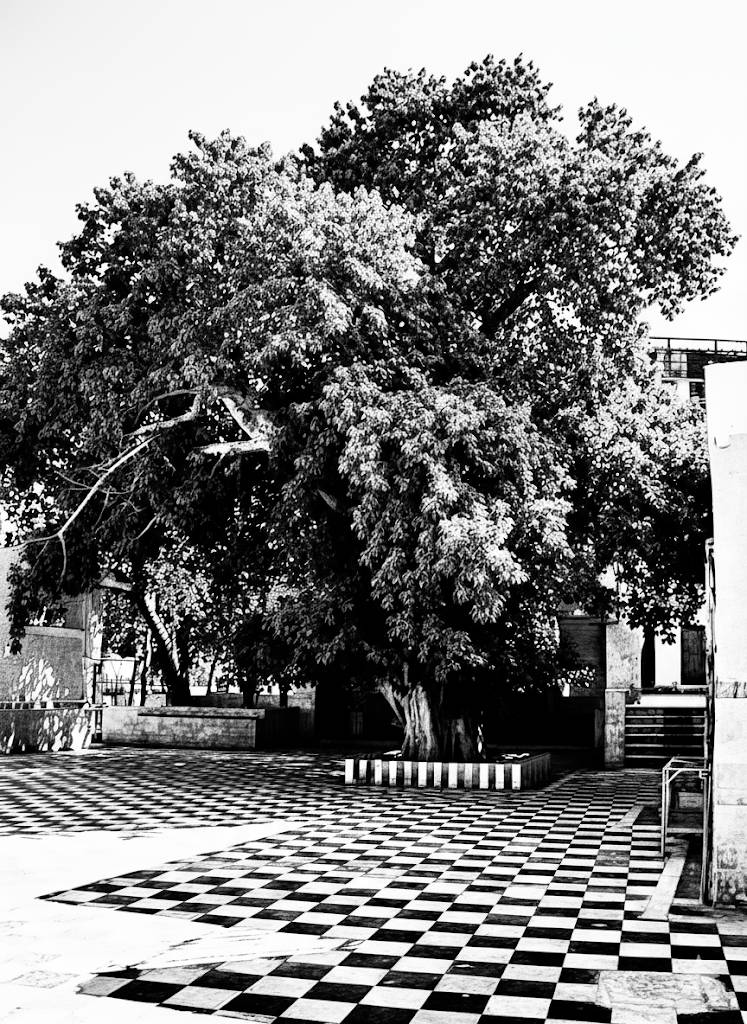
In 1823, Baba Bankhandi made the temple at Sadh Belo. When he arrived, the island was a thick forest. He liked its peace, so he lit a sacred fire (doheen) to claim it as his home. A story says the goddess Annapurna gave him a pot. This pot made sure the kitchen always had food. The main Darbar was built in 1889. It was made of Jaipur marble. The building has carvings of Hindu gods and saints. One panel shows hell with seven fiery realms. Another shows a peaceful heaven. Three scenes above show the god Vishnu. He is a fish, saving holy books. He also saves an elephant from a crocodile. New shrines were built over time, each housing both the Guru Granth Sahib and the Bhagwad Gita.
Historically, there were various spellings and ways of writing island’s name. It was written as: ‘Sadhu Belo,’ ‘Shree Sadh Belo,’ ‘Shree Sadhbella Tirth,’ and ‘Sadh Belo.’ However, the Gazetteer of the Province of Sind ‘B,’ Volume III, Sukkur District [JW Smyth, 191] spells it as ‘Sadh Belo.’ Afterwards, it is written as it is spelled in the gazetteer. The island features two inlets, Sadh Bela and Din Bela, and is officially marked on maps dating back to 1893-4. A survey in 1912 confirmed its area to be 629 acres.
The Udasipanth spread to various parts of India, with Maharaja Ranjit Singh playing a major role in its outreach. However, the Udasi sect’s influence began to decline toward the end of the 19th century due to the rise of puritanical movements like the Singh Sabha Movement and its political wing, the Akali Dal. One of these groups’ aims was to seize control of Gurudwaras managed by the Udasis, or other factions which they eventually achieved with the passage of the Sikh Gurudwara Act of 1925. This legislation placed all Gurudwaras under the control of the Sikh Gurudwara Prabandhak Committee, a move that severed the Udasis’ direct link with the community and severely affected their ability to spread their teachings.
Despite this turbulent period, services at the Sadh Belo complex continued without interruption until the Masjid Manzilgah issue surfaced in 1939-40. Prior to the Partition, Sadh Belo's resources were so regular that it served three daily meals to between 900 and 1,000 pilgrims, including 300 Sadhus. An undated leaflet, titled A Short Account of the Ideas and Growth of Shri Sadhbella Tirth, Sukkur, states that a Kumbh Mela should be held at Sadh Belo, on the banks of the Indus River. The leaflet argues that in earlier times, the Kumbh Mela used to be held on the banks of the Indus, and that such gatherings came to a stop with the spread of Buddhism. It further states that the Indus is a mightier river compared to the Ganges, the Yamuna, and the mythical Saraswati. The leaflet notes that Hindu sacred books were authored on the banks of the Indus and that Sadh Belo already hosts similar religious congregations. However, the document does not clarify whether the author and supporters of the idea wanted the Kumbh Mela to be held only at Sadh Belo or it should be included as a fifth location alongside Haridwar, Ujjain, Nashik, and Prayagraj. This leaflet clearly establishes the importance of Sadh Belo and confidence of the mahant and his devotees in proposing and organising such a great event.
However, the Partition, altered the scene. So many Sindhi Hindus migrated to India, which even challenged the survival of Sadh Belo. The complex faced three major difficulties: the number of pilgrims and donations diminished, the Sindh government and federal departments showed a hostile attitude with police raids, and visitors, many of whom were migrants, began to treat the sacred site as a mere tourist spot rather than a holy place.
These challenges, however, ran counter to the spirit of the Inter-Dominion Conference, held on 19 September 1947, in New Delhi. At the conference, both India and Pakistan pledged to preserve and safeguard the sacred sites of all communities, even if they were left vacant. However, a chronology based on newspaper reports and archival documents regarding Sadh Belo shows that the government failed to uphold the spirit of the Delhi Conference.
The first grievous blow Sadh Belo faced was on 19 November 1948, when police raided the temple. During the raid, cash and other valuables were stolen, and sacred books and deity idols were desecrated. In response to this injustice, Shri Harmandas, the mahant of Sadh Belo, swiftly wrote to India’s Ministry of External Affairs, detailing the raid and the defilement of holy objects. The matter was further complicated on 23 January 1949, when the Governor of Sindh visited the site and a controversial remark was made, either by the Governor himself or a member of his team. The statement claimed that the island’s secondary inlet, Din Belo, was linked to Emperor Akbar’s Din-e-Ilahi, though revenue records only recognised Sadh Belo. This statement was widely publicised, appearing in the Sindh Government’s Sindhi bulletin, Itla’t Sindh (Sindh Governments’ Notices) and later in a Bombay-based Sindhi newspaper, which raised suspicions among devotees about the government’s intentions.
Due to these events and the overall uncertain situation, the migration of Sindhi Hindus continued. It made difficult for mahants to sustain services at Sadh Belo. On 29 May 1949, with a heavy heart, bawa Ganeshdas wrote to the Indian High Commissioner in Pakistan, highlighting a drastic drop in devotees and revenue that threatened the temple’s operations. He urged Pakistan’s government to provide financial support, citing India’s aid to sites like Ajmer Sharif. The overall situation was so depressed and the sudden drop in financial resources left the sadhus stationed at Sadh Belo with no other option but to leave. In this desperate situation, Ganesh met the Chief Secretary of the Government of Sindh on 9 October 1949, and informed him that most of the sadhus wished to migrate to India. Thus, he had no option but to request the Commissioner of Sukkur to take possession of the complex. Afterwards, he formally requested the Sukkur Commissioner to assume management of Sadh Belo on 22 October 1949. The crisis deepened when, on 3 November 1949, India’s Ministry of External Affairs documented a conversation between the Indian High Commissioner in Karachi and Honourable Ghulam Muhammad. The discussion revealed that 40–50 mahants and sadhus had evacuated Sadh Belo due to relentless police harassment, leaving its vast movable and immovable properties to the Custodian. Ghulam Muhammad promised to raise the issue at the appropriate forum for a resolution.
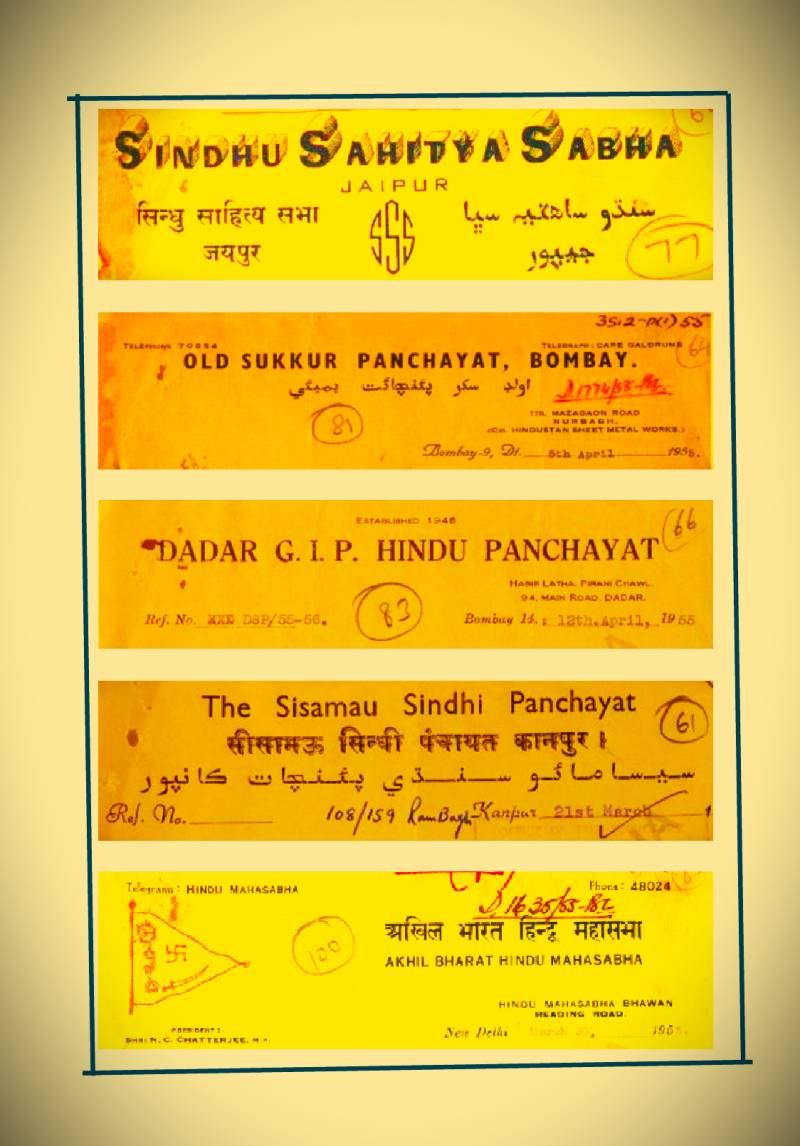
In such uncertain situation, Sadh Belo calmly continued its activities. But, on 9 February 1953, Dawn reported that Sukkur’s Collector, Nusrat Hussain, planned to transform Sadh Belo into an art and cultural centre, akin to Bombay’s Elephanta Caves, while assuring the protection of Hindu sacred spaces. This proposal, part of a broader plan including a boat club, stunned Sindhi Hindus in India, who saw it as a grave threat to the temple’s sanctity. In response, protests erupted across Indian cities. After the 1947 Partition, many Sindhi Hindus who migrated to India quickly formed community organisations. These groups often brought together people from the same city or town in Sindh. However, some associations were also founded based on shared political views, a common religious sect, or devotion to a specific guru.
These organisations played a leading role in protecting the religious sanctity of Sadh Belo. On 16 March 1955, the Sindh Refugee Panchayat in Gwalior, led by Ramchand Wadhumal, demanded assurances from India’s Rehabilitation Ministry to preserve Sadh Belo’s sanctity. The following day, 17 March 1955, the Sindhi Hindu General Panchayat in Chawri Bazar, Lashkar (Gwalior), under Seth Balchand, and the Sind Hindu Panchayat in Agra, presided over by Shri Bulchand Rajpal, echoed this demand. On 20 March 1955, the Sisamau Sindhi Panchayat in Kanpur, led by Mukhi Dayaldas, condemned the Collector’s plan as an affront to Sindhi Hindu sentiments, urging Pakistan’s government to uphold Sadh Belo’s sanctity. Similarly, the Sindh Wholesale Cloth Association in Indore, under Kashi Ram, and the Delhi Sindhi Brother Mandal, led by Dipachand and Dayano Mal, pressed India’s government for action. On 15 April 1955, the Old Sukkur Panchayat in Bombay joined the outcry, calling for Sadh Belo’s protection.
Sadh Belo, through all these trials and controversial proposals of the Government has survived. Now the Evacuee Property Trust Board stewards Sadh Belo and tends it, even though the void left by the Udasi mahants after the Partition still lingers.
Thanks God! In a world of narrow politics and communal fear, the enduring spirit of Sadh Belo stands as a powerful testament. This sacred island remains a beacon of memory, where the sacred doheen still burn. The aroma of incense purifies the mind, and the stillness of the space calls to us. It is a timeless invitation to seek the divine along the ceaseless flow of the Indus.