

Long before I was an engineer, I owned a Jundar, a centuries-old water-powered flour mill, in a remote village of Murree. It sat beside a fast-flowing mountain stream and ground grain with nothing but water and gravity, no electricity and no fuel. Before school each morning, I stood watching that wheel turn and wondered how its energy could become light for our homes. That question shaped my life. At Engineering University Lahore, it became an obsession, and it is why the flooding of Tarbela 5 feels to me like a personal loss.
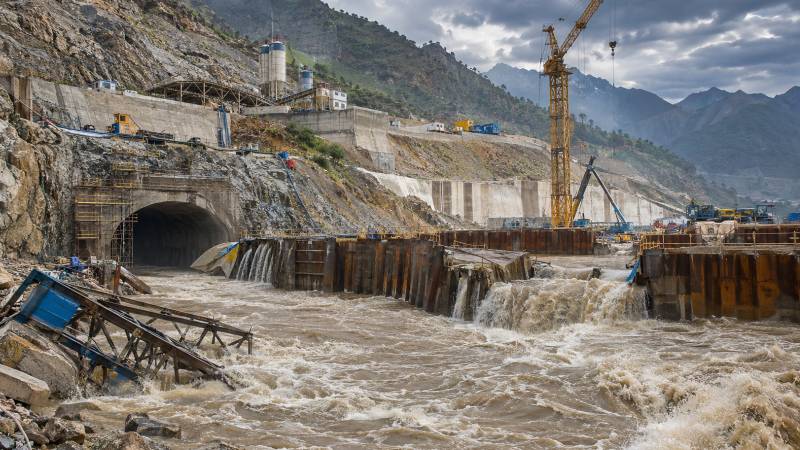
I have spent my working life believing that hydropower is the most honest form of energy Pakistan has: it is our own, it is renewable, and it is built to last a century. So when water poured into Tunnel 5 and the powerhouse area of the Tarbela Fifth Extension on 9 November, it did not feel like a news item. It felt like a death in the family.
I have worked as a consultant too, and I carry one rule from that work. I treat every project as a patient in the intensive care unit. You do not walk past the bed, sign the chart and leave. You watch the vitals, you question every change in treatment, and you tell the family the truth even when it is uncomfortable. A consultant's first duty is not to the contractor who wants approvals or to the firm that wants fees. It is to the client and, through the client, to the public. Judged by that standard, what has happened at Tarbela 5 is hard to watch.
Let me say plainly what hurts most. This project has now flooded twice in fifteen months. Its cost has climbed from Rs82.36 billion to Rs316.41 billion, an increase of 284 percent. A nation that cannot clear its power-sector circular debt is being asked to absorb that, and the public is entitled to ask who is accountable.
I want to be careful, because anger is not evidence. The August 2025 cofferdam collapse was not an act of God. A three-member government inquiry found that river flows were within Tarbela's historical range and well below design capacity. Flooding did not break the structure. The structure was not what it should have been.
According to the inquiry's findings, the contractor proposed replacing the approved design with a rock-filled cofferdam that the contract did not allow. The supervising consultant accepted the deficiency conditionally, without ensuring technical compliance. WAPDA then approved the change late in construction, without checking its contractual or technical risks. That is three links in one chain, and every one of them failed.
There is more. In July 2023, WAPDA asked for a performance review of the cofferdam. The consultant passed that request to the contractor instead of assessing it independently, and the report arrived only in October 2024. Asking the builder to grade his own homework is not supervision. In my ICU analogy, it is asking the disease to write its own diagnosis.
WAPDA later terminated the consultancy, citing the lack of a qualified project manager and continuing staffing problems. Payments had been made for temporary rather than permanent works, which weakens the state's ability to claim compensation. Consultancy costs, meanwhile, rose from Rs1.8 billion to more than Rs19 billion in the revised PC-I. The Planning Minister criticised that figure and then approved it anyway. A criticism that ends in approval is not oversight.
The Auditor-General's observations deserve equal attention. The Rs3,269.700 million replacement consultancy of 9 September 2024 went to MM Pakistan by direct selection, with no recognised emergency. Audit notes that key-expert criteria were lowered, from 1,000 MW experience to 500 MW and from seven years to three, and says the criteria appear tailored to suit specific consultants. The audit also records the PEC Chairman as co-owner of the firm and calls this a conflict of interest. No reply from him is recorded.
If criteria can be lowered to fit a bidder, if a consultant can pass a safety review to the contractor, and if WAPDA can approve a late design change without a risk check, then replacing one consultant solves nothing. The same gaps will swallow the next one.
I must be fair, as a professional should be. These are audit observations, disputed or unanswered by management, not court findings. Professional negligence is a legal conclusion that only a court, tribunal or formal inquiry can reach, and no such finding against MM Pakistan exists in the public record. Nothing I have seen establishes that the PEC Chairman influenced the award or broke any law. Nor can we say the consultant alone caused the cofferdam failure.
But "not proven" is not "nothing to see." A client who pays a heavy fee is buying one thing above all: honest, professional advice, especially when that advice is unwelcome. On the record as it stands, I do not believe WAPDA received it. A consultant that conditionally accepts an unauthorised design change, hands a safety review request to the contractor, and cannot keep a qualified project manager on site has not given its client the candour the fee was meant to buy. In my view, on the combined record, the supervising consultant carries the primary professional responsibility for what went wrong in 2025. Whether that amounts to legal negligence is for a tribunal to decide, and I say so deliberately.
The 9 November incident calls for the most restraint. WAPDA says weak rock mass collapsed during excavation of the second-bench connecting tunnel. But I will not pretend to know the cause. Anyone who announces one within days, whether to defend WAPDA or to condemn the consultant, is speculating. Rock mass behaviour is exactly why geological data, investigation records and design-basis documents exist, and whether they were held and used is a question for documents, not rumours.
So what should Pakistan do? First, commission an independent root-cause review, led by engineers with no stake in the outcome and given full access to design records, change approvals, correspondence, geological data and payment files. Publish it. Burying inquiry reports in drawers is itself a risk to the next project.
Second, fix the system, not only the firm. If criteria can be lowered to fit a bidder, if a consultant can pass a safety review to the contractor, and if WAPDA can approve a late design change without a risk check, then replacing one consultant solves nothing. The same gaps will swallow the next one.
Third, answer the conflict-of-interest question openly. The Auditor-General has recorded it. The PEC Chairman has the right to reply, and the public has the right to hear the reply. Silence helps nobody, including him.
Fourth, protect the state's right to recover money. Payments for temporary works have already weakened the compensation position. Before another rupee moves, the Ministry of Water Resources and the Planning Commission should take legal advice on what can still be claimed, and from whom.
Fifth, honour the engineers. Pakistan has outstanding hydropower engineers who have worked in hard conditions at Tarbela, Mangla and Ghazi-Barotha Hydropower Project for decades. They are not the problem. The problem is a procurement and oversight culture that too often rewards proximity over competence.
I do not write this to settle scores. I write it because Tarbela is not just a project. It is a promise that this country can build something enormous, safely and honestly, that will serve our grandchildren. A cost increase of 284 percent and two floods in fifteen months are not merely accounting problems. They erode that promise.
The easy path is to find one villain, terminate one contract and move on. The more difficult course is to acknowledge that accountability rests with the consultant in accordance with FIDIC regulations, as adopted by the Pakistan Engineering Council (PEC). That is the path I urge. The water that flooded Tunnel 5 will recede, but if we do not learn from it, it will come back.