

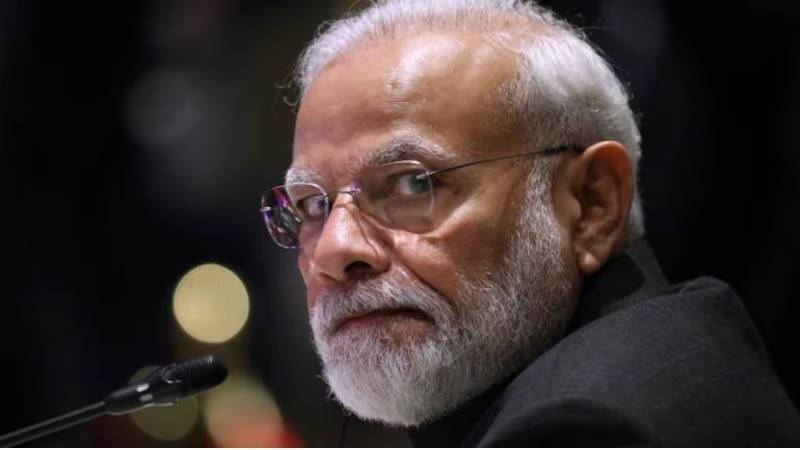
One question - just one - posed by a Norwegian journalist to India’s visiting prime minister has triggered a political and media meltdown that says far more about the state of Indian democracy than any official government statement ever could.
The episode should have been routine. A journalist doing her job. A world leader is being asked to answer. Instead, it turned into a revealing spectacle of evasion, intimidation and institutional insecurity.
India’s prime minister has now spent twelve years in office without holding a single formal press conference. Zero. In any functioning democracy, that alone would be alarming. Previous Indian prime ministers faced the press regularly, often under intense scrutiny. Press conferences are not ceremonial obligations; they are among the most basic mechanisms through which elected leaders are held accountable.
But accountability appears to have become an unacceptable inconvenience.
During an official visit to Norway - a country consistently ranked among the freest in the world for press freedom - the Indian prime minister was approached by a Norwegian journalist attempting to ask a question. Rather than engage, he simply walked away.
That should have been the end of a mildly embarrassing news moment.
Instead, it became something much bigger.
The journalist later attended a press briefing organised by the Indian embassy in Oslo. There, she asked a direct and legitimate question: Why should India be trusted?
It was not a hostile question. It was not an unreasonable question. It was precisely the kind of question journalists are supposed to ask.
The response from India’s senior diplomatic representative, Sibi George, Secretary in charge of Europe and North America in the Ministry of External Affairs, was extraordinary - not for its clarity, but for its complete absence.
Rather than answering, he launched into a lengthy and meandering monologue about India being a 5,000-year-old civilisation, about its constitution, and about how women in India can seek justice through the courts.
The Norwegian journalist accomplished what much of India’s own media no longer seems willing - or able - to do
It was a textbook exercise in political deflection: substitute mythology for accountability, symbolism for substance, and national pride for an actual answer.
Social media quickly did what the official response could not withstand: it laughed.
The clip spread rapidly and was widely mocked - not just internationally, but by many Indians themselves. The embarrassment was obvious. A senior diplomat had been asked a straightforward question and had delivered a rambling, defensive answer that satisfied no one and, if anything, raised more doubts.
What happened next was even more telling.
India’s mainstream television channels - many of which now function less as independent media institutions and more as extensions of political messaging - sprang into action. But instead of examining why their prime minister refuses to answer questions, or why a senior diplomat failed so publicly, they focused their anger on the journalist.
Entire broadcasts were dedicated to attacking her.
She was accused of bias. Her motives were questioned. Her professionalism was smeared. She was portrayed not as a reporter doing her job, but as an adversary daring to challenge India’s leadership.
This was not journalism. It was damage control masquerading as patriotism.
At the same time, India’s notorious online political machinery - the BJP’s IT networks and associated troll armies - appeared to mobilise.
The Norwegian journalist became the target of coordinated abuse online. She was denounced as a foreign agent. She was harassed relentlessly. Then came an even more disturbing development: she announced that both her Meta and Instagram accounts had been suspended, leaving her unable to access them.
While the exact reasons remain unclear, the likely explanation is obvious. Mass reporting by coordinated trolls can trigger automated platform suspensions, effectively silencing individuals through digital mob pressure.
If that is what happened, it represents a deeply troubling evolution in political intimidation: using online swarms to suppress journalists beyond national borders.
And this, perhaps, is the central lesson of the entire episode.
India often presents itself as the world’s largest democracy. But democracy is not measured by election size alone. It is measured by tolerance for scrutiny, by respect for dissent, and by the willingness of leaders to answer uncomfortable questions.
What does it say about a democracy when its prime minister cannot - or will not - face a single unscripted question in twelve years?
What does it say when a foreign journalist, on her own soil, is effectively prevented from getting an answer? What does it say when the response to journalistic inquiry is not transparency, but vilification?
And what does it say when a nation’s media closes ranks to attack the questioner rather than interrogate power?
The fragility on display was unmistakable. Strong democracies do not fear journalists. Secure governments do not need armies of television anchors and online trolls to defend them from a single reporter.
Only insecure systems react this way.
What unfolded in Oslo was not merely an embarrassing diplomatic episode. It was a rare, unscripted glimpse into how power increasingly operates in India: evade scrutiny, weaponise nationalism, mobilise outrage, and punish dissent.
Ironically, the Norwegian journalist accomplished what much of India’s own media no longer seems willing - or able - to do.
She asked a question.
And in the reaction that followed, India answered it.
And that answer laid bare all of the hypocrisy and sham façade upon which India’s so-called democracy and respect for its own constitution rest.