

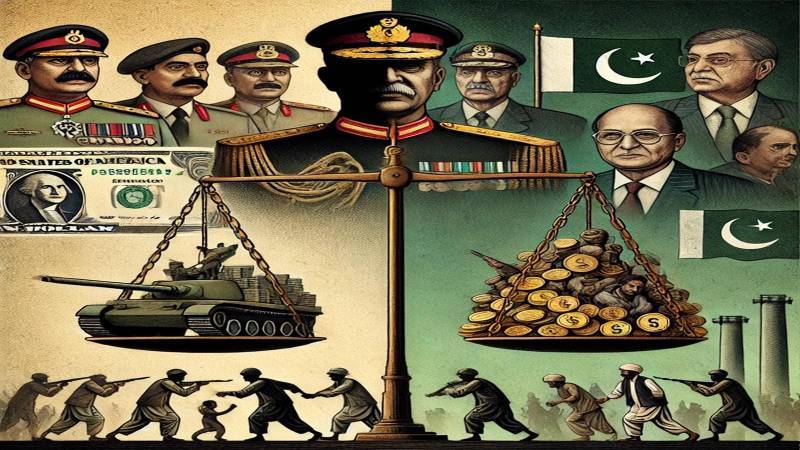
The World Bank Fame Pakistani economist, Shahid Javed Burki wrote a piece for a local newspaper on August 31st, 2004, titled “Growth, poverty & politics”. In this piece, he gave very interesting facts and figures about how different civil and military governments fared in reducing poverty and inequalities. According to him, the 11-year rule of military dictator General Zia-ul-Haq stands out as one of the most successful governments in our history whose economic policies reduced poverty headcount in the country by 11 million. In contrast, the Bhutto era added six million to the poverty headcount if we compare his rule with that of 1969—the last year when military dictator General Ayub Khan was in power.
Shahid Burki noted in the piece that the Zia period not only saw a sharp pick-up in economic growth, it also witnessed Pakistan's second green revolution, but this time also centered around increasing production and productivity of cotton, the country's main cash crop, “Since cotton is grown in the areas that were poorer to those producing rice and wheat, there was a tremendously positive impact on the incidence of poverty of this development” reads his piece in Daily Dawn, “The Zia period ended in August 1988, with his death in an air crash. At that time Pakistan had a population of 97 million, of which about 18 per cent or 17 million were poor. This was a remarkable development. While the size of the population in these 11 years increased by 25 million, the number of poor declined by 11 million”.
If we trust Shahid Javed Burki’s figures, the whole theory of popular political leaders emerging in the post-Zia period because they ruled the hearts of Pakistani masses on account of their pro-poor policies, comes crumbling down. When Zia died in a plane crash on August 17, 1988, he assumed the status of one of the most hated figures in urban Pakistan of his time. Zia’s hate figure status was later confirmed by the results of the parliamentary election that followed his death. ISI’s involvement in those parliamentary elections to defeat or at least neutralise Benazir Bhutto’s popularity in Pakistani society is a well-known fact.
The question is if Zia, through his economic policies, lifted 11 million above the poverty line during his 11-year rule, then why was he a hate figure? Why Benazir Bhutto was the most popular figure in Pakistan at the time of Zia’s plane crash when she had yet to prove her mettle in governance. She was a political novice when she led the PPP into election victory in 1988. And PPP's previous tenure in office was not at all a glorious success in eradicating poverty from Pakistani society. 11 million is a huge figure and lifting so many people above the poverty line is no small feat that can escape the eye of the masses. 11 million people becoming relatively affluent is something that would have been reflected in the social and political life of society. Then why Zia-ul-Haq was the hate figure and did Benazir Bhutto emerge as a “prince of hearts” in 1988? One explanation could be that Zia’s legacy continued in the post-1988 period as consolidation of a conservative vote bank, which was captured by Nawaz Sharif, who, in those years was still claiming to be linked with Zia’s legacy and was pretending to be champion of ultra-right-wing politics that military strong man founded and pursued.
During the 11 years of civilian rule starting from 1989 till 1999, the incidence of poverty had climbed back to 36 percent of the population
Then what explains Benazir Bhutto’s charisma? I remember firsthand witnessing the welcome she received in Lahore in 1986—it was electric, and I vividly remember how there was talk of the military junta’s panic over this welcome. I was a student in Lahore in those days and I took a ride on my motorbike to the Lahore mall—From Data Darbar to Lahore Old Airport, it was jam-packed. Perhaps Benazir’s tragic political career explains her rise and her political charisma. Her father was hanged, her family was forced out of the country, and she spent exile years in London after spending many years in Zia’s prison. She did not submit before the military Junta, and she continued to resist while she was inside the country and after that during her exile years. Perhaps Pakistanis are attracted to those who resist power more than the powers that be themselves. This fact of Pakistani political history is attested twice in the later years—first when Nawaz Sharif resisted the military-backed president, Ghulam Ishaq Khan in 1993 and through this act transformed himself into a popular leader and second time when Imran Khan took on the military leadership after his removal from power in 2021 and this time too the resisting leader transformed himself into a popular political leader.
However, all this doesn’t explain why the rise of popular political leaders like Benazir Bhutto and Nawaz Sharif—leaders who ruled the hearts of common and poor people in our society—in the post-Zia period. In the post-Zia period when Benazir and Nawaz Sharif started to take turns becoming the prime ministers of the country, Pakistan’s economic growth took a nosedive and poverty increased manifold if we compare the democratic period with the 11 years of military rule that preceded it. During the 11 years of civilian rule starting from 1999 till 1999, “the incidence of poverty had climbed back to 36 percent of the population. Since the population increased to 131 million, the number of people living in poverty reached 47 million” Shahid Javed Burki writes in his abovementioned piece, “The size of the poverty pool began to increase at the rate of 10 percent a year, or at a rate four times the growth of population. This is when the military returned to power under General Pervez Musharraf in October 1999. On the eve of Pakistan's fourth military rule, the country was faced with an extreme crisis of poverty”.
The question is how and why Pakistani masses perceived Benazir Bhutto to be pro-poor when she had no experience in governance. When she came to rule in 1988 and was followed by her rival, Nawaz Sharif in the prime minister’s office—the economic performance of both these civilian rulers was pathetic. Pakistani economists say that the gains made in reducing poverty during the 1970s and 1980s were reversed during two tenures of Benazir Bhutto and two tenures of Nawaz Sharif till 1999—when the civilian experiment was cut short with the advent of another military government.
We must search for other factors behind Benazir Bhutto’s Charisma and Nawaz Sharif’s popularity in the post-Zia period, primarily because both of these leaders did not do anything to attract the attention of the Pakistani poor. During the Zia period, the print media, the only kind of media that was there at the time as social media and electronic media, were decades away—was heavily censored. There was no chance or no medium through which Benazir Bhutto could have portrayed herself as a champion of the poor while sitting in exile in London. In the post-Zia period when she became the Prime Minister the economic performance of her government was pathetic and the poverty headcount increased during her tenure. Nawaz Sharif, on the other hand, never claimed to be the champion of the poor's cause—he represented the interests of the Punjabi middle class and big industrialists and traders.
The theory that Benazir Bhutto, or Nawaz Sharif for that matter represented the Pakistani poor is standing on a false premise. This theory seems to be the invention of the crafty media managers of Benazir Bhutto and Nawaz Sharif. A more plausible theory would be that both these leaders were perceived by Pakistani masses as challengers of the military Junta and military-backed President respectively—the two most powerful actors on the political stage in the post-Zia period. Both Benazir Bhutto and Nawaz Sharif entered into extremely anti-poor Loan agreements with the IMF and World Bank based on Structural Adjustment that broke the back of the Pakistani poor in the 1990s. And yet both these leaders were elected prime ministers even after the IMF programs had negatively impacted the poor in society.
Running pro-poor policies does not make you a popular political leader in Pakistani society. And you can still retain your popularity even after you have signed anti-poor agreements with foreign donor agencies
We can safely conclude that running pro-poor policies does not make you a popular political leader in Pakistani society. And you can still retain your popularity even after you have signed anti-poor agreements with foreign donor agencies. Even a cursory look at the poverty figures of the last five decades will make you conclude that we need to discover some factors behind Benazir and Nawaz Sharif’s popularity, other than the political rhetoric of their parties’ propaganda machinery that they had been the champion of the cause of poverty. We also need to inquire into the decision-making processes during Benazir Bhutto’s two tenures in office when she signed anti-poor loan agreements with the IMF and World Bank. What compelled her to endanger her popularity by signing an anti-poor agreement with the IMF? Maybe, she was too sure about the durability of her popularity when she wholeheartedly embraced the neo-liberal economic agenda of the West during her first and second tenures. The same is the case with Nawaz Sharif.
Then there is another twist in the story. Benazir Bhutto lost the 1997 elections after the full weight of the IMF-sponsored Structural Adjustment program was carried out during her second tenure in office, leading to an increase in poverty headcount. Similarly, Prime Minister Shehbaz Sharif’s first tenure in office witnessed a substantial increase in petroleum prices after the IMF forced him to withdraw subsidies and this led to erosion of PMLN’s popularity in Central Punjab, its stronghold. From 1993 till 2013 Punjab middle classes wholeheartedly supported Nawaz Sharif and his party. But under the economic hardship unleashed by the IMF program Punjabi middle classes parted company with PMLN. Is it possible that in the times of social media people feel their economic plight more intense?
People are introduced to the tool of social media as an apparatus through which they acquire a mechanism to perceive the collective misery of people. Thus, show harsher reactions as they did when they voted overwhelmingly in favor of Imran Khan’s party which led to a rout of PMLN. Does this mean that social media has transformed the dynamics of our politics? Any political leader going against the interests of the public cannot escape public eyes now? Or is it simply that good social media teams can win your elections and popularity?