

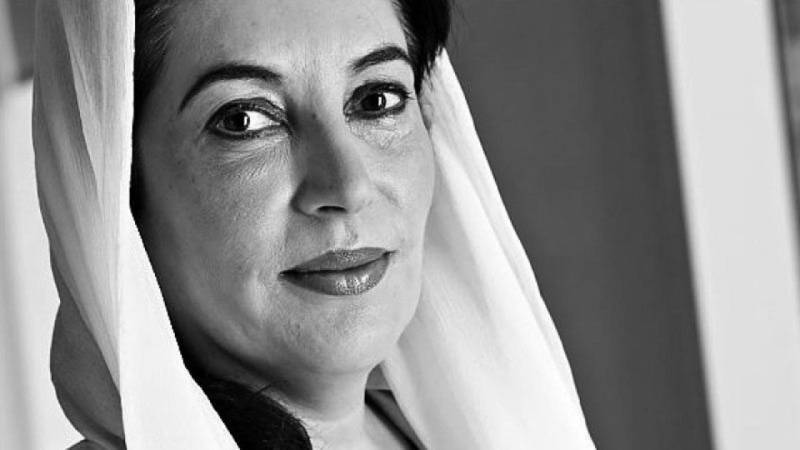
My connection with her story began just weeks after her father, Zulfikar Ali Bhutto, was overthrown by General Zia-ul-Haq on 5 July 1977. As Secretary General of Karachi’s inter-collegiate body—a coalition of elected student union leaders—I joined the Pakistan Peoples Party (PPP) as a form of protest against martial law. Karachi had played a central role in the movement against Bhutto. So, when a group of student leaders decided to side with the PPP, it made the news.
Word reached Bhutto. We were invited to meet him on 3 September 1977. That meeting took place in the afternoon. A few hours later, in the early morning of 4 September, he was arrested from his house at 70 Clifton. His arrest galvanised the workers. They were ready to resist Zia. But something about the senior leadership of the party felt off.
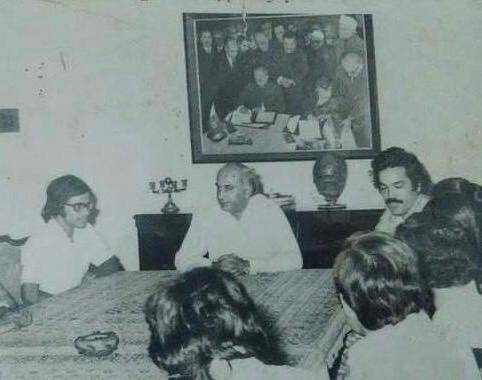
The author is on the right in the photograph taken with Zulfikar Ali Bhutto on 3 September 1977
Sometime in early 1978—before the Lahore High Court sentenced Bhutto to death—I remember sitting at Kamal Azfar’s house, not far from the Abdullah Shah Ghazi shrine. It was a casual gathering after a senior PPP meeting at 71 Clifton. Present were people like Sahibzada Farooq Ali Khan and Malik Meraj Khalid. Kamal Azfar told us a shopkeeper had asked him, “When is our Bhutto sahib coming back from jail?” Farooq Ali, a seasoned politician and former Speaker of the National Assembly, replied in a tired tone, “Tell them to forget Bhutto sahib.” It was clear that some senior leaders already knew the outcome.
Among younger activists, frustration was growing. The leadership didn’t seem willing to confront the regime on the streets. Bhutto had nominated Sheikh Rasheed, the party’s senior vice chairman, to lead in his absence. But Rasheed proposed that Nusrat Bhutto take charge instead, believing the party would remain more united under her leadership.
She embodied a blend of her father’s idealism and the post-Cold War pragmatism, driven by a desire to uplift the poor and guide Pakistan toward stability
Benazir was just 25 then. She had returned from her studies in 1977 and wasn’t seeking a political role. But as trust in leaders like Ghulam Mustafa Jatoi, Kausar Niazi, and Mumtaz Bhutto eroded, the rank and file began to look to her and her mother. That’s how her political journey began—not by choice, but by circumstance.
My first meeting with Benazir happened around early 1978. I was organising protests in Karachi. Many of us had stopped looking to the senior leaders for direction. When I was introduced to her, I brought up something she thought was sensitive. She took me outside, onto the front lawn. She sat on the grass, motioned for me to sit, and asked questions. She came across as one of us—young, serious, and without airs. That moment stayed with me.
I met her several times over the next few years, until I left Pakistan in the spring of 1981. Our last meeting before I left ended with a written plan I gave her about forming a united opposition. I had no idea she took it so seriously—until the plan document was confiscated after her arrest. The regime spun it into a “conspiracy” and broadcast it on national television.
While I moved abroad to study, Benazir led the party. She became the face of resistance and, after the 1983 MRD movement, the clear opposition leader. We met again in 1988, after Zia’s death. I had returned to Pakistan, but was disappointed with her growing tilt towards the United States. I decided to stay away from politics. Still, I paid her a courtesy visit. There were many people around, most seeking election tickets. I didn’t expect her to remember me—it had been years, and I had changed. But she smiled warmly and said, “Remember the days we worked together?” I was honestly speechless. She asked about my work and mentioned a new policy planning group she was forming. I simply said I was glad she was back, and Zia was gone.
Over the years, I stayed in touch. She was always approachable. Even when in office—and even during the turbulent final weeks of her life—I could reach her when I needed to. Perhaps it was because I never asked her for anything, and she respected that. She didn’t hold grudges against those who disagreed with her, as long as they were sincere. She never forgot those who had stood by her during the hardest times. It was a reflection of her strength of character—a quality sorely missing in today’s leaders.
She was assassinated at 54. By then, she had matured as a leader. Some still argue her father would’ve lived had he not challenged Zia. Ironically, Benazir tried to reconcile. She even titled her book Reconciliation and tried to open a dialogue with the establishment. But that didn’t save her either.
She embodied a blend of her father’s idealism and the post-Cold War pragmatism, driven by a desire to uplift the poor and guide Pakistan toward stability.
In a June 8, 1999, New York Times article, she wrote:
“Recently, I met with Shimon Peres… and realised that the process of reconciliation now going on in the Middle East… may provide a replicable model for conflict resolution between India and Pakistan... For 50 years, we in Pakistan thought Kashmir had to be resolved before any normalisation... That approach may have been self-defeating.”
Only a popular and strong leader with a vision could have written those lines. As they say, she was the last of that breed.