

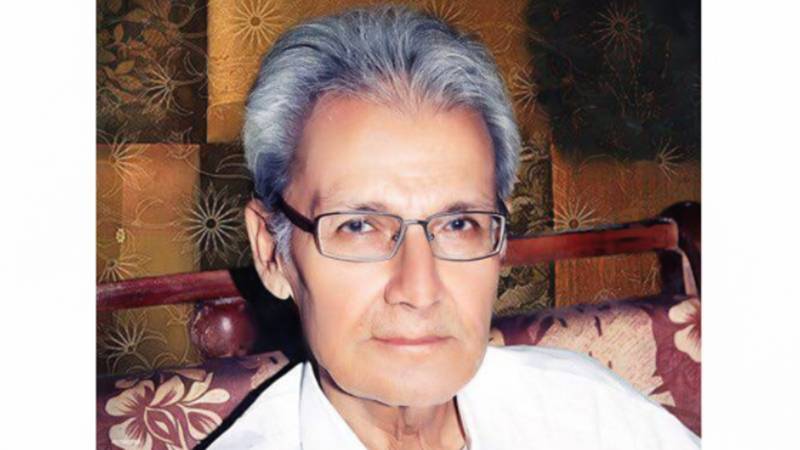
In the parched yet fertile soil of Sindh — where the Indus flows like history in motion, where poetry breathes resistance, and where truth often walks barefoot — emerged a man whose life redefined the meaning of struggle, sacrifice, and vision. Rasool Bux Palijo, one of Pakistan’s most formidable political thinkers, was not merely a man of ideas — he was a movement that marched on foot, bled in prison, wrote in fire, and lived with unflinching grace.
He was, at once, a lawyer, philosopher, historian, poet, activist, and revolutionary. But above all, he was a voice — a Latifian voice — that spoke for the voiceless.
Born on 20 January 1930, in the modest village of Mungar Khan Palijo in Thatta, he came from the peasantry but dreamed like a statesman. A keen student with a restless intellect, he pursued education with devotion and earned his law degree. But Rasool Bux Palijo never sought comfort in the corridors of legal privilege. He chose to walk instead with those who had no shoes, no voice, and no justice.
His education did not distance him from the people; it sharpened his weapon of thought. For him, knowledge was not for acquisition but for transformation.
A Political Ideologue, Not a Power Seeker
Palijo’s politics was never electoral cosmetics or dynastic inheritance — it was principled, deeply ideological, and fearlessly anti-establishment. In an era of shifting loyalties and political brokerage, he founded Awami Tehreek, a party rooted in grassroots activism, Marxist ideology, and Sindhi nationalism.
Far ahead of his time, Palijo recognized the power of women in revolution. He founded Sindhiani Tehreek, one of the earliest and most powerful women-led movements in rural Pakistan
He stood tall against the One-Unit policy, denounced General Zia’s dictatorship, and resisted feudalism and imperialist interventions with the boldness of a sage and the clarity of a revolutionary. His thunderous speeches in towns and villages weren’t mere political rallies — they were awakenings.
He did not speak to win votes. He spoke to liberate minds.
Fluent in Sindhi, Urdu, English, Persian, and Chinese, Palijo was a rare public intellectual whose activism was matched by an equally profound literary and scholarly contribution. He authored over two dozen books, each weaving together political insight, historical context, and cultural depth.
His classic, “Shah Latif and the Message of Revolution,” remains one of the most powerful reinterpretations of Sindhi Sufi poetry in the light of social emancipation. He transformed Shah Latif’s mystic verses into a revolutionary manifesto — decoding the metaphor, reclaiming the narrative.
His prison diaries, legal treatises, and political essays are part of Sindh’s intellectual heritage.
Far ahead of his time, Palijo recognized the power of women in revolution. He founded Sindhiani Tehreek, one of the earliest and most powerful women-led movements in rural Pakistan. Through it, thousands of women in villages and towns were empowered to become participants in political struggle, rather than passive observers of their fate.
He gave space and dignity to those who were deliberately kept invisible — and demanded a seat for them at the table of power.
A Life Lived in Prison — But Never in Defeat
Rasool Bux Palijo spent over 11 years in prison, often in solitary confinement. His only crime: refusing to kneel. Whether in the darkest jails of Hyderabad or the dungeons of Lahore, he remained unshaken. The bars could not restrain his mind. The chains could not bind his soul. His enemies feared him not for his weapons — he had none — but for his unyielding belief in people’s power.
He emerged from every prison stronger, more focused, more resolved.
The legacy of Rasool Bux Palijo is not etched on walls — it is alive in movements, manifestos, and moral courage. But his legacy was never meant to be inherited by bloodline, and he made that clear. In his later years, observing ideological deviations and personal ambitions, he consciously distanced himself from his son, Ayaz Latif Palijo, and formally withdrew political heirship from him.
Instead, he reaffirmed his trust in Awami Tehreek, the very party he had built from scratch — a party that continues to uphold his values: anti-feudalism, anti-imperialism, cultural preservation, class struggle, and the rights of Sindh.
Today, Awami Tehreek remains the ideological custodian of Palijo’s mission, organizing peasants, women, workers, and youth without compromise, without shortcuts, and without apology.
To speak of Rasool Bux Palijo is not to eulogize a departed hero — it is to remind ourselves that principles can still survive politics, and that revolutions can be gentle in spirit, yet unbreakable in conviction.
He did not seek power, he sought transformation.
He did not create followers, he created thinkers.
He did not die — he dissolved into the conscience of his people.
On this 7th anniversary of his passing, as thousands gather in Jungshahi, they are not mourning him — they are marching with him.
Rasool Bux Palijo was not the past. He is the unfinished future.