

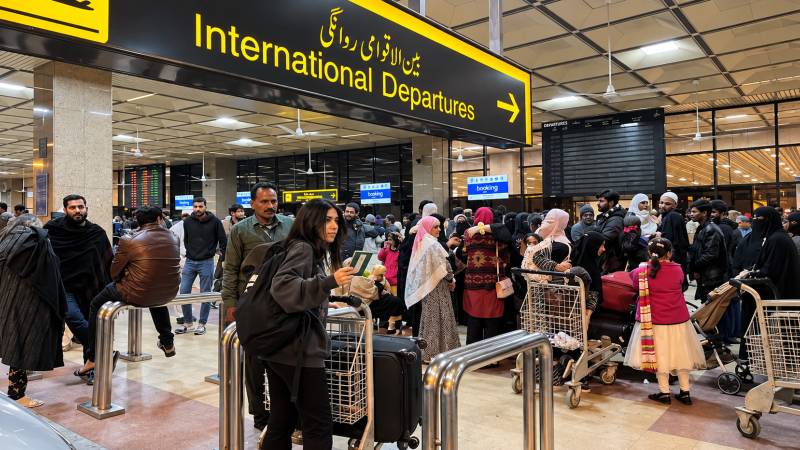
Growing up in Lahore, a beautiful, historic city, and attending Aitchison College’s boarding school, with its lush grounds and wonderful sports facilities, gave me a sense of belonging that distance has never diminished. The friendships we formed there have endured across countries and decades, connecting us to one another and to the place where our lives first took shape. Living outside Pakistan has taught me how firmly those early years remain part of who we are. You build a career abroad, learn the rhythms of another society and appreciate the opportunities it offers. Yet the city where you grew up, the friends who knew you before your professional identity took shape, and the familiar ease of being among your own people retain a claim on you. Success abroad does not extinguish that attachment. Sometimes it makes the distance more noticeable.
For an expatriate, home becomes something that must be scheduled. A visit depends on annual leave, school calendars, ticket prices and work commitments. Relationships once sustained by ordinary proximity require deliberate effort. You can speak to family every day and still miss the small changes that daily life reveals. An older relative becoming quieter, a friend carrying a difficulty they would have mentioned over tea, a neighbourhood gradually losing its familiar faces. Technology allows us to remain in contact. It cannot give us back the time we would have spent together.
I think about this when Pakistan celebrates another record in remittances. Overseas Pakistanis sent approximately $42 billion home in the financial year ending June 2026. That money supports households and helps sustain the country’s external finances. Behind the aggregate, however, are individual decisions about work, responsibility and separation. Every transfer has a sender whose life is being lived somewhere else. The financial contribution is visible in the national accounts, the years spent apart have no corresponding entry.
Those transfers deserve recognition. They pay for food, education, medicines and housing. They allow families to withstand emergencies and give children opportunities their parents lacked. Migration has also enabled Pakistanis to build businesses, acquire expertise and contribute to societies across the world. Many expatriates, myself included, appreciate what living abroad has made possible. Gratitude for those opportunities can coexist with a deep sadness about the everyday life with family and friends that distance makes difficult.
The scale of this experience is considerable. Recent government statements place the overseas Pakistani community at roughly 11–12 million. Pakistan’s 2023 census counted about 38.3 million households. Dividing those figures produces an illustrative ratio of approximately 29–31 overseas Pakistanis for every 100 households at home. It is tempting to translate that into “one in three households has someone abroad”, but the evidence does not establish that claim necessarily. Some families have several overseas members, others have none, and the diaspora includes descendants born abroad. The comparison conveys scale, it is not a measured household migration rate.
That distinction matters because migration’s effects are uneven. In a family with a member overseas, better financial security may arrive alongside a redistribution of care. A spouse may manage the household alone. Grandparents may help raise children. Siblings may carry more responsibility for ageing parents. The person abroad may shoulder expectations that increase with each apparent success. These arrangements can demonstrate extraordinary resilience, but they also impose demands that a discussion confined to foreign exchange will overlook.
Pakistan must prosper enough that fewer families have to choose between financial security and years of separation. True progress means decent work, functioning institutions and families able to live together.
Children can experience the same departure differently from adults. A parent may understand separation as a sacrifice for school fees and a better future. A child may experience it through an absence at dinner or a missed milestone. Across generations, another distance can emerge. Pakistan may be a place of vivid personal memory for parents and a place encountered through stories and occasional visits for their children. Families work to preserve language, affection and belonging while allowing the next generation to make a life in the society it knows.
Literature gives these experiences a language that economic analysis often lacks. In Kiran Desai’s The Inheritance of Loss, winner of the 2006 Booker Prize, Biju moves between restaurant jobs in New York while his father remains in India, emotionally invested in his son’s life abroad. Their separation brings the promise of migration into contact with its uncertainty and loneliness. The novel’s insight travels well beyond its setting. The life imagined by those at home can differ sharply from the life endured by the person overseas.
Jhumpa Lahiri’s Interpreter of Maladies, which won the 2000 Pulitzer Prize for Fiction, explores the tensions of intimacy, culture and belonging across borders and generations. Such writing helps explain why migration cannot be understood solely through the moment of departure or the achievement of financial stability. Building a life abroad involves continual adjustments within families and within oneself. For Pakistani readers, these are recognizable human experiences even when the characters come from another country.
Pakistan’s economic circumstances give this emotional story particular urgency. The World Bank’s October 2026 regional update identifies Pakistan as accounting for approximately 48 per cent of the extreme poor in the Middle East, North Africa, Afghanistan and Pakistan region. This is a share of the region’s extreme poverty headcount, not a claim that 48 per cent of Pakistanis are extremely poor. The Bank’s latest country assessment puts Pakistan’s extreme poverty rate at 23 per cent and the rate below the lower middle-income benchmark at 47.9 per cent, based on the 2024/25 survey. These international thresholds use purchasing power parity, rather than ordinary exchange rate dollars.
The link with migration is straightforward, although it should not be overstated. An International Organization for Migration survey published in 2019 identified better livelihoods and income as the principal motivations for Pakistani emigration, with education another driver. The World Bank has also linked overseas employment to Pakistan’s limited progress in productivity and quality job creation. People may leave because they cannot find work, or because the work available offers too little security, income or advancement to meet their responsibilities.
The poorest households are not necessarily those best able to migrate. Recruitment charges, documentation, travel and the ability to finance an initial period abroad can create substantial barriers. Migration may therefore relieve hardship for some families while remaining inaccessible to others. Nor does every educated professional who leaves have the same motivation as a worker accepting a temporary overseas contract. Ambition, study, family reunification and foreign demand all play a role. A serious policy discussion must accommodate these differences rather than reduce every departure to a single explanation.
Nevertheless, there is reason to be concerned when families increasingly see an overseas departure as their most credible route to progress. The World Bank’s October assessment reports declining real wages after 2018, widespread losses in real consumption and job creation that failed to keep pace with labour force growth. Under such conditions, migration can become a household’s response to an economy that offers too few dependable paths forward. Remittances ease the consequences, but the underlying employment problem remains.
This should change how Pakistan defines success. Higher remittances are welcome, but they should sit alongside measures of productive employment, real wages, educational quality and household resilience. The government should be able to demonstrate that an increasing number of young people can build a viable future within the country. Policies that expand competitive businesses and exports, improve skills, support women’s employment and make rules more predictable would give families stronger choices. These reforms matter as much to the parent considering a work visa as to the investor considering a new factory.
Pakistan also owes better protection to those who leave. Recruitment should be transparent, contracts enforceable and complaints addressed promptly. Workers need accessible consular assistance and practical routes to recognition of their skills. Returning migrants should be able to use their experience in employment or enterprise. Families at home would benefit from more dependable schools, healthcare and care services, reducing the pressure on both the absent breadwinner and the relatives managing daily responsibilities.
A broader relationship with the diaspora would recognize expertise as well as earnings. Overseas Pakistanis can mentor young professionals, connect businesses to markets, support research and help institutions improve. Such contributions require credible counterparts and continuity. Repeated appeals to patriotism will achieve less than organizations that deliver, honour commitments and make participation worthwhile. Many expatriates retain a strong desire to contribute, effective institutions can turn that attachment into lasting results.
For me, the enduring question is whether Pakistan can offer its people greater freedom over the shape of their lives. Some will always choose to study, work or settle abroad, and they should be able to do so with dignity. Others would prefer to earn a decent living near their families, friends and the places that formed them. A successful Pakistan would make that preference more attainable. We all want Pakistan to prosper enough that fewer families must weigh financial security against years of separation. The ultimate achievement will be visible at home in terms of worthwhile work, functioning institutions and families able to spend more of their lives together. That is a form of prosperity the remittance figures, however impressive, will never fully capture.