

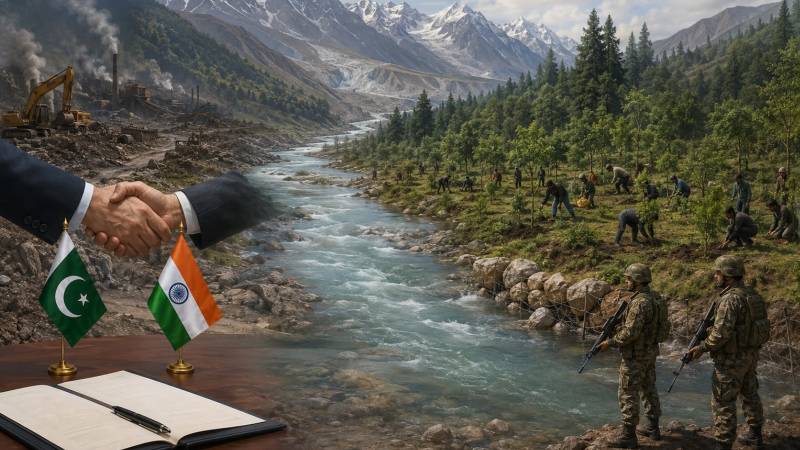
It is with a profound sense of grief and a heavy mourning heart that we must begin this appeal. We live in a tragic reality where the very survival of millions is openly bartered for political hostility. When the Indian Army Chief chillingly declares that Pakistan will no longer remain on the world map, and when Prime Minister Modi suspends the Indus Waters Treaty—repeatedly threatening to choke the life-giving rivers and stop water from ever entering Pakistan—we are forced to watch the weaponization of nature itself.
We write this not as adversaries, but as two deeply devoted lovers of peace and the environment. Our hearts harbor no ill will; we constantly think of the betterment, prosperity, and survival of the 1.4 billion people of India, alongside our own, because the Earth makes no distinction between us. The United Nations and the global community must open their eyes to this fierce, existential aggression from India, and recognize our tireless efforts to seek harmony amid threats of annihilation. It is against this dark, sorrowful backdrop of looming catastrophe that we plead for a saner, gentler path forward.
Water has become one of the most contested subjects between India and Pakistan in recent years, as tensions over the Indus Waters Treaty have sharpened on both sides of the border. We write as two people who are not policymakers on either side, but who are well-wishers of the Indian people simply because they are our neighbors, and because the Himalayan rivers that sustain both our countries don't recognize the line between them. What follows isn't a comment on that dispute. It's a narrower, practical idea about what happens upstream, in the mountains where those rivers begin.
More than four years into the Russia-Ukraine war, one of its quieter legacies is a re-examination of the main battle tank's place in modern warfare. Cheap loitering munitions and anti-tank guided weapons have repeatedly found the seams in older armor designs, and a number of military analysts have argued that mass tank fleets — particularly older Soviet-lineage designs like the T-72 — are more vulnerable than their Cold War-era doctrine assumed. That debate is real and ongoing among defense professionals worldwide.
The sobering reality of modern warfare has rendered these massive, conventional steel fleets largely redundant and obsolete. In a landscape dominated by hyper-accessible technology, heavily armored columns are effectively immobilized, unable to safely cross any international border without facing immediate destruction. The strategic vulnerability is absolute; today, even basic commercial drones, the likes of which are readily available in local bazaars like Raja Bazar in Rawalpindi, can easily be configured to bypass multi-million dollar defense systems. Striking from the blind spots directly above a tank's weakest top armor, these low-cost unmanned aerial vehicles can instantly transform a sprawling fleet into a tragic, fiery grave for Indian soldiers. Our honest, heartfelt advice to the Indian government is to completely shelve this tank manufacturing program before more wealth is turned to ash. We urge India to instead redirect these vast sums to heal the bruised landscapes of Jammu & Kashmir, Himachal Pradesh, and Uttarakhand, transforming barren wastelands into thriving, thick forests. As neighbors who share this delicate ecosystem, we stand ready to extend our hand and provide full technical assistance and expertise on these reforestation initiatives to secure a greener future for the entire subcontinent.
India fields one of the largest tank fleets in the world — T-90s, upgraded T-72 "Ajeya" variants, and the indigenously developed Arjun — and is already planning a roughly $9 billion, 1,770-vehicle Future Ready Combat Vehicle program to replace its aging T-72s starting in 2030. That is a defensible hedge against conventional threats on India's borders, and no outsider has full visibility into the threat assessments behind it.
Even a modest redirection of capital could fund a watershed rehabilitation program at a scale, India's forestry and water ministries have rarely had the resources to attempt.
But it is fair to ask, as a matter of public budgeting rather than military strategy, whether every rupee of that outlay is better spent on new armor than on the water crisis quietly unfolding in the same mountains those tanks are meant to defend. A large mechanized fleet is a hedge against a war India hopes never to fight again at that scale. A degraded Himalayan watershed is a slower-moving but far more certain problem — it is already costing lives and livelihoods every flood season and every summer heatwave, with total certainty, right now.
Even a modest redirection of capital — some share of the acquisition budget, plus the scrap value of the tens of thousands of tons of steel already sitting in retired-vehicle depots — could fund a watershed rehabilitation program at a scale India's forestry and water ministries have rarely had the resources to attempt. Money spent on reforestation and check-dams doesn't sit idle waiting for a conflict that may never come; it starts recharging aquifers and slowing floods the year it's spent.
While the tank debate plays out in defense journals, a quieter emergency has been building in the hill states that ring northern India. Himachal Pradesh has roughly 125,000–138,000 hectares of cultivable wasteland, with barren and rocky terrain covering close to 18% of the state. Uttarakhand carries an even heavier burden — an estimated 1.27 million hectares of wasteland, nearly a quarter of its geographic area, of which some 366,000 hectares could support cultivation if it had reliable water. Jammu & Kashmir's degraded and under-utilized land runs into the millions of hectares as well.
Downstream, the consequences are already visible every monsoon: flash floods in the hills, siltation-choked rivers, and increasingly erratic water supply across Punjab, Haryana, Rajasthan, Uttar Pradesh, and the National Capital Region. Groundwater tables in the Indo-Gangetic plain have been falling for years even as flood damage rises — a paradox that, ecologically, isn't really a paradox at all. It's what happens when forest cover disappears from a watershed's headwaters.
The mechanism is well established in hydrology and forestry science, not speculative. Forest canopy and leaf litter slow the impact of monsoon rainfall, absorbing the kinetic energy that would otherwise erode bare hillsides. Root networks create channels that let water infiltrate the soil rather than sheet off it, recharging groundwater instead of flooding the valley below. Standing forest shades snowpack and slows its melt, stretching river flow later into the dry season instead of releasing it all in one spring pulse. And reduced runoff velocity downstream means less flood energy reaching the plains of Punjab and Haryana on the Indian side, with correspondingly less pressure on shared river systems that also affect flood patterns in Pakistan's Punjab. None of this requires exotic technology. It requires water — delivered reliably enough, early enough in a planting cycle, to establish trees and medicinal plant nurseries on slopes that are currently too dry and too remote for conventional irrigation.
This is the actual, modest proposal at the center of this piece: decommissioned armored vehicle hulls — stripped of anything sensitive, demilitarized, and repurposed under whatever oversight India's own defense and environment ministries deem appropriate — are simply very large, very durable steel containers. Converted into static water-storage tanks, gravity-fed to nursery plots, or used as check-dam components to slow hillside runoff, that scrap has a second life that costs far less than fabricating new tankage from scratch.
Militaries in several countries have experimented with similar "swords into ploughshares" repurposing of retired hardware for civil engineering and disaster-relief infrastructure; there's nothing radical about the concept, only about applying it here. Paired with reforestation and medicinal-plant cultivation on the wasteland acreage already documented in Himachal Pradesh, Uttarakhand, and Jammu & Kashmir, this kind of low-cost water infrastructure could plausibly support nurseries for native tree species and Himalayan medicinal plants on land currently too dry to cultivate, slower and more even snowmelt and monsoon runoff, better-timed recharge of the aquifers that Punjab, Haryana, Rajasthan, and Uttar Pradesh increasingly depend on, and some tempering of the extreme pre-monsoon heat that now regularly grips North India, as regional afforestation has been shown to shave off peak land-surface temperatures at a local scale.
We think the budget argument is a strong one: a rupee spent greening a Himalayan watershed starts paying dividends immediately, while a rupee spent on additional armor pays off only in the event of a war nobody wants. Repurposing already-retired hulls as water infrastructure, and weighing a slower pace of new tank acquisition against faster-growing water and reforestation budgets, is worth serious study by India's own planners.
We'd also be doing readers a disservice not to note the obvious counterargument: deterrence isn't optional just because it's expensive, and a credible conventional force is precisely what keeps a slow-moving environmental problem from becoming a fast-moving military one. India's own strategists, not outside commentators, are best placed to weigh that tradeoff against the numbers above. What we can say with more confidence is that the current split — vast sums for armor replacement, comparatively little for the watersheds that feed a quarter of the country's population — deserves an honest public debate, not a default.
The ultimate delusion of heavy mechanization is exposed by the sheer democratization of destruction. From the stalls of Raja Bazar in Rawalpindi and Karwan Bazar in Dhaka, to the crowded lanes of Indra Chowk in Kathmandu, the components for AI-powered drones and devastating electronic warfare are now cheaply and widely accessible to anyone. The era of armored dominance is dead; these low-cost systems can effortlessly disrupt communications, fry software, and blind the electronics of complex military vehicles, completely neutralizing Indian tanks long before they ever reach a frontline. When the tools of total military obsolescence can be bought in the common marketplaces of South Asia, clinging to a multi-billion dollar armor program is not just a strategic error—it is an act of tragic hubris that starves the very earth we must collectively save.