

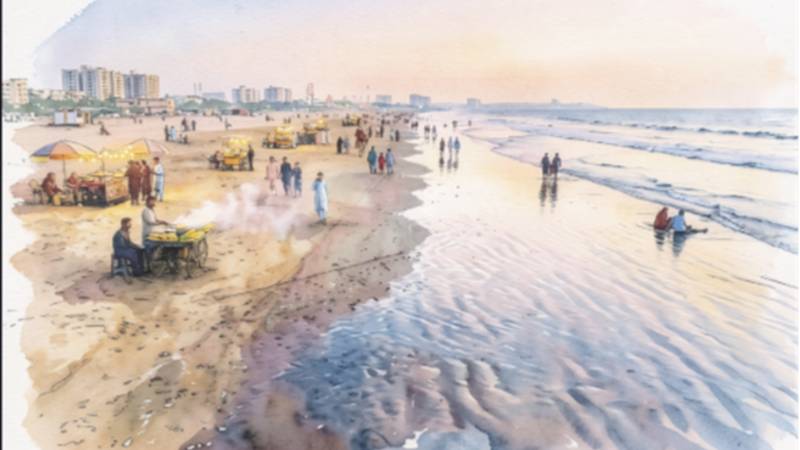
The debate over carving Karachi out of Sindh to form a separate province is one of Pakistan’s most enduring political controversies. On one side, the Pakistan Peoples Party (PPP) maintains that Karachi is the inseparable heart of Sindh. On the other, parties representing the Urdu-speaking Mohajir population, most notably the Muttahida Qaumi Movement (MQM), argue that the city suffers from systemic neglect because it lacks a Sindhi-speaking majority.
While the MQM often frames the PPP strictly as a "Sindhi party," the PPP’s political footprint has historically extended well beyond the province. It commanded a substantial vote bank in Punjab until 2008 and currently leads governments in Balochistan and Gilgit-Baltistan alongside Sindh.
Meanwhile, Karachi’s Mohajir electorate, whose support is largely divided among the MQM, Jamaat-i-Islami (JI), and Pakistan Tehreek-i-Insaf (PTI), widely believes that the metropolis can only thrive as an independent province or under direct federal administration.
Political commentators frequently reduce this issue to a binary struggle between Sindhis and Mohajirs. However, this framing overlooks an important demographic reality: non-Mohajir communities comprise nearly half of Karachi’s population, and their historical memories and economic anxieties largely make them staunch opponents of partitioning Sindh.
Demographic Reality and Historical Memory
While Mohajirs remain the city’s largest single demographic, accounting for 50.6 per cent of the population, Karachi has evolved into a deeply diverse metropolis. Millions of Pakhtuns, Sindhis, Punjabis, Baloch, Seraikis, Hindko speakers, and Bengalis call the city home.
Consequently, any alteration to Karachi’s administrative status directly impacts millions of non-Mohajir citizens, whose resistance, albeit quiet, to a separate province is rooted in the turbulent decades between the 1980s and the 2000s.
During that era, the rise of the MQM as the dominant Mohajir political force coincided with severe ethnic strife. Beginning in earnest in 1985 with clashes between Pakhtuns and Mohajirs, Karachi descended into protracted turf wars involving Mohajir, Pakhtun, Sindhi, and Baloch factions fighting over transport routes, real estate, markets, and public-sector jobs.
Commentators often reduce this issue to a binary struggle between Sindhis and Mohajirs, but this framing overlooks an important demographic reality: non-Mohajir communities comprise nearly half of Karachi’s population
This volatility reached a grim milestone on the 12th of May 2007, when daylight political and ethnic violence paralysed the city and claimed dozens of lives. For nearly thirty years, non-Mohajir neighbourhoods endured political marginalisation, frequent strikes, and widespread extortion (bhatta). These lived experiences fostered a deep-seated distrust of the MQM and left a lasting fear of single-party street dominance.
Community Apprehensions Across Karachi
As a result, when politicians propose separating Karachi from Sindh, non-Mohajir residents rarely hear a promise of improved civic infrastructure. Instead, they perceive an attempt to restore chauvinistic Mohajir hegemony. Their primary concern is that without the oversight of the PPP-led provincial government, a separate Karachi administration would fall entirely under the control of exclusionary Mohajir factions, reviving localised harassment and political disenfranchisement.
Each non-Mohajir community harbours specific apprehensions regarding such a shift. Pakhtuns, who play a central role in Karachi’s transport, retail, and construction sectors, fear that a Mohajir-dominated administration would restrict their commercial activities and resurrect extortion networks.
Similarly, Punjabis worry that single-group political dominance would trigger renewed instability and disrupt trade through forced market closures. For Sindhis, Karachi is their historic and economic capital, meaning any partition is viewed as an effort to fracture their homeland and alienate them from their own metropolis.
Meanwhile, Baloch residents fear losing ancestral and residential lands to urban development projects steered by a Mohajir-led local government.
Lessons from the 2022 Local Government Elections
Although non-Mohajir communities are not uncritical of the PPP’s governance in Sindh, they consistently favour a flawed provincial administration over a city government monopolised by groups they associate with Mohajir hegemony.
The PPP successfully leveraged this dynamic during the 2022 local government elections. With the MQM boycotting the polls, Mohajir-majority constituencies largely backed the JI and PTI, whereas non-Mohajir areas consolidated behind the PPP. A review of the detailed results of the last local elections confirms this.
With the MQM boycotting the polls, the contest fractured along ethnic and geographic lines into a three-way race among the PPP, JI, and PTI. After direct Union Council (UC) elections and the addition of reserved seats in the 367-member Karachi Metropolitan Corporation (KMC) City Council, the PPP finished first with 155 total seats, followed by JI with 132 and PTI with 62, enabling PPP’s Murtaza Wahab to win the mayoral election (173 votes to 160 for JI’s Hafiz Naeem ur Rehman).
PPP won four of Karachi’s seven districts (Malir, Keamari, South, and West) and finished a strong second in District East. It swept multi-ethnic, coastal, and peripheral districts, and successfully courted Pakhtun voters who had previously backed PTI. PPP secured a majority of Town Municipal Corporations (TMCs) in working-class and peri-urban belts.
JI dominated Karachi’s dense urban core, sweeping District East and District Korangi. It capitalised most effectively on the MQM boycott, capturing the bulk of middle-class Mohajir constituencies and winning control of most TMCs in these Mohajir-majority districts.
PTI suffered a sharp decline compared to its 2018 general election sweep of the city. Unable to retain its 2018 Pakhtun vote bank against the PPP in West, Keamari, and Malir, PTI saw its wins confined largely to scattered Mohajir and affluent urban pockets across East, Central, Korangi, and South.
PML-N and parties such as JUI-F, PML-Functional, and TLP played marginal roles, with PML-N winning a handful of UCs in Punjabi-populated pockets of Keamari and Korangi.
Inter-Provincial Politics
In effect, the provincial government in Sindh serves as an institutional counterweight that prevents any single ethnic group from monopolising power in Karachi. This delicate balance is often misunderstood in more ethnically homogeneous provinces like Punjab, whose political circles frequently critique Karachi’s governance.
Ironically, while provincial leaders in Punjab often mock Karachi’s struggles with urban flooding, severe monsoon rains regularly overwhelm infrastructure across Punjab’s own cities. Rather than addressing the shared global threat of climate change, some political parties in Pakistan routinely weaponise these crises for partisan point-scoring.
The sharp criticism directed at Sindh by PML-N administrations in Punjab is partly driven by the lingering political memory of the PPP once being an electoral force in Punjab—this despite the PPP’s diminished electoral presence in Punjab today. But PML-N remains sensitive to the era when the PPP commanded a formidable Punjabi vote bank.
Reckoning with Karachi’s Pluralism
Karachi has outgrown the volatile political terrain of the late 20th century to become a sprawling economic engine built by workers, entrepreneurs, and families from across Pakistan. Any viable discussion about the city’s administrative future must reckon with this pluralism.
Partitioning Sindh is not merely a constitutional debate between power brokers in Islamabad and Karachi; it is an existential question for millions of non-Mohajir residents concerned about their security and political voice. It is rather simplistic to understand Karachi as a ‘Mohajir (Urdu-speaking) city’.
Until leaders can guarantee an inclusive governance framework in which every community feels protected and represented, proposals to separate Karachi from Sindh will continue to face formidable resistance, not only from Sindhis, but from nearly half of Karachi’s own citizens.