

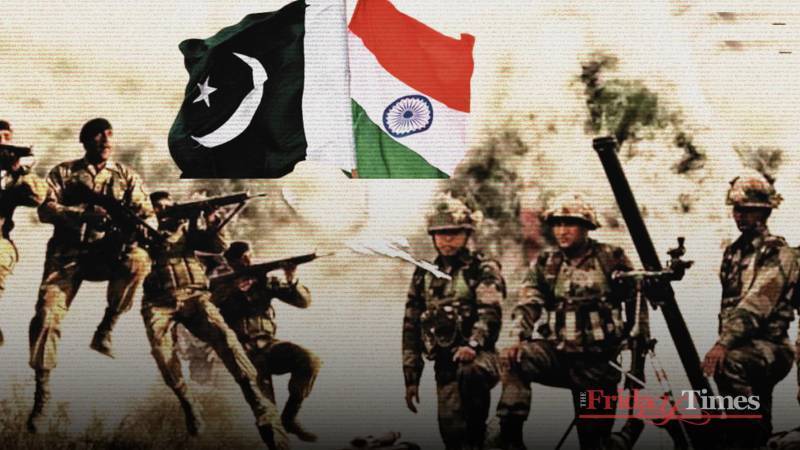
The guns have fallen silent, and the shortest war between the two nuclear powers—India and Pakistan—has now been consigned to the dust heap of history. However, there is a dire need to analyse and study the many facets of this latest crisis between the two neighbours.
This clash was markedly different from previous wars. Never before had the two antagonists employed missiles, drone technologies, or new-generation high-tech weapons. The wars of 1965, 1971, and Kargil were all conventional clashes involving infantry and armour units, with air support and limited naval engagements on the high seas. This was the first time both countries came to the brink of total war after acquiring nuclear weapons. It was also the first time that the fires of war were extinguished by third-party intervention—namely, by the President of the United States.
Both countries have claimed success and drawn contrasting conclusions from this latest crisis. Narendra Modi has asserted that any act of terror will now be treated as an act of war and will trigger an immediate and proportionate response. The Indian side further claims to have destroyed the training camps and secure bases of Lashkar-e-Taiba in Muridke and Jaish-e-Mohammed in Bahawalpur.
Conversely, Pakistan’s response led to the downing of five Indian Air Force fighter jets, including three Rafales, and damage to the Indian S-400 radar systems, alongside multiple airbase facilities. This crisis has demonstrated that Pakistan possesses the capability to strike deep into Indian territory and has the military muscle to force India into a ceasefire.
The crisis has produced sharply contrasting outcomes—deep political divisions and dissent in India, and unprecedented national unity in Pakistan for the first time since 1965
In the arrogantly simplistic view of the Modi regime, Pakistan was seen as divided, economically weak, and internationally isolated. It was presumed that a minor military action would yield a decisive Indian victory, possibly recreating the 1971 surrender scenario. To the dismay of Indian planners, everything unfolded contrary to expectations. Pakistan was prepared—armed with the latest Chinese technology, which had been expertly adapted by its military apparatus. Indian aircraft and radar networks were swiftly neutralised.
This perceived decisive victory has instilled a renewed sense of self-confidence and pride within Pakistan, especially following the humiliation of the 1971 war. The Pakistan–China alliance has once again proven its resilience, and this conflict has further cemented that strategic partnership. After being denied access to Western and American technology, Pakistan opted for Chinese high-tech military equipment—and the results have surprised not just India, but the wider Western world.
The Directors General of Military Operations (DGMOs) of both countries are now in regular contact. This is a positive first step towards a durable ceasefire. However, these contacts must eventually evolve into secretary-level and then ministerial-level talks, culminating in a summit meeting to address the unresolved issue of Kashmir—the unfinished agenda of the 1947 Partition.
At present, the situation remains unpredictable and fraught with danger. Modi has already stated that Indian military operations have only been suspended. This time, Pakistan not only delivered a military response but also embarrassed India on the global stage. The Indian government misjudged the international climate, as evidenced by the vocal support Pakistan received from Turkey, Azerbaijan, and Iran. In contrast, India found itself isolated diplomatically.
This crisis has re-internationalised the Kashmir issue—much to the dismay of the Modi government. The most significant diplomatic setback for India came with the ceasefire announcement issued from Washington, D.C., along with the U.S. offer to mediate the Kashmir dispute. While India is certain to reject the Trump administration’s offer, the damage is done—Kashmir is back at the centre of international diplomatic discourse and remains on the agenda of the United Nations.
India’s suspension of the Indus Waters Treaty has similarly failed to gain any meaningful support from the international community. It has not only failed to achieve its stated military objectives, but also grossly miscalculated the consequences of its military adventure.
An uneasy peace now prevails between the two countries, but there is hope that this may lead to future diplomatic contact, potentially a summit-level dialogue on Kashmir, the Indus Waters Treaty, and other longstanding bilateral issues. However, the danger of both sides drawing vastly different conclusions from this clash could lead to further miscalculations, and possibly a repeat crisis in the near future, unless the highest levels of diplomacy are urgently engaged.
The Trump intervention has put Modi on the back foot. India has long resisted third-party mediation and insisted on bilateral talks with Pakistan, on its own terms. Former Indian Foreign Secretary Shyam Saran observed that this crisis has reversed years of Indian efforts to dissuade the world from treating India and Pakistan as geopolitical equals. “That hyphenation is now back,” he remarked. He added that if one of India’s top foreign policy goals is to join the world’s big league, this crisis has produced the opposite outcome.
The Modi government failed to predict the response of the U.S. administration. It had anticipated full-throated American support for its military action. Instead, it received a diplomatic shock when the Trump administration offered to mediate and called for restraint.
The crisis has produced sharply contrasting outcomes—deep political divisions and dissent in India, and unprecedented national unity in Pakistan for the first time since 1965. Modi now faces immense political pressure from opposition parties and even within his party to explain what was achieved by the much-hyped Operation Sindoor. His critics are furious at the abrupt ceasefire announced by Donald Trump, seeing it as a diplomatic retreat rather than a strategic victory.