

"Violence is the last refuge of the incompetent."
(Isaac Asimov)
With the announcement of a ceasefire agreement, people living across the borders have breathed a sigh of relief as the clouds of war hanging over the people of the two countries have lifted, and the drumbeats in the battlefield have fallen silent.
One of the worst consequences of a full-scale war is that not only soldiers but also civilians become cannon fodder—not to mention the economic, ecological, and demographic catastrophe, and institutional disfigurement.
War before War
Water lubricates all engines of human civilisation. History testifies that those who disrupt natural water flows are destined to doom and gloom. On the heels of the Pahalgam tragedy, India's suspension of the Indus Water Treaty (IWT) was a prelude to aggression, choreographed in Indian corridors of power.
In the aftermath of the Pahalgam tragedy, Pakistan's offer to engage in a joint investigation to unravel the truth behind the ensuing blame game with India was a beacon of restraint and bilateral cooperation. This gesture, aimed at de-escalating tensions, starkly contrasts with the rising crescendo of hostility that threatened to engulf the region in a full-scale war. Blaming Pakistan within minutes of the cold-blooded murder of tourists being discussed was irresponsible behaviour, and such sensationalism is a slippery slope—a phenomenon that must be avoided, given the dangers of digital demagoguery, which raises public expectations for retribution, whose entire edifice is built around the customary blame game.
Pakistan's former Foreign Minister Bilawal Bhutto Zardari, while responding to an international media outlet, correctly commented that Pakistan's willingness for an impartial investigation and India's unwillingness for the same speak volumes. It would not be an exaggeration to suggest that the film called "Operation Sindoor" is a product of warmongering.
Caught in the quagmire, India chose cross-border incursions targeting civilian populations—which is a war crime. Pakistan acted in self-defence. As a nuclear state, it avoided an offensive, contrary to public aspirations given the cross-border incursions and consequent civilian casualties. Escalating sensitivities could be suicidal in the age of AI-generated lies and digital demagoguery. Sensationalism seems sweet, but its fruit is bitter. Demagoguery in the wake of escalating tensions across borders, emanating from mutual mistrust, has historically undermined geopolitics and communal cohesion in the two countries.
India's authoritarian teeth
The first casualty of war is the truth. India's authoritarian tendencies came under public scrutiny, with the media blackout prioritised by the BJP-led government exposing its authoritarianism. This reveals a tale of tyranny that survives only through the repression of independent minds and the muzzling of the media. Earlier, India prioritised the blackout of Pakistani media channels and social media platforms, underscoring its tendency to suppress information and manipulate public opinion for warmongering purposes under Narendra Modi's leadership. Under such circumstances, the Indian media churned out fabricated news about taking control of Pakistan's strategic buildings, not to mention the destruction of state institutions like airports. This phenomenon is reflective of a broader issue within India's media landscape, where certain outlets often prioritise sensationalism and political narratives over factual reporting.
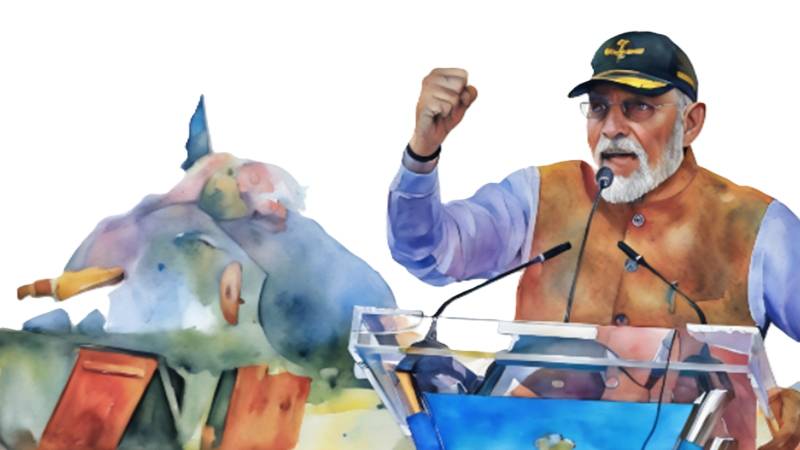
Operation "Sindoor" launched against Pakistan by India will haunt none other than India - for a very long time to come
The subservient Indian media has not only been exposed but has also revealed loopholes and black holes in the narrative built by Modi in the wake of Operation Sindoor, with netizens questioning the credibility of media houses. The term "godi media" has been used to describe biased Indian print and TV news media that openly supports the ruling Bharatiya Janata Party (BJP) government. What those at the helm of Indian affairs need to focus on is that democracy dies in darkness.
Cost of conflict
Indian shares fell for a second straight session past Friday, losing about $83 billion in market value, as intensified military action between India and its neighbouring Pakistan rattled investors. Reportedly, a notice issued by CMA CGM, one of the world's leading shipping and logistics firms, confirmed the imposition of a surcharge, citing operational disruptions resulting from the ongoing conflict.
As high as $800 per unit were imposed as Emergency Operational Recovering Surcharge for routes from Pakistan to Europe, Mediterranean, US, and Africa and from Asia to Pakistan. $300 per unit surcharge were to be applied on cargo from Europe, the Mediterranean, US, Canada and Africa to Pakistan and from Pakistan to Asia. The full cost of the conflict in terms of business losses and consequent economic baggage to be shouldered by the two states is yet to be assessed by economic experts.
Turning point
The downing of the French-made Rafale jet, including other aircraft, by the Pakistan Air Force exposed a significant vulnerability in India's armour and punctured its arrogance. The swift and rash manner in which India launched a strike against Pakistan on dubious grounds underscored the Modi-led government's propensity for escalation and provocation. Yet, the downing of the jet—a supposed tower of strength in battle—brought India's military preparedness and hubris crashing down.
Modi has lost both the political narrative he built around "Operation Sindoor" and the subsequent conflict. The claims made by Modi regarding the Pahalgam incident were diligently dissected by independent minds in India and abroad alike. Modi was left embarrassed, with few takers of his narrative following the incident. He has to answer many questions posed by sharp observers, even in India. As someone aptly remarked, "You can fool some people for some time, but you can't fool all people all the time."
Distinguished Pakistani author and columnist Nadeem Farooq Paracha foresees Narendra Modi's downfall, describing it in a nutshell: "It's finally dawning on some Indians that they have lost the 'war.' They'll finally come to realise that this 'war' was triggered by a false flag operation by their government, and by a mad, mutant media. This may lead to Modi's eventual electoral fall. But he's making sure he falls like Mussolini did: shredded to bits by the very people who once treated him like a demigod."
Tainted legacy
Narendra Modi's rise to power is marred by Muslim hatred, violence, and authoritarianism. During his tenure as Chief Minister, Gujarat witnessed the slaughter of Muslims in the 2002 riots, which originated from a train fire in Godhra that killed 59 Hindu pilgrims. Given Modi's warmongering and hatred of Muslims embedded in his state's policies, one is convinced to recognise the vision of Quaid-e-Azam Muhammad Ali Jinnah, who initially advocated for Hindu-Muslim unity but later realised the threat of Hindu majority domination—a phenomenon now manifesting as Hindutva. This led him to demand a separate homeland for the Muslims of South Asia. Modi's modus operandi, particularly in the aftermath of the Pahalgam incident, echoes the tyranny that Jinnah feared would loom large over Muslims in an undivided subcontinent.
"War is the continuation of politics by other means," as Karl von Clausewitz famously put it.
The devastating wars fought under various banners have had catastrophic consequences, including loss of human life, destruction of civilisation, and long-term damage to food security and peace. The aftermath of such conflicts often includes widespread hunger, homelessness, despair, and human suffering. A full-scale war between nuclear-armed neighbors like India and Pakistan would likely yield similar tragic outcomes. Diplomacy and peaceful resolution are essential to avoid such devastation.
Pakistan's firepower
Under the captaincy of COAS General Asim Munir, Pakistan successfully repelled India's aggression. India's attack became a Waterloo moment as Pakistani forces not only defended their homeland but also brought the opposite side to its knees by neutralising its arsenal directed against Pakistan. The quick intervention by the White House and subsequent ceasefire brokered by the US administration saved India from further loss and humiliation. Operation "Sindoor" launched against Pakistan by India will haunt none other than India for a very long time to come, following its failure on all fronts in the face of fierce opposition offered by the Pakistani side. The successful defence and robust retaliation that prompted the US administration to intervene to prevent further fallout will be a stepping stone for Pakistan's future defence strategy. This Indian aggression was not the first, nor would it be the last, since old habits die hard. However, India will think twice before any future military adventure, given Pakistan's demonstrated military prowess in frustrating the enemy—a phenomenon that has made the nation proud.
Dr Huma Baqai, a foreign policy and current affairs expert, correctly commented: "What Pakistan did in the last four days has changed the power equation of South Asia for good. A lot of rethinking should happen in Western capitals, in New Delhi, and in Kabul."
With both countries grappling with pressing domestic challenges such as poverty, inflation, bad governance, debt traps, and climate-induced vulnerability, it is imperative that they prioritise cooperation over confrontation. The world was watching with bated breath as the situation unfolded. The United Nations Secretary-General, Antonio Guterres, sounded a timely warning, cautioning that the international community cannot afford a military conflict between two nuclear-armed states like Pakistan and India. The stakes were indeed high, and the potential consequences of such a conflict would be catastrophic. Various international players also called on both sides to de-escalate.
Way forward
In this context, it would be wise for Indian policymakers to take a leaf out of history and visit a war-torn country to witness firsthand the ravages of conflict. The experience would serve as a sobering reminder of the devastating human and economic costs of war. By choosing the path of diplomacy and dialogue, both nations can work toward resolving their differences and building a more peaceful and prosperous future for their people.
It must be acknowledged that initiating war is easier than ending it. Let the cadets not be cannon fodder for wars launched to further political agendas. War destroys civilisation, population, peace, dreams, and economic and political success achieved with great effort and resources. Delhi and Islamabad should sit together to find a sustainable solution—namely, peace—in the larger interest of humanity.
Reportedly, India is said to have approached the Trump administration to navigate India out of the deepening quagmire by brokering a ceasefire. The nexus among the USA, India, and Israel is an open secret. The trio has maintained strategic alignment and uses the support of one another when needed. Were Pakistan in trouble, the global feudal lord would use ifs and buts—delaying tactics. Remember political games in the Ukraine-Russia war. The US game in South Asia is no secret, as it wants to keep a check on China through India. Hence, America continues to financially and logistically support India. However, seeing the noose tightening around India's neck, the White House, which had initially decided to remain detached from the ongoing conflict between India and Pakistan, felt the need to intervene.
Narendra Modi, a significant player in the South Asian Subcontinent—a would-be Netanyahu—had started the war arrogantly, but within four days, the Pakistan Army retaliated through Operation "Bunyan al-Marsoos" (a Quranic term for the concrete wall), targeting around 26 Indian military and critical infrastructures, ultimately pushing India against the wall and prompting its great ally America to bail it out.
International players have their own vested interests when it comes to supporting or leaving those involved in the conflict to fend for themselves. In the war being waged, some countries selling weapons see their potential in terms of selling more weapons, while others see their geopolitical equations being materialised. It is only the population of the countries involved in war that bears the brunt of war and its aftermath in every context, from suffering humanity to economic meltdown and the subsequent destruction of sources of survival.
As Smedley Butler put it, "War is a racket. It always has been. It is possibly the oldest, easily the most profitable, surely the most vicious. It is the only one international in scope. It is the only one in which the profits are reckoned in dollars and the losses in lives."
What the Narendra Modi-led government needs to realise is that creating hype when statesmanship is needed will throw the region into flames.
Once war starts, either compulsively or accidentally depending on the situation on the battlefield, the use of weapons of mass destruction by either side involved in the conflict cannot be ruled out.
Let us hope that political wisdom prevails over jingoism, and the two nations can find a way to peacefully resolve their differences in the future. The decades-long rivalry and consequent arms race have led the two nuclear-armed states to allocate large chunks of their budgets to defence and weapons.
Hans Morgenthau said: "People do not fight because they have arms; they have arms because they fight."
By prioritising peace, the two countries can divert the hefty amount spent on defence and address looming threats, instead spending it to uplift the lives of ordinary citizens.