

The Karachi division has several historic cemeteries that contain stone-carved tombs. Some of the stone funerary monuments have fallen victim to Karachi's relentless urban expansion. Some of the most fascinating tombs that once stood along the Lyari River have disappeared entirely, while many of the surviving monuments are also at risk of being lost.
I have been documenting these stone funerary monuments for over two decades in various districts of Karachi division. There are three clusters of stone-carved tombs in Mangho Pir, a town in the Karachi West district. The first cluster is located east of the shrine complex of Mangho Pir and extends to the northern side of the ridge, which may be referred to as the third cluster of tombs. There are several tombs in the first cluster to the eastern side of the Mangho Pir shrine. A few tombs were restored long ago; they now lie in disrepair.
The Depiction of Jewellery
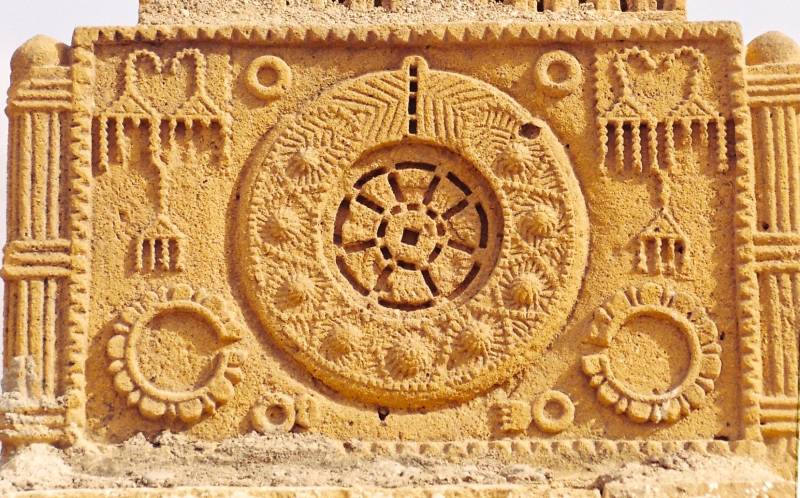
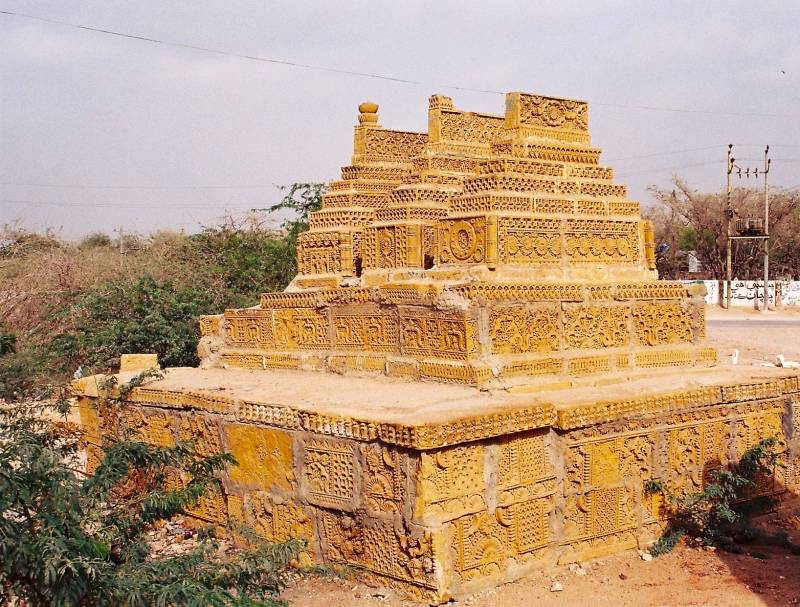
Of these tombs, the most noticeable are those erected on double platforms that represent both floral and geometric motifs. Two tombs belong to male members, while the third belongs to a female member of the Burfat tribe. The grave of a woman depicts a variety of jewellery items on both the northern and southern slabs. These are refined carved jewellery depictions found at Mangho Pir. Such refined and magnificent jewellery depictions can also be seen at various other necropolises in Karachi division, including those of Chaukhandi and Memon Goth. Several tombs in both graveyards depict jewellery.
Burfat tombs at Mangho Pir are the only monuments that feature a great variety of jewellery depictions, making them a unique and stunning facet of Sindh's architectural heritage
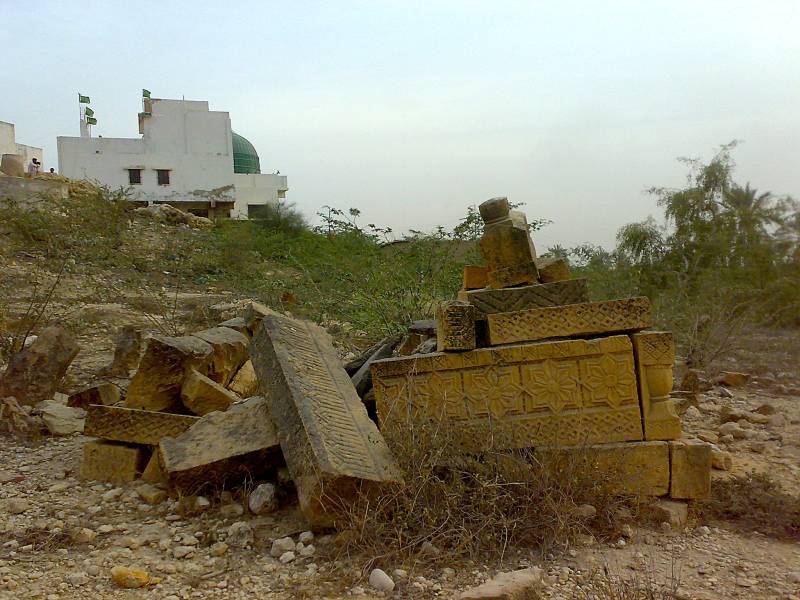
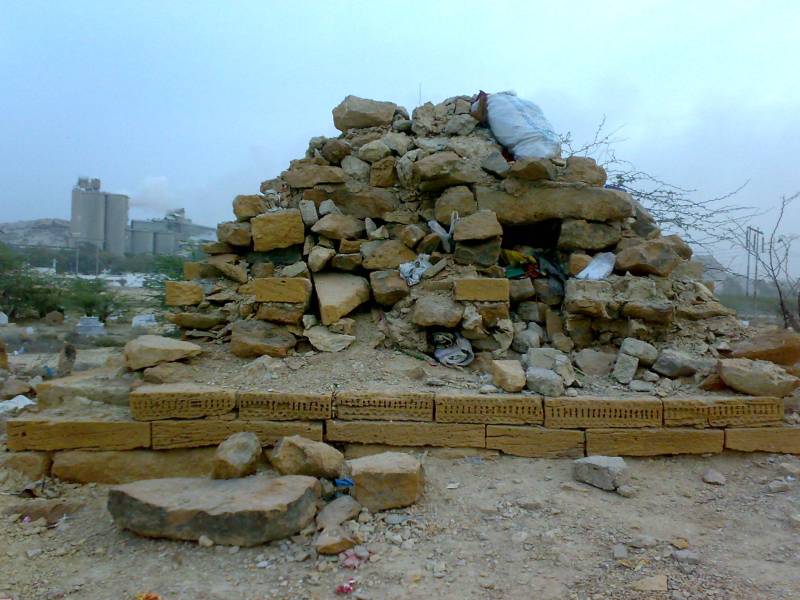
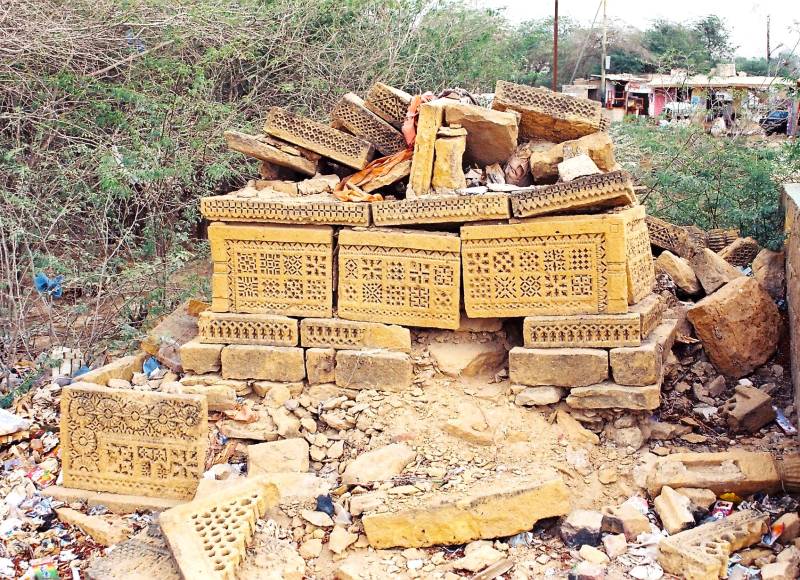
Close to these double-plinth tombs, there are a few other stone-carved graves, of which one also shows a variety of jewellery items. This is a double-casket tomb with five covering slabs laid on the second casket, diminishing in size. The gravestone on the covering slabs features rosettes and geometric patterns. The southern and northern slabs of the first casket feature jewellery items including necklaces, earrings, finger rings, and bangles. Burfat tombs at Mangho Pir are the only monuments that feature a great variety of jewellery depictions. Adjacent to this double-casket stone-carved tomb are a few other cenotaphs that lie in shambles. Their decorative slabs are scattered. Most of the tombs were erected in the first and second quarters of the 18th century, but tomb building continued up to the 19th century.
The Second Cluster and the Canopy of Malik Sapdar
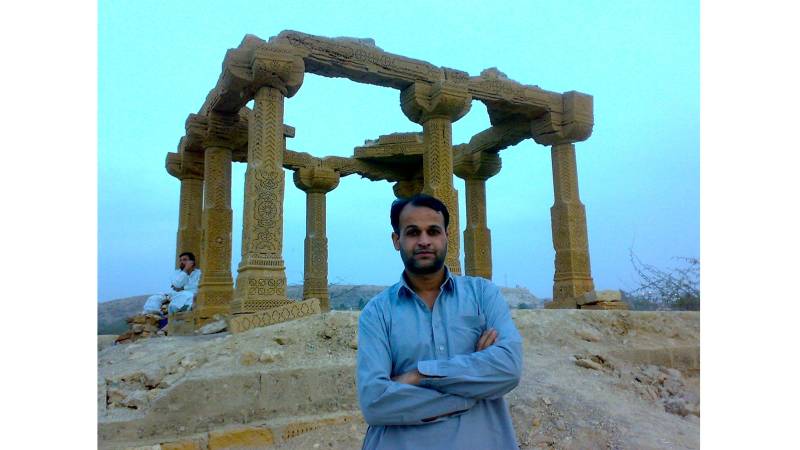
Apart from the cluster adjacent to the Mangho Pir shrine complex, the second-earliest are those located south of Mangho Pir in the Naya Nazimabad housing scheme. There are now the last remnants of a canopy, surviving as only four pillars and lintels. Formerly, there were a few outstanding stone-carved tombs at this site. I first visited this site in 2009. It was located in the Javedan Cement factory premises. The cement factory was shut down in 2010. At that time, the majority of the stone-carved tombs were in a dilapidated condition.
From Jean Philippe Vogel's article, "Tombs in Hinidan, Las Bela", published in the 1902–3 Archaeological Survey of India (ASI), one learns the dates of the tombs in the second cluster of the Mangho Pir tombs and the names of Burfat nobles interred in those tombs. These tombs were constructed in 1157 AH (1744–45) and 1171 AH (1757–58), respectively. Shaikh Khurshid Hasan (1996) has also given dates for these tombs in his book Chaukhandi Tombs in Pakistan. He mentioned four inscriptions on the canopy and stone-carved graves. These dates—circa 1157 AH / 1744–45, circa 1171 AH / 1757–58, and circa 1179 AH / 1765–66—provide an important perspective on the architecture of the tombs that existed in that period and on the role of the buried dignitaries in local politics. These dates correspond to the period when Kalhoras (1700–1783) ruled Sindh.
Another important inscription records the cost of construction of the canopy and its builder. On one of the pillars of the canopy, it is recorded that five thousand rupees was spent by Malik Sapdar, son of Malik Haroon Burfat, and Malik Duha, son of Malik Haroon, to construct the domed structure. This inscription was painted during my first visit to the canopy in 2009, and I returned to the site in 2010, 2013, and 2016. The graves of these Burfat nobles, Malik Sapdar, Malik Haroon, and Malik Duha Khan, were found there. Apart from the tombs of Malik Sapdar, Malik Haroon, and Malik Duha, the tombs of Bula Khan and others were also found there.
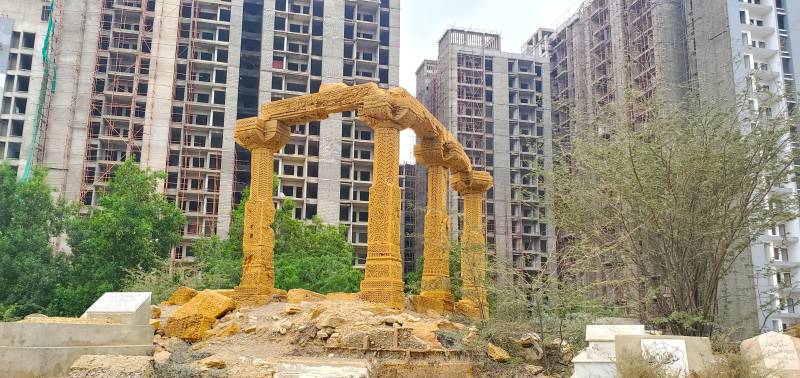
When I revisited the canopy of Malik Sapdar in 2010, I observed that a boundary wall had been constructed around the canopy of Malik Sapdar and Malik Haroon Burfat, separating it from Bula Khan's tomb. Today, one can only see the last remnants of Malik Sapdar's canopy, which stands on four pillars with lintels. It was a eight-pillared canopy, noted for its intricate decorative pillars, capitals, shafts, square bases, and lintels, making it one of the most magnificent canopies in Karachi. The expanding concrete jungle is devouring Karachi's cultural landscape. It has also devoured the tombs of Burfat nobles. This canopy now stands on its four pillars, which land grabbers will also remove, since other pillars have already been whisked away. The Sindh Culture, Tourism, Antiquities and Archives Department should put forth every effort to protect and preserve this canopy. This is an important chapter in Karachi's history; if we lose this canopy, we will lose a significant part of it.
The Third Cluster and Its Inscriptions
Apart from the second cluster, the third cluster of stone funerary monuments of Mangho Pir is located to the north of the shrine complex. There are both new and ancient stone funerary monuments in this graveyard. Old tombs were probably constructed in the 18th century and continued up to the 20th century. Some of the old tombs are in poor condition and are noted for their exquisite decoration. There are many gravestones, most of which are inscribed. Inscriptions are in Sindhi, not in Persian, as seen on the tombs located south of the Mangho Pir shrine, at the canopy of Malik Sapdar Burfat.
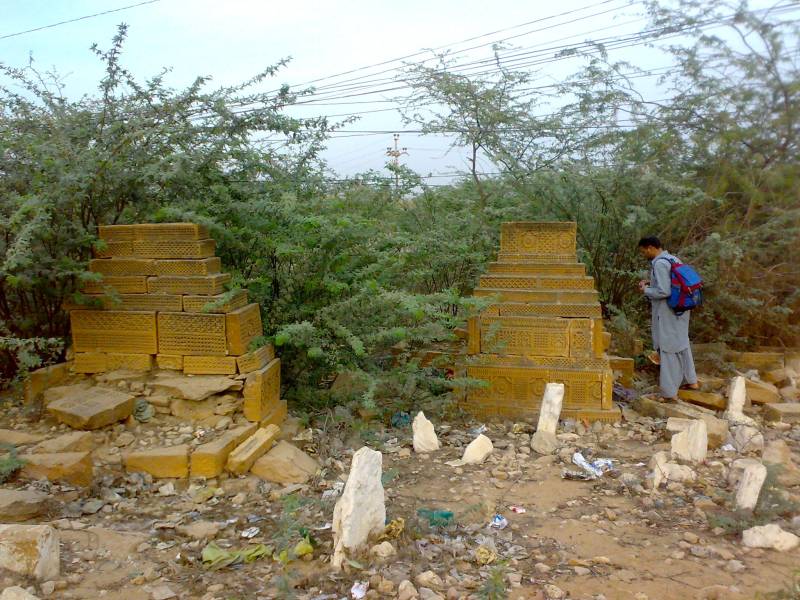
Unfortunately, all Persian inscriptions have been lost due to the destruction of the tombs. It is believed that the tombs of Mangho Pir are as old as Mangho Pir himself. It is believed that he lived in the 13th century! This means that the stone-carved tombs of Mangho Pir began to appear in that century, or perhaps in the 14th century. But the present tombs do not appear to be from the 13th or 14th century. If there were any, they were lost.
However, the Karachi District Gazetteer records the date of circa 913 AH / 1506 on the grave of Sardar Khan, chief of the Burfat tribe, who was killed in the battle against Jokhias at Allah Buna, 29 km from Mangho Pir. It is not known where that inscription is now. Even so, it is difficult to trace that grave amid the mushroom growth of housing schemes in Mangho Pir town. If one assumes the date of 913 to be correct, the earliest stone funerary monuments of Burfat at Mangho Pir were built in 1506 during the Samma period, when Jam Nindo Samo was ruling in Sindh. However, the existing stone-carved tombs date from the 18th century onward.
The Vast Graveyard of Dignitaries
To the north of the shrine of Mangho Pir is a vast graveyard where the dignitaries of various castes are buried: Mondar, Jokhia, Alandarani, Khaskheli, Bikak, Soor, Bareja, Kachela Sasoli, Menghal, and others. The earliest custodians of the Mangho Pir shrine, known as Khalifas, are interred in this graveyard. In contrast, the later custodians are buried inside the boundary wall of the Mangho Pir shrine complex, including Khalifo Bahawaldin. Khalifo Bahawaldin, a famed custodian of the shrine, died in the last quarter of the 19th century. Khalifo Bahawaldin village in Mangho Pir was named after him.
As one moves from north to south in the graveyard, one notices two stone-carved graves on a common platform that belong to two brothers from the Panhwar caste. Both are inscribed graves. The western grave belongs to Sakhero, son of Shabat, and the eastern to Sanjar, son of Shabat. Both graves were commissioned by Alu.
The graves in this cemetery are also very old. The earliest ones may date back to the 16th century. These were not stone-carved graves. A few of the earliest graves now lie in dilapidated condition.
A Call for Protection
These priceless funerary monuments, which bear witness to Karachi's evolution over the centuries, deserve urgent protection for future generations. These ancient tombs should be declared a protected heritage corridor. The entire heritage corridor—from the eastern section containing the tombs of the Burfat tribe and the custodians of the Mangho Pir shrine, extending northward with the graves of Sindhis, Balochs, and Brahuis, to the southern side of the shrine where the last surviving four pillars of the canopy of Malik Sapdar Burfat still stand—should be officially declared a protected cultural landscape by the Sindh Culture, Tourism, Antiquities and Archives Department.
Such a declaration would safeguard not only these remarkable stone monuments but also the centuries of history, identity, and cultural memory they embody. Today, this invaluable heritage is disappearing beneath the relentless expansion of housing schemes, markets, restaurants, and hotels. Unless immediate conservation measures are taken, Karachi risks losing one of the most significant chapters of its historical and cultural legacy forever.