

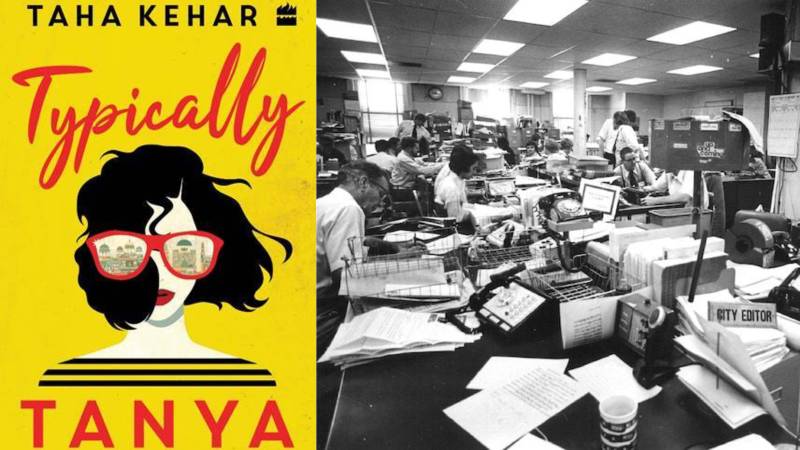
There is much more to Taha Kehar’s comic satirical novel Typically Tanya than meets the eye. Typically Tanya is Kehar’s second notable novel; the first was Of Rift and Rivalry, and the latest is No Funeral for Nazia. He completed his degree in law from SOAS, London, and is currently working as a journalist and literary critic. His novel Typically Tanya is light, humorous, and written in a conversational tone, whereas Of Rift and Rivalry is serious and historical, and No Funeral for Nazia is introspective and suspenseful. Undeniably, it is nearly impossible to look at the cover of Typically Tanya and not feel the urge to buy it. The cover is chic, stylish, and more vibrant than that of any other book by a Pakistani author.
The novel tells the story of Tanya Shaukat, a journalist at Daily Image in Karachi. She is passionate about her job, which becomes evident when she says, “Either way I begin to enjoy the stress, ambiguity and challenges that come with being a sub.” She belongs to the upper stratum of society and travels to and fro between home and office using the Careem cab service. She freely mixes with ex-lovers and attends bold parties with colleagues and friends. However, she does not hesitate to expose the double-faced personalities of those working alongside her. This particular trait keeps readers on tenterhooks, in the hope that she’ll provide the other characters with stories to gossip about. She is in the habit of “murdering the characters” of people with whom she has had some connection in the past. The whole narrative, as the title underscores, revolves around Tanya and her shenanigans.
Unlike her colleague Khirad, Tanya has an inkling about the unscrupulous nature of the metropolis’s editors. Despite her caveat, Khirad continues to have an affair with her married boss, only to experience humiliation in the end when he refuses to leave his spouse and tie the knot with her. Though Khirad falls prey to her boss’s delusional promises, she ultimately takes charge of her life. That said, Tanya herself gets exploited in many ways throughout the novel. The characters Bilal, Inder, and Hafeez go to great lengths to take as much advantage of her as they can. In a way, Tanya pretends to be a know-it-all, but the case is otherwise. As with all things in life, there is a limit to what one can know, especially when it comes to what people choose not to share. Therefore, Tanya goes through several experiences, some of which are not so rewarding.
In comparison to novels set in Lahore, Taha takes readers less out into the city and writes more about the social lives of his characters
The narrative bets on satire, humour, and, somehow, on transient love affairs. There is no such thing as limerence among any of the characters depicted in the novel. Amid the emotional outbursts of Tanya, which she often suffers due to her illicit relationships of the past, her Mummy serves as comic relief. Mummy is a vivacious, cheerful character, and her presence adds liveliness to the story. However, her separation from her spouse—Tanya’s father—leaves a deep void in their lives. Still, she puts on a brave face and keeps advising Tanya against the things she considers inappropriate. “The woman thinks that all I need to catch an eligible boy is a slim figure,” Tanya remarks about her mother’s advice. If judged properly, her words are nothing less than pearls of wisdom for Tanya. Sadly, the latter couldn't care less about what Mummy says throughout the novel.
While reading the novel, I stumbled upon a few sentences that sounded more like a prediction. The recent unilateral decision by the Indian government to suspend the Indus Waters Treaty has been a war-inviting initiative. In her dialogue with Inder, an Indian journalist who asks Tanya to write a story for his media house and flirts with her time and again, she says, “I’ve been meaning to write a gut-wrenching critique on the possibility of the Indian PM doing away with the Indus Waters Treaty.” These words caught me off guard because the Indian government has, in reality, placed the treaty in abeyance. Therefore, it is rightly said that fiction is often the higher reality.
On the whole, the novel is a good read for those who feel like taking a break from the hectic routines of their lives. There is no verbosity, and the language used is quite simple. The overall tone of the novel is colloquial and conversational. It seems the author has purposely circumvented the use of overly dramatic and ornate prose, keeping the novel’s language accessible to readers of all age groups.
In comparison to novels set in Lahore, Taha takes readers less out into the city and writes more about the social lives of his characters. Readers like me, who consider cities a sine qua non of narratives, might find a few things lacking in the novel, but the author makes up for it by offering detailed insights into the personal lives of his characters. Typically, Tanya, in short, is a sharp, witty take on modern urban life.