

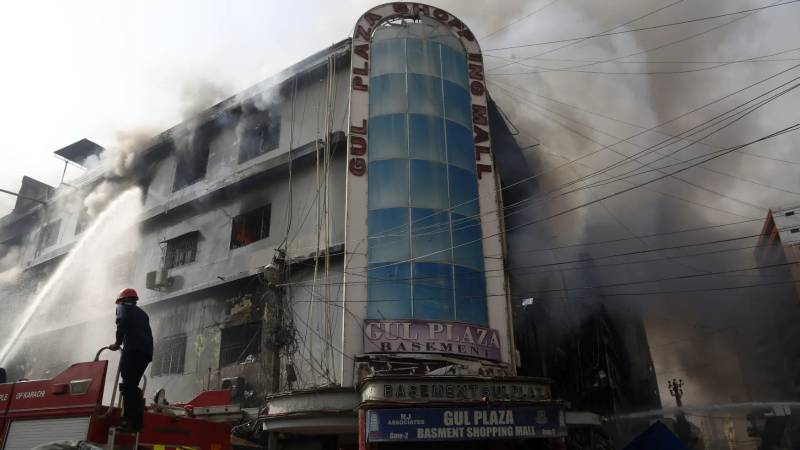
Karachi’s Gul Plaza shopping mall fire, which has already claimed 14 lives and injured scores, is once again making headlines—not because it has been fully controlled, but because it keeps reigniting despite a massive firefighting effort. Television cameras capture the valiant efforts of firefighters, rescue teams, and even the armed forces called in to assist—but one critical question remains unasked: why is the fire still not under control, and why is there no mention of foam-based suppression technology, a standard in modern fire science?
Reports from the scene describe firefighters struggling to enter the building as flames spread floor by floor. Water bowsers and high-reach snorkels dominate the coverage. Officials repeatedly highlight hydrants and water tankers, and politicians line up to express grief and condolences. Yet, for all the visible effort, the blaze continues, and reports of trapped people persist. What is clear is that Karachi’s firefighting system is heavily reliant on water-based methods alone, even when the fire has escalated beyond the point where water can effectively suppress it.
Most of the criticism covered by the media focuses on issues such as the insufficient number of firefighters, delays in their arrival, the misuse of building space for an excessive number of shops, and the carelessness of government officials. Yet no media outlet or firefighting expert has discussed foam-based suppression technology, most probably due to a lack of awareness about the subject.
Water, while essential, is only effective in the early stages of a fire. Once a blaze has reached a deep-seated, fully developed phase, as is the case at Gul Plaza, water applied externally or intermittently serves largely as a cooling measure. It cannot penetrate enclosed shops and warehouses filled with combustible goods, nor can it prevent re-ignition from smouldering material hidden inside walls and storage piles. This is precisely why the fire has been flaring up repeatedly: the fundamental issue is not a lack of effort, but a mismatch between fire behaviour and firefighting methods.
Foam-based suppression systems, long used in aviation hangars, chemical plants, and modern warehouses, offer exactly the kind of control needed in such situations. Foam smothers flames, cuts off oxygen, penetrates stacked materials, and prevents the cycle of re-ignition that water alone cannot stop. It is routine in settings like PIA aircraft hangars, where regular drills, equipment readiness, and trained personnel ensure the technology is effective.
No amount of manpower can substitute for a pre-planned suppression strategy and appropriate technology
In Karachi, however, foam is absent from municipal firefighting doctrine. The silence around foam on live television and in official statements is telling: the city’s firefighting apparatus either lacks foam entirely or does not trust it as a tool, leaving firefighters to rely on methods that are largely symbolic at this stage.
The problem is deeper than equipment. It lies in institutional culture, training, and urban governance. Buildings like Gul Plaza lack functional sprinklers, internal standpipes, compartmentalisation, and smoke management systems—all of which are critical for modern fire suppression. Compounding this, many shopkeepers do not maintain even basic fire extinguishers, leaving large areas completely unattended in the event of an outbreak.
These vulnerabilities are well known and recurring across the city, yet the firefighting department has never adopted a proactive disaster readiness plan, stocked necessary tools, or ensured the availability of chemical suppressants such as foam. Every fire in Karachi—from warehouses to shopping plazas—has exposed these weaknesses, but no long-term corrective measures have been implemented.
Firefighters are trained to respond heroically, but structural and systemic deficiencies often prevent effective intervention. External attacks with water become an endurance contest rather than a tactical solution. The reliance on large-scale visibility—dozens of fire tenders, snorkels, and ambulances—masks the underlying technical incapacity. Bringing in the armed forces, as is now being reported, underscores the scale of the challenge but does not solve it. No amount of manpower can substitute for a pre-planned suppression strategy and appropriate technology.
Foam alone, applied externally at this phase, would only mitigate re-ignition temporarily. The real solution lies in a systemic overhaul: equipping municipal fire services with foam-capable engines, training personnel in mixed-load commercial fire suppression, enforcing building codes, and mandating internal suppression and sprinkler systems.
Karachi continues to pay the price for treating fire safety as a post-disaster spectacle rather than a preventive discipline. Each fire, from Gul Plaza to previous warehouse and mall conflagrations, repeats the same script: heroic effort, visible deployment of resources, condolences, and then an inquiry—while fundamental vulnerabilities remain unaddressed. The absence of foam suppression in reporting, and likely in practice, is not a minor oversight; it is symptomatic of a system that has yet to internalise the science of modern firefighting.
As flames continue to consume Gul Plaza, the lesson is clear: courage alone cannot replace competence, and water alone cannot replace strategy. Until Karachi invests in technical preparedness, trains its firefighters in modern suppression methods, and enforces preventive regulations, fires will keep claiming lives, destroying property, and leaving the public and the media watching helplessly as the cycle repeats.