

Pakistan’s brief economic reprieve—driven by record remittances, the lowest international oil prices in three years, falling inflation, and a credit upgrade from junk status to “B‑”—belies the deep distress faced by its people. Despite $4.1 billion in remittances arriving in March alone and foreign reserves approaching $11 billion, the country is grappling with a troubling exodus of skilled workers, widespread poverty, and the decline of its agricultural heartland.
Water protests in Sindh, enraged wheat growers in Punjab, an escalating insurgency in Balochistan and militant ambushes in Khyber Pakhtunkhwa—all underscore the fragile threads still binding Pakistan’s federation. In Islamabad’s marble corridors, a tenuous coalition clings to power yet wields little real authority. And beneath the polish of stabilising macroeconomic indicators, rising public anger and deepening regional polarisation threaten to pull the country out of its uneasy limbo and back into full‑blown crisis—this, set against the backdrop of a sharpening U.S.–China rivalry.
Pakistan’s remittance inflows hit an all‑time high of $4.1 billion in March 2025, the State Bank’s governor announced, eclipsing previous records and underscoring expatriate lifelines. Over the first nine months of FY 2025 (July 2024–March 2025), these inflows swelled 33 per cent year‑on‑year to $28.07 billion, fanning hopes of external stability. Urban consumer‑price inflation plummeted to just 1.2 per cent in March 2025—down from nearly 27 per cent a year prior—offering a rare respite for beleaguered working and middle-class households. Even Fitch Ratings nudged Pakistan’s sovereign score from “CCC+” into investment junk territory at “B‑,” citing improved buffers and market access. Yet this modest recovery is stitched together by remittances and roll‑over of loans from China and Saudi Arabia, not by booming factories or thriving farms.
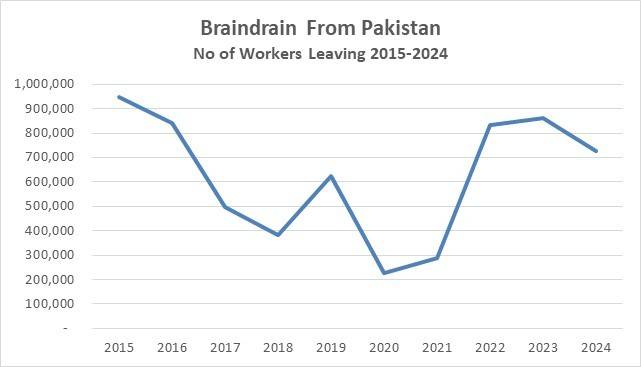
Behind the macroeconomic optics lies a troubling trend: an accelerating brain drain. From 2022 to 2024, an estimated 2.4 million Pakistanis—including highly skilled professionals like doctors, engineers, and educators—left the country, eclipsing the 2 million who departed over the previous five years. This surge signals not just economic desperation, but a deepening loss of faith in the state’s capacity to provide stability or opportunity. While remittances from this diaspora temporarily plug fiscal gaps, the exodus is stripping the country of human capital essential for long-term development.
Pakistan’s macroeconomy may be stabilising in terms of some indicators but in classrooms, courtrooms and canals, the human toll tells a different story
Hospitals, universities, and industries are being drained from within, compounding an already precarious growth outlook. Simultaneously, 37.2 per cent of the population—roughly 98 million people—live on less than $3.65 per day (2017 PPP). This modest improvement since 2018 owes more to demographic momentum than to any substantive poverty alleviation. In urban centres like Karachi, a nominal 20 per cent dip in food prices means little when unemployment lingers above 10 per cent and power outages remain routine. These are not isolated crises—they are structural failures converging into a national reckoning.
Agriculture, which employs a little more than one‑third of workers and accounts for 24 per cent of GDP, stands on a knife‑edge. An adverse growing season and halved support prices have shrunk planted area by 6.8 per cent, dragging forecast wheat output down from a record 31.6 million tonnes in 2024 to as low as 27.5 million tonnes in 2025 —short of national needs and import‑averse policy goals. In Punjab, farmers now sell wheat at Rs 2,000–2,200 per 40 kg, barely two‑thirds of their Rs 3,300 production cost—a loss‑making squeeze that leaves fields fallow and debt spiralling.
Yet Punjab’s bounty is born on water arrangements questioned by Sindh. Sindh’s farmers, who produce one‑third of Pakistan’s rice, report per‑capita water availability of just 820 cubic metres, below the United Nations’ 1,000 cubic metres scarcity threshold—after Punjab canals are alleged to siphon off 64 per cent of Indus flows, triggering deficits up to 38 per cent. Everywhere along the delta, saltwater creeps over the land. “My father told me it is 4.3 million acres that is now underwater,” lamented Fatima Majeed of the Pakistan Fisherfolk Forum, as mangrove nurseries drown and shrimp ponds sour.
The Cholistan Canal protests have become a flashpoint: PPP’s Bilawal Bhutto Zardari thundered on Friday at a massive rally in Hyderabad that his party would quit the federal coalition unless Islamabad shelved the Rs 211 billion irrigation scheme he decried as “water robbery”.
Meanwhile, Imran Khan and other PTI leaders languish in jail under riot and conspiracy charges, their protests answered with mass detentions and heavy-handed tactics. The ruling party PMLN has lost its vote bank in Punjab, while Shehbaz Sharif’s government scrambles for breathing room under IMF deadlines and public derision. Democracy’s façade cracks as the Establishment’s hand reaches deeper into law enforcement and judicial pronouncements.
In Balochistan, where $1.2 billion in gas and copper revenues flow north, 64 percent of the 14.9 million residents live without reliable electricity, from a grid they helped finance through the China‑Pakistan Economic Corridor (CPEC). Militant ambushes stoked by local resentment claimed several lives in 2024–25, a steady drumbeat of violence that undercuts any notion of development.
To the northwest, Khyber Pakhtunkhwa endured its deadliest insurgent year in a decade: at least 685 security‑force fatalities and 444 terror attacks in 2024 alone, according to the Centre for Research and Security Studies. Villagers whisper of nights when throttle‑back convoys curl through mountain passes, unlit and under siege, a grim reminder that Taliban still stalk the border region.
Beijing’s projects loom large: China holds nearly $29 billion of Pakistan’s external debt—22 per cent of the total—courtesy of CPEC loans for roads, ports and power plants that feed Chinese contractors and local oligarchs more than local communities. Pakistan’s repayment obligations peaked at $26 billion for FY 2025, though $16 billion may be rolled over into new loans, a tactic that extends repayment pain rather than alleviating it. With reserves flirting near $11 billion—just 2½ months of import cover—the country remains perilously reliant on donor grace, be it IMF tranches, Gulf deposits, or World Bank pledges.
Pakistan’s macroeconomy may be stabilising in terms of some indicators but in classrooms, courtrooms and canals, the human toll tells a different story. Nearly 100 million live below the poverty line, 38 million adults remain illiterate, while fields parch under just 930 cubic metres of water per person annually, projected to shrink to 860 by 2025.
As provinces chafe under federal edicts and armed groups stalk border highways, the centre’s grip loosens. Until Pakistan bridges the gulf between balance‑sheet metrics and lived realities—reintegrating its peripheries, quelling water wars, and halting its talent exodus—its veneer of stability remains perilously brittle. The country remains as vulnerable to an oil price shock as it was in October 2021, when it had a current account surplus of $797 million for the previous quarter.
Balochistan’s alienation, Khyber Pakhtunkhwa’s bloodshed, Sindh’s thirst, and Punjab’s discontent point to a deeper malaise. The warning signs are stark. Without bolder, fairer policies, the tightrope between macroeconomic stability and widespread discontent could snap, plunging Pakistan into turmoil again in the backdrop of an escalating US-China conflict.