

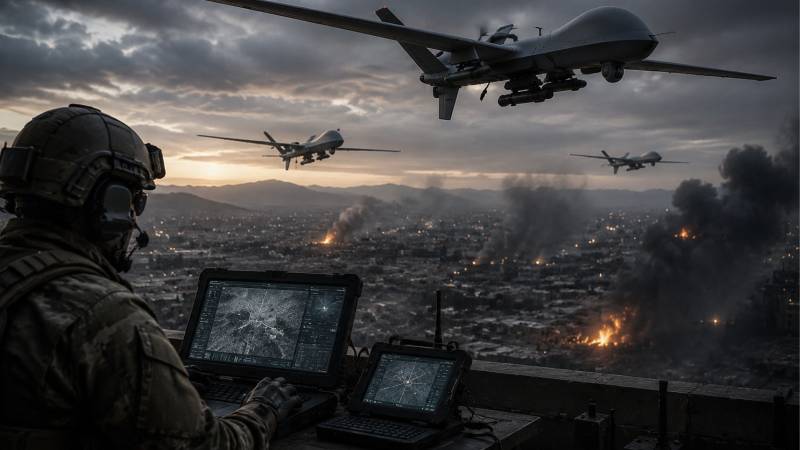
The continuous acceleration of the unmanned aerial system (UAS) into border defence and crisis setting is largely shaping the structural transformation of military power projection and interpretation in South Asia. Beyond their role in surveillance and intelligence, drones are increasingly playing a part in signalling and escalation games between states in an area marked by nuclear buildup, unresolved border issues, and recurring crises.
Over the past few years, there has been an increase in the use of drones by both sides along the Indo-Pak border. Indian defence sources have reported an increase in drone activity along the western border in recent years, with several incidents linked to suspected cross-border smuggling and surveillance attempts. In response, counter-drone technologies that include electronic jamming, radar detection and interception systems have been increasingly incorporated into the daily activities of border security.
Meanwhile, unmanned systems are no longer limited to the surveillance mission. During times of heightened tension, both India and Pakistan have increased their use of drones to gather and share intelligence, and conduct limited operational strikes, with India reported to have used drones alongside missile firings and air defence exercises in 2025. This is a progressive yet considerable change in military posture in the region as drones are now part of the escalation process and not the periphery of conventional warfare.
According to a recent Reuters analysis, the loitering weapons, including Israel made Harop drones, were used in coordinated attacks on radar and air defence facilities, and that both sides claimed to intercept drones coming at sensitive facilities. This was a broader development from the use of drones as instruments of passive surveillance to those of tactical engagements and deterrence signalling.
The significance of these developments is not only that drones are being discovered in claimed airspace but that drones introduce an ambiguity in interpretation that could signal a crisis. Unlike traditional military platforms, UAVs do not always act in a manner from which it is easy to determine what they are doing, for whom, and at what level of deception or escalation. One drone entering into another country’s airspace can be seen as a reconnaissance, probing, signalling, or readiness for possible kinetic actions. This uncertainty shortens decision making timelines during crisis and heightens risk for miscalculation during already turbulent times.
The same is taking place at the India-China border where drones have become an integral part of long-range surveillance at high altitudes. Drones and satellite-based surveillance systems have been integrated into the standard monitoring equipment of the region in places like Ladakh, which lessen the need for man powered patrolling and expand ongoing surveillance opportunities. It is part of a wider regional move towards the real-time monitoring of aviation traffic as a key element of border management.
Drones are also becoming an integral part of hybrid threat landscapes in South Asia beyond state-state dynamics. In the past, small drones used for smuggling arms, narcotics, and reconnaissance equipment to non-state actors have been seen regularly in the wild in India-Pakistan border regions. These systems are easy to conceal, low cost and can evade regular border senses. The end result is a hazy operational area where state and non-state players can function in the same area and even blanket each other topographically, making attribution and response more complicated.
This uncertainty shortens decision making timelines during crisis and heightens risk for miscalculation during already turbulent times.
In the counterinsurgency operations, drone operations have been conducted in Khyber Pakhtunkhwa province as well as border areas, where authorities have expanded surveillance, intelligence gathering, and counter-drone capabilities in response to evolving militant threats. Meanwhile, these same technologies have been linked to contentious events, where the state and non-state actors are vying over who did what. The developments underscore the fact that the future of drone warfare is not limited to competition between two states, but is diffused amongst several security domains in South Asia.
It’s also a very important technological aspect of this competition. India is expanding defence cooperation playing a more advanced game with the USA and Israel to access advanced UAV systems, as well as developing indigenous system such as the MQ-9B and Heron series, compared to Pakistan, which is restricted to Chinese-origin UAV systems and locally adapted systems. This imbalance isn’t just a lack of abilities; it’s a perception of strategy as well. Perceived technological imbalance can affect threat assessment, be a source of insecurity, and, in crisis situations, it can lead to risk-taking as a form of deterrence compensation.
Although the drone warfare is in expansion mode, South Asia has no formal procedure on drone activity. No bilateral procedure exists for identifying drones, no way exists of communicating about these types of incidents, nor do there exist any norms that will distinguish between surveillance and hostile action. However, as the technology rolls out more quickly than diplomacy adapts, this regulatory shortfall can become more and more impactful. There has been a dependence on reacting and signalling with force in recent crisis escalation moments, instead of de-escalation mechanism-building.
So over-all it is a paradox. While drones can boost surveillance, increase situational awareness, and decrease the likelihood of risks to personnel in contested areas, their drawbacks are equally significant. While drones have many benefits, such as increasing surveillance capability, improving situational awareness and reducing risks to personnel in contested areas, they also have their share of drawbacks. They also allow for more unclear “intrusions,” faster reaction times and greater chance of misunderstanding during times of stress. This uncertainty is a structural weakness in crisis management, in a nuclearized area where stability is crucial and the clarity of intent is decisive.
Diplomacy by drones in South Asian, therefore, is not only a matter of technological modernisation. It’s a more fundamental shift in space perception, intent understanding and managing escalation when uncertainty is possible. The future stability of the area will not rely so much on the growth of drone capabilities as it will on the ability of the states to establish common norms, communication and crisis management processes able to govern an area where the difference between observation and aggression is becoming more ambiguous.