


Pakistan’s political pundits often dismiss Sindhi organisations as merely another collection of regional political entities. However, the Awami Tehreek’s sophisticated strategies and organisational depth forced a departure from this conventional wisdom. The movement demonstrated its political maturity and organisational acumen during the MRD movements of 1983 and 1986, proving it was far more than a local outlier. Remarkably, it emerged as a singular people’s organisation, uniquely integrated into the lives of peasants, women, students, writers, and the middle class through both horizontal and vertical mobilisation mechanisms.
While the Awami Tehreek’s later influence is well-documented, a critical gap remains in the historical record. Until now, scholars have failed to unpack how, exactly fifty-six years ago in the first week of March, this radical organisation was born. This article examines its ideological soul, a core identity that, despite its impact, remains largely unexamined.
Let me explore its early formation years. Historical records confirm that the Sindhi Awami Tehreek began its formal existence on 5 March 1970, at a convention held at Bhurgri House in Hyderabad. Seventy representatives from various villages and towns attended the meeting to deliberate on the future of the Sindhi people. This assembly followed months of grassroots mobilisation and cultural outreach throughout the province. The delegates elected Advocate Abdul Hafiz Qureshi as president and Rasool Baksh Palijo as general secretary.
The organisation immediately launched a campaign against the Pakistan government’s land grant policies in Sindh. On 14 March 1970, the Tehreek protested the sale of Sindh’s lands to industrialists, retired military, and civilian officers. This struggle resonated deeply with the masses. The leadership utilised a strategic masterstroke by focusing on a single demand: “Stop the Auction.” This slogan spread rapidly across the province because of its simplicity and commanding tone.
At its inception, the Sindhi Awami Tehreek faced a crowded political environment. Jamaat-e-Islami dominated the urban centres while the Pakistan Peoples’ Party held sway over the rural districts. Meanwhile, students followed the Jeay Sindh Students Federation and a small minority of the professional class aligned with Karachi and Lahore-based progressive groups.
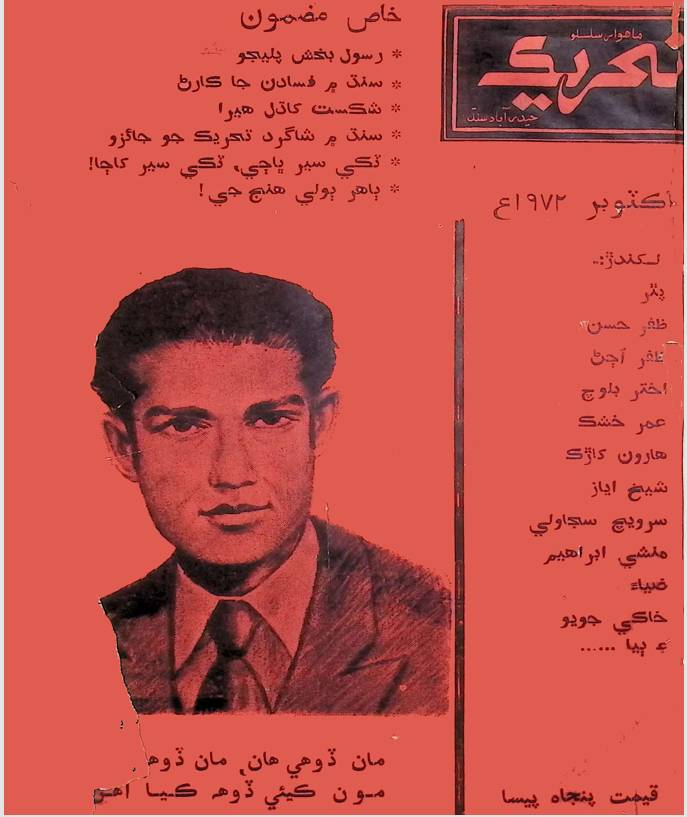
The movement secured its position through bold actions and cultural activities. Workers campaigned for the Sindhi language and resisted the illegal ejection of tenant farmers. The Tehreek exposed the collaboration between landlords, the military, and the civilian bureaucracy. To solidify its theoretical reach, the organisation launched a monthly magazine, Tehreek, in October 1972. It was effectively utilised as the organisation’s organ to reach the far-flung rural areas and urban pockets of Sindh. Rasool Baksh Palijo’s articles published in Tehreek magazine established the theoretical foundation for the movement. Following the Maoist tradition of the ‘Mass Line,’ Palijo transformed the publication into a collective educator and organiser for the Sindhi masses.
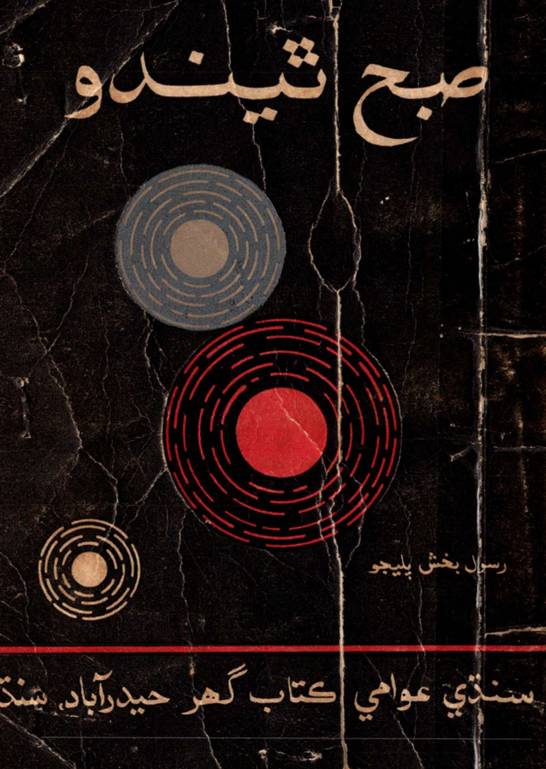
Rasool Baksh Palijo authored a series of definitive articles. These writings functioned as a strategic roadmap for a revolutionary-patriotic organisation, the Sindhi Awami Tehreek.
The following analysis explores nine articles to understand how a small group of lower-middle-class Sindhis created a political space and succeeded within the congested political landscape of Sindh and Pakistan.
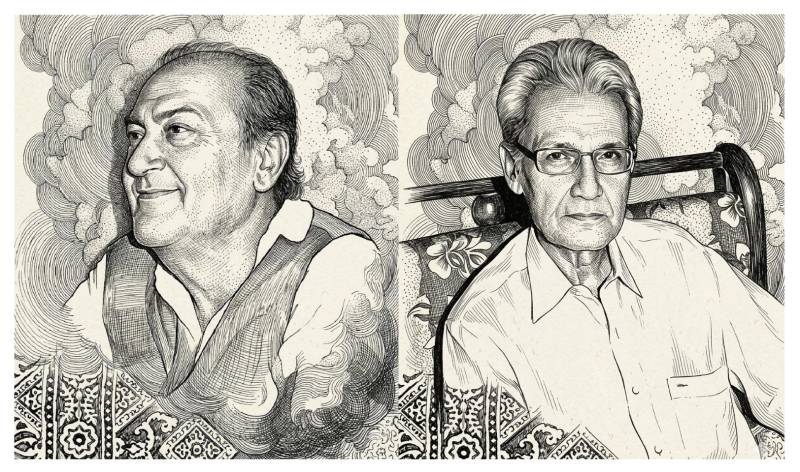
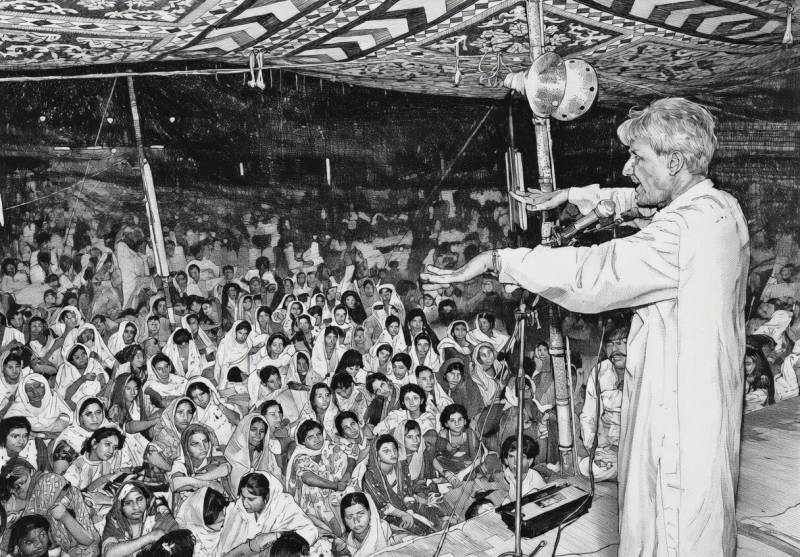
Right: Rasool Baksh Palijo, General Secretary of the Sindhi Awami Tehreek, 1970
1. On the Requirements of National Unity
This article states that a genuine national unity must be forged through a patriotic struggle, and that struggle should be people-centred. Success depends upon revolutionary vigilance and the mastery of a correct strategy that advances the struggle of the oppressed people. However, some prerequisites are required to attain the goal. One of them is a deep and serious study of the science of revolutions. The author explains that such an education, no matter how small in quantity, must be of the highest calibre in meaning and concept; rather, it should meet international standards. He adds that such education should contain no errors, no single essential aspect should be overlooked, and no single aspect should be given undue emphasis. It must be sequential and dialectical, explaining both evolutionary and revolutionary changes.
Regarding the style of expression for such an education, he emphasises that it must be simple, direct, clear, and complete. It must be devoid of complexities, confusion, hollow academic hypotheses, metaphors, useless embellishments, and rigid, lifeless words; it must be concise and pure. However, the proposed education must be so artistic, impactful, and semantic that a highly educated individual, even a PhD holder or an expert, immediately realises that what he understands now is for the first time in his academic and professional life.
He also proposes textbooks and divides them into three parts. Part one should have three sections: the first section should be about revolutions and history. The readers should not merely understand accidental occurrences but must understand the societal impacts of those changes. In this regard, the biographies of Lenin, Ho Chi Minh, Mao Zedong, Sukarno, Kim Il-sung, Gamal Abdel Nasser, Fidel Castro, Karl Marx, and Friedrich Engels should be prepared. While describing their deeds, the necessary points of revolutionary science and history will naturally emerge for discussion and debate.
The second section suggests books, stories, and major events of peoples’ history. These include the French Revolution, the Paris Commune, the 1905 Russian Revolution, the February and October 1917 Revolutions, and the Great Chinese, Korean, Indonesian, Egyptian, Vietnamese, and Cuban Revolutions, as well as the Great Chinese Cultural Revolution. Likewise, section three proposes some books and essays about 'Socialism', 'Science of Revolution', 'Dialectical Materialism', 'Historical Materialism', and 'Peoples’ Revolutionary-Patriotic Struggles' around the world. Apart from this, some books should be included that educate political workers that national and class struggles are not contradictory in Sindh’s context.
Rasool Baksh Palijo’s essays enlightened a vast number of Sindhis, helping them take responsibility for their own past, present and future
The second part focuses on selected Sindhi literature and some eras of history. He adds that patriotic poets such as Shah Abdul Latif Bhitai, Shaikh Ayaz, Khalifo Nabi Bakhsh, Sarwaich Sujawali, Niyaz Hamauni, Dr. Tanveer Abbasi, Imdad Hussaini, and Ustad Bukhari should be read and popularised. Some events highlighting Sindhis’ achievements should be read and celebrated. Likewise, some Sindhi short stories and abridged novels should be designed to elevate the national spirit. In the third part, he proposes that condensed masterpieces of world literature from international revolutions, both classics and modern, should be published in the Sindhi language.
The article concludes with an assertion that Sindh’s national unity necessitates a pro-people struggle equipped with a scientific objective.
2. The Struggle Against Wadera-shahi is an Essential Part of the National Struggle
The struggle against Wadera-shahi is an indispensable component of the broader national movement. In the rural hinterlands, the Sindhi peasantry maintains a persistent grievance against the Waderos, identifying them as the immediate and primary antagonist of rural people. Therefore, the liquidation of feudal remnants is the priority of the revolutionary struggle. Conversely, the urbanised intelligentsia and the relatively affluent classes prioritise a confrontation with Punjabi-Panahgir imperialism and exploiters. For this urban stratum, the struggle against the Wadera is often relegated to secondary importance.
The article describes at length how Wadera-shahi is at work against the peasant and rural people. It mentions eight situations where the Wadero betrays Sindhis, aligns with Punjabi-Panahgir imperialists and exploiters, and damages the national struggle.
First, Wadera-shahi is a root cause of the Panahgir-Punjabi group’s influence in Sindh. The author elaborates that in pre-Partition Sindh, Muslim Waderas and Hindu Seths fought to secure their political and economic interests. Their unnecessary fights created a political void that was filled by the leadership of the UP and Punjab Muslim League, who stepped into Sindh’s affairs. However, in those days, Waderas and their new leaders from Indian areas separated Karachi from Sindh and imposed One Unit. Until now, the Wadero harms the interests of the common Sindhi, and their internal group fights have made them a laughingstock.
Second, Wadera-shahi halts Sindhis's fight with the exploiters, and in all types of roles and representations, his class betrays the common Sindhi. Wadera-shahi, in collaboration with officials and other orthodox groups, has entangled the poor Sindhi in fake police cases, unjust evictions from agricultural lands, nominations in fake FIRs, and related burglaries and theft cases. Therefore, the rural population merely tries to survive rather than wage a war against their exploiters.
Third, a common Sindhi does not consider our struggle as the national struggle. It is so because our national struggle neither gives importance to the problems of the people, nor do we consult them about the devised programmes. Therefore, a rural Sindhi neither gives importance to the national struggle nor becomes part of it. This means that what educated people call the 'national struggle' is merely the middle class’s wish list.
Fourth, the majority of Sindhi peoples’ basic and perpetual problem is Wadera-shahi. The crises the Sindhi masses face are poverty, chronic hunger, illiteracy, and mental subjugation. These are direct outcomes of the exploitative Wadera-shahi system. This internal structure serves as the primary mechanism of oppression, effectively neutralising the productive potential of the peasantry and keeping them in a state of stagnant dependency.
The Wadero maintains a vacuum of ignorance and economic frailty; such a situation creates the specific conditions that also allow outsider exploiters to plunder the resources of the common Sindhi. Consequently, in the current stage of the struggle, the common Sindhi correctly identifies the Wadero as their immediate and primary enemy. A successful patriotic revolution necessitates the liquidation of this feudal class to forge a genuine national unity capable of resisting both internal and external exploitations.
Fifth, only that struggle will succeed which addresses the basic problems of the Sindhi people. At the time of the anti-One Unit movement, some educated Sindhis tried their utmost to make their struggle a mass movement but failed to achieve the desired results. However, in 1967, some students went to prison and equipped themselves with broader people’s ideologies, and it was seen that their struggle gave a new face to the national struggle.
Sixth, the Sindhi national struggle will not bear fruit urgently. Sindh’s struggle has a long way to go; it will be zigzag rather than straight. Undoubtedly, it will not be instant, neither can its duration be predicted.
Seventh, Panahgir-Punjabi pseudo-progressives disillusion Sindhi labourers and educated Sindhis. Without a doubt, the Sindhi national struggle has failed to address the issues of the common people. Until now, we have taken care of the issues of minority people who are well off and live in towns, and we call it the national struggle. This political lapse gives an opportunity to Panahgir-Punjabi pseudo-progressives to brainwash labourers into believing that the present 'national struggle' is a struggle of Waderas and well-off people. Therefore, Sindhi labourers and some middle-class people are detached from Sindh’s national politics.
Eighth, the struggle against Wadera-shahi should be an integral part of the national struggle. The real cure for Wadera-shahi is the complete elimination of the Zamindari system. Without this, no Sindhi nation can liberate itself. Therefore, Sindhis must unite on a national agenda, and that must contain programmes for the welfare of the Haris and the common Sindhi. We must neither delay in demanding peasants’ rights nor accept the oppression of Waderas. We must not enter any compromise on our demands. Instead, we must firmly stand on the truth of our agricultural laws, rights, and the law of the land. We must not bow before Wadera-shahi or power, whatever it may be.
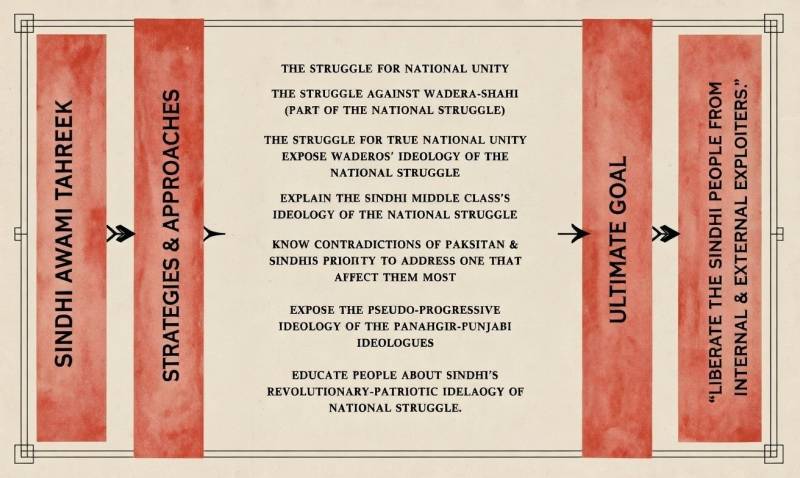
3. The Struggle for True National Unity
The present objective conditions in Sindh are historically unprecedented; the depth of the current crisis finds no parallel in the past. The only systematic path to transcending this deterioration is the forging of a disciplined, iron-clad unity among the masses. This necessitates five distinct yet interconnected levels of unity:
The first level is the unity of objective and destination. The collective economic, political, and cultural demands of the Sindhi nation constitute a singular national objective. This objective is divided into two strategic phases: immediate contradictions that can be resolved through our own skills and resources, and future strategic challenges that must be addressed systematically. It is an imperative of the vanguards to communicate these future objectives to the masses today, thereby preparing the subjective conditions for the upcoming struggle.
The second level is the unity of the correct path. Explaining the roadmap to the Sindhis’ destination is the second vital step. Presently, the nation is stratified into five factions: (1) Haris, (2) Labourers, (3) Big Landlords, (4) Capitalists (upper and middle class), and (5) the Lower Middle Class, comprising self-cultivators, employees, artisans, and small traders.
Certain factions, due to their social formation and parasitic economic interests, inherently sow rifts and confusion within the national ranks. It is therefore a strategic necessity to purge these reactionary elements from our formation. Only then would patriotic groups be able to resolve their internal contradictions amicably, establish scientific standards for future dispute resolution, and move towards genuine national unity.
The third level is the unity of motion and advancement. Even with correct policies, if the chosen path of advancement is flawed, forward motion remains impossible. Currently, the Sindhi people pursue fragmented, parallel paths that dissipate revolutionary energy. It is essential for all patriotic people to consult and consolidate all efforts. We must recognise that current decisions must remain adaptable to future material conditions, incorporating options previously unconsidered.
The fourth level is the unity of the organisation. Unity of purpose and path is insufficient without the unity of organisation. History proves that without a centralised organisation that carries the struggle, unifies factions, fulfils the vanguard role, and enforces discipline across the rank and file, success is unattainable. No patriotic struggle can succeed without a dedicated revolutionary-patriotic organisation.
The fifth level is the unity of action in the struggle. Finally, the unity of action is also important. It is a tactical failure that while some patriotic groups are active, others remain stagnant. Success in the struggle is only possible when various groups coordinate their efforts and provide mutual support, transforming isolated acts into a collective revolutionary wave.
4. The Wadero’s Ideology of the National Struggle
In Sindh, the Wadero perpetuates the exploitation of peasants and the lower rural classes. The national struggle of this class revolves around two points: attack the outsider exploiters but never pinpoint the internal exploitation that has continued in Sindh for centuries. Therefore, this group’s ideology stands far from the class question. It stands too far because the Wadero fears that if the people organised themselves, they would surely liberate themselves from his exploitation, and the Wadero-class would lose its sole right to exploit the poor of its own nation and land.
The Wadero keeps himself relevant through four strategies: 1) When the people’s struggle is weak, he aligns with external exploiters; 2) When the struggle of the poor gains importance, he retains contacts with both the people and the exploiters; 3) When the exploiter is weakened and the struggle of the poor takes a serious turn, he resumes his involvement untimely; and 4) Whenever he sees the total success of the national struggle is inevitable, he joins it and seizes its leadership by hook or by crook.
Apart from this, other features of the Waderos’ national struggle are: a) engaging with the national struggle in such a fashion that it must protect his class interests or at least not damage them; b) ensuring that while the majority of the national struggle workers belong to the middle class, the Wadero heads it as a leader; and c) ensuring that sometimes, small landholders, artisans, and middle-class people also get some benefits by being associates of this so-called national struggle, which retains them through tricks.
The revolutionary-patriotic ideology has to expose the Wadero as the internal enemy within the nation. The masses have to be educated that the Wadero-class is opportunist, treacherous, and a protector of feudal exploitation under the mask of patriotism. Thus, the only way is to smash this false ideology, and then the Sindhi people’s true national struggle will advance along the correct class lines.
5. The Sindhi Middle Class’s Ideology of the National Struggle
The Sindhi middle class or the bourgeoisie is a technical term defined or applied with specific scientific intent. While popularly defined by income, in Sindh’s context, it comprises all elements of society including peasants and labourers, except the landed aristocracy. However, rigorous standards define that no upper bourgeoisie or such family exists in Sindh, with the notable exception of the Haroon family. Historically, pre-Partition Sindh possessed only a fragile middle class represented by Sindhi Hindus. The post-Partition bourgeoisie has emerged as a structurally weak and vacillating force. Consequently, this class perpetually seeks the patronage of either the feudal landlords or Punjabi-Panahgir imperialism and exploiters, which is fundamentally anti-Sindhi. Since the colonial era, this stratum has aligned its interests with the British Raj. Later, they served as touts and collaborators for all governments and anti-people forces.
The Sindhi bourgeoisie is not yet positioned to openly contradict the Wadera-class or the external exploiters. Instead, they lean toward these forces to secure petty concessions while simultaneously keeping their fellow citizens in a state of subjugation, just to protect their own easily earned status. Compared to the masses, this class is orthodox and reactionary, and views the national struggle with hostility. In the name of practical politics, this group preaches compromise. This group claims that progress is impossible without the landlords’ support. Sadly, this group teaches the masses to accept exploitation as fate, and to accept the Wadera as a protector rather than a predator.
During the colonial period, higher education in Aligarh or Junagadh served only to entrench feudal attitudes. Even those who studied in Europe remained aloof from modern revolutionary discourse due to their inherent class limitations. Today, the Sindhi student is vibrant but remains isolated. Their energies are often wasted in hollow slogan-mongering, which they mistakenly label as struggle. The educated class remains cut off from international social, political, and cultural trends.
The Sindhi bourgeoisie is immature and opportunist. This group endorses the reactionary ideas of redundant segments like Jamaat-e-Islami or the pseudo slogans of Punjabi-Panahgir politicians. Some of the members of this group adopt a detached attitude from the masses or an existentialism of Western writers and remain completely ignorant of their historical role. Their struggle is confined to issuing press releases and attending non-political gatherings predicated on the arrogant belief that the masses are ignorant and lazy.
A review of the peoples’ struggle reveals a fundamental truth: those movements achieve victory that are led by labourers and peasants. While the bourgeoisie may join the struggle initially, their wavering nature and petty class interests push them to abandon the common cause. To end this cycle of exploitation, revolutionary consciousness must be spread directly among the Haris and labourers so they may reject the hypocritical leadership of the middle class and achieve true liberation from both internal tyranny and external domination.
6. Some Contradictions of Pakistan and Sindhis' Priority to Address the One That Affects Them Most – I
Pakistan is a bundle of contradictions, but a lead contradiction is a national question. Until and unless that contradiction is solved, merely changing the government right away from Khuhro to Bhutto doesn’t dent the exploitative structure. Presently, there are six anti-Sindh groups that are very much active against the revolutionary-patriotic struggle of the Sindhi people. These groups are: 1) big Sindhi zamindars and Sindhi bureaucrats; 2) groups of military and civilian bureaucracies; 3) big landlords of Punjab and Karachi, and their capitalist allies; 4) Abul A'la al-Maududi type orthodox groups, who exploit people in the name of Islam and threats of martial law and dictatorships; 5) Panahgir-Punjabi groups’ educated middle class and lower-middle class, who in the name of progressive ideology distract a common Sindhi from the revolutionary-patriotic struggle (presently, the group of fake leftists is divided into Chinese and Russian factions, but both are against the Sindhi people’s righteous struggle); and 6) America, which is the leader of international imperialism.
The author elaborates on how each anti-Sindh group works against a common Sindhi. However, he is of the view that one of the deadliest groups is the so-called Panahgir-Punjabi progressive group that, since the earlier days of Pakistan, has portrayed itself as a legal heir of the Indian Mughal Empire, custodian of Islamic culture, and the sole representative of Pakistan. This group always gives an impression of knowing more about the politics of Pakistan, South Asia, and international affairs. In its political discourse or deliberation, the Sindhi, Baloch, and Pashtun are non-entities. The Sindhis could only expose this group's tricks when they study more and understand that all nations' interests are not the same.
7. Some Contradictions of Pakistan and Sindhis' Priority to Address the One That Affects Them Most – II
This so-called progressive group also survives by being a propagandist. It claims that a nation cannot act as an exploiter, a rhetoric designed specifically to shield the structural interests of the oppressive nation. These parrot-phrase-mongers conveniently omit Karl Marx’s 1848 directive regarding the German attack on Italy, where he asserted that genuine German progressives must support the independence of Italy to prove they are not complicit in the exploitative machinery of their own ruling class or even nation. However, this so-called progressive group also disregards Lenin’s fundamental distinction between oppressor and oppressed nations. Furthermore, they ignore Marx’s observation regarding the German attack on France, in which he informed the German intelligentsia that such an invasion was rarely possible unless all German strata were in functional agreement.
The primary weapon of this pseudo-progressive intelligentsia is the whispering wedge: a clandestine conspiracy of secretive communication and rumours designed to drive a division into the peoples’ struggle and split the Sindhi revolutionary-patriotic organisation. A prominent example of this reactionary intrigue was the campaign against Comrade Hyder Bakhsh Jatoi, where they propagated the falsehood that his struggle against exorbitant agricultural taxes served the Zamindars, thereby branding a champion of the Haris as a leader of the landlords. Beyond this whispering wedge, the group’s other toolkit of sabotage includes manufacturing naive individuals as national-level progressive mouthpieces, launching conspiracies to make genuine mobilisation impossible, and using connections within the Urdu press for the character assassination of the leaders of oppressed nations. These deceptive techniques helped them to maintain hegemony, because the Sindhi middle class was numerically insignificant.
8. The Pseudo-Progressive Ideology of the Panahgir-Punjabi Ideologues
The article analyses Panahgir and Punjabi history to expose how pseudo-progressives sabotage the 'national question' in Sindh. This group opposes Sindh’s historical claims over its land and resources. The members of this group frame the national struggle as a threat to the country and then negotiate a higher rate for their services. This group also manipulates the oppressed nation’s intellectuals for their group’s gain. They blackmail Zamindars and Sardars to force unprincipled alliances. To undermine the peoples’ movement, the group portrays the national struggle as an outdated concept and also occupies political forums to crush radical debate. This group’s age-old role is to train fifth-columnists to slander revolutionary leaders as illiterate and systematically confuse the masses.
Through an ideological rat trap, this group deceives the revolutionary-patriotic struggle. They claim workers have no motherland to justify foreign labour’s exploitation. This group deliberately denies the existence of nations to assert that only classes exist. This group also argues that the national question or contradiction harms the poor and benefits the Zamindars. Equating all Waderas, regardless of their national status, allows them to manipulate the masses. This group also argues that the national struggle invites foreign interference or that, in the end, the upper class captures it. Another naive argument of this group is that the class struggle solves the national question in its own way. This group arrogantly and ignorantly insists that Panahgir-Punjabi leadership must remain dominant or retain leadership because Sindhi labourers do not lead the trade unions.
The author cites Marx, Engels, Lenin, and Mao to refute these fake claims. These citations prove that every nation has distinct interests and that supporting their struggle fulfils the revolutionary duty. Since the international revolution relies on successful national struggles, denying a nation’s existence violates the ideologies of Ho Chi Minh and other revolutionaries. This fake progressive group acts as paid agents for industrialists. Trickily, this group aligns with oppressive groups with the pretext of helping them, but in reality, tries to prolong the exploitation. It shouldn’t be forgotten that exposing this pseudo-progressive group is a prime revolutionary act.
9. Sindhis' Revolutionary-Patriotic Ideology of National Struggle
The article defines that an understanding of Sindh’s challenges depends upon a thorough grasp of international politics. National slavery presents two faces: internal and external exploitations. Political workers must know and master the evolution of the kith and kin system, slavery, feudalism, and capitalism. Every era and actor eventually faces replacement by new historical forces.
The Sindhi people require a separate strategy to address their interests. The long-term goal of the Sindhi revolutionary-patriotic struggle is to liberate the people from exploiters and make them masters of their own fate and wealth. Ending the curse of Wadera-shahi remains the primary challenge in this process. Agreed, feudalism exists on the verge of natural death; yet, the revolutionary organisation must act to catalyse its end. Sindhi society, like all societies, faces a choice between capitalism and socialism. Rejecting socialism implies an automatic choice of capitalism. Since socialism cannot appear instantly, a National Democratic Revolution serves as an intermediary step to provide breathing space. This period witnesses economic reforms. Achieving this goal generates a new alignment of friends and enemies. Peasants and labourers constitute the primary friends. Enemies include the Panahgir-Punjabi-Jagirdar, their touts, and American imperialism and its allies, like the Mullah and fascist gangs. Indirect opponents are workers under the influence of fake progressives and Waderas.
True supporters are the patriotic middle class and farmers, along with enlightened landlords and some groups of Balochs or Pashtuns. Some righteous individuals from Panahgir-Punjabi groups or anti-imperialist factions also strengthen the national struggle. It must be understood that Sindhis’ revolutionary struggle does not hold ill-will against the common Panahgir-Punjabi people. A long-term revolutionary struggle will resolve these contradictions through a natural process. However, Sindhis must refuse to compromise on their historical claims to land, territory, and all types of resources. Furthermore, we have to encourage common people of other nations to revolt against their own exploiters. Political groups in Punjab must be insisted upon and reminded to struggle for the due status of the Punjabi language in Punjab. The political worker has to remember that the Sindhis’ revolutionary-patriotic struggle targets only those Waderas who act against the interests of the Sindhi people. The revolutionary cadres must erase traits of dictatorship and opportunism through discipline and continuous education. One more point is that success requires opening different fronts to engage opponents. However, a patriotic organisation serves as the necessary vanguard. This organisation understands every zigzag and twist of the struggle. It provides collective leadership to unite various patriotic groups for unified action.
Let me conclude that the conceptual-strategic contours of the Sindhi Awami Tehreek established a systematic framework for national struggle. This doctrine targeted both internal enemies and external exploiters. Today’s political workers should not forget that Rasool Baksh Palijo’s essays enlightened a vast number of Sindhis, helping them take responsibility for their own past, present, and future. How can one deny that these texts, over five decades later, still inspire the men, women, students, workers, peasants, and the educated class of Sindh to take collective action? They continue to fuel the length and breadth of an unstoppable revolutionary tide across Sindh.