

In the past four decades, most of the journalistic, policy, and scholastic studies on Afghanistan have focused on two broad themes and analyses; terrorism, Afghan Jihad, rise of the Taliban, second on the role, rivalries, and interventions of great powers--British, Soviet, and the US. The primary thrust has been on the warrior skills of Afghans and their resilience to resist any foreign rule. The renowned Pakistani journalist, Ahmad Rashid unveiled the Taliban at the global level in his pioneer book, Taliban: Militant Islam, Oil and Fundamentalism in Central Asia (2001). They were perceived and treated as terrorists. Steve Coll, Ghost Wars: The Secret Story of the CIA, Afghanistan, and Bin Laden, From the Soviet Invasion to September 10, 2001 (New York: The Penguin Press, 2004) provides abundant evidence and incisive portrayals of individual decision-makers, their relationship with intelligence agencies and how the war on terror is planned and executed; first by promoting ‘Global Jihad’ and then by discrediting and thereby devising policies and developing strategies to uproot the same Jihadis, who were once allies but now became declared enemies and symbols of ‘evil’.
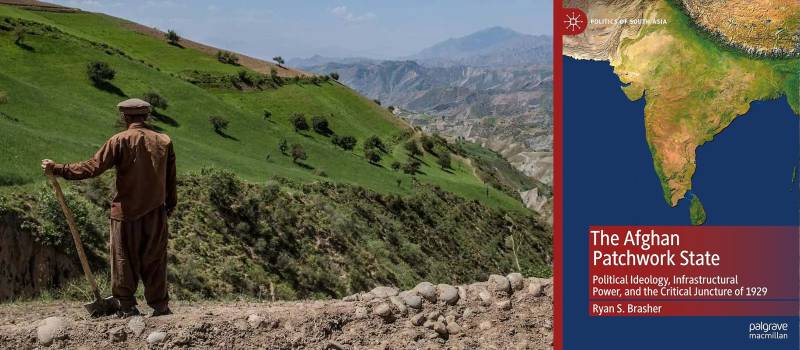
Even in the post-2002 period despite waging a war and disrupting sources of terrorist infrastructure, the declared intent of the US & NATO partners was rejuvenating and resurrecting the Afghan state, yet it remained illusionary, why? Cognizant and acknowledging multiple discerning recent studies on the deepening US involvement and botched up withdrawal from Afghanistan (2021), Brasher has astutely observed that these studies primarily focus on recent history (1979-2021), and despite valuable information on the changing dynamics of political power remains fruitless in explaining the inadequacies of state formation in Afghanistan. Ryan S. Brasher, The Afghan Patchwork State: Political Ideology, Infrastructural Power, and the Critical Juncture of 1929(Palgrave/Macmillan,2024), which has grown out of Brasher’s doctoral dissertation is a fastidiously researched and perceptive study. The book is divided into eight chapters, I have found chapters 1,2,3,4 & 6 refreshing, informative, and engaging.
Shifting focus from Afghan Jihad, warrior skills, and militancy he zeros in on the challenges of state formation. Brasher’s intent and declared goal is, ‘’to provide a theoretically and historically grounded explanation for the perennial failure of the Afghan government to directly govern the territory formally under its control, despite the centralised unitary structure of governance it has maintained since the days of Amir Abdul Rehman in the last decades of the nineteenth century.’’ He continues, that the goal will be, ‘to explain the origins and persistence of patchwork nature of the Afghan state’. Tracing the lineage and kinship intricacies of the perennial tribal web of Afghanistan’s societal structure, Brasher does a commendable job in simplifying and constructing this ‘patchwork’, and if I may use the expression stitching together challenges of the Afghan state through history & ethnographic insights. In this patchwork construction of state formation, he lionizes the role of local elites in their beliefs and perceptions of threats that influence the shaping of their ideological framework. He interjects his ideology theory of state formation in explaining the case of Afghanistan. He constructs a confluence of three factors to propound the ideology theory of state formation in Afghanistan; elite ideology, elite perceptions, and treatment of regional elites. Contextualising the historiography of Afghanistan, he treats 1919 as a cataclysmic year, claiming that until then, the socio-economic structures of Afghanistan and Iran were similar; no roads or railroads, poor transport and educational networks, and small military.
Perceptions of the central elites matter in shaping their political ideology as well as perceived threat from the regional elites and that is what determines their ability to use force or coopt or leave alone the regional elites and the peripheries
However, post-1919, Iran‘s infrastructural power changed, which facilitated core-periphery connectivity and led to the consolidation of centralising elites to secure territorial control of the state, in the case of Afghanistan that did not happen. The Qajar state in Iran and Amir Abdul Rehman in Afghanistan had little power beyond their capitals, the regions and sub-nationals were autonomous and had considerable local authority. He contests that the European model of State formation/origins does not explain the exceptionality of Iran and Afghanistan and their historical trajectories, and nor do anti-colonialism theories lead to state formation. Brasher introduces the creation of Afghanistan in a nuanced and innovative way as an ‘Imperial buffer state’- a state, where colonial institutions were not established. He continues that Afghanistan & Iran emerged as non-colonised and non-European states, and continued to survive as imperial buffers, that need to be explicitly studied as an alternative with a distinct set of contextual factors and incentives’ and according to him, Afghanistan is such a case.
Furthermore, he portends, that in the case of Afghanistan, ‘political ideology’ serves as a stronger explanatory power as compared to ‘structural or cultural’ factors. In this context, Brasher relies on and synergises rational choice and elite theory literature and asserts that in a post-imperial buffer state like Afghanistan, the elite’s ideology acquires primacy in the formulation of the state. He asserts, ‘‘elite ideology of legitimation shapes institutional strategies and consequently explains relative levels of infrastructural power at both the national and sub-national levels in non-colonised agrarian societies like Afghanistan’’. Here Brasher brings in three Weberian ideal types of legitimations of authority, legal-rational, traditional, and charismatic. He is dismissive of charisma and argues that in the case of Afghanistan, the central state elites rely on traditional authority, seeking and ensuring personal loyalty to the ruler, like the ‘Sultans’.
Perceptions of the central elites matter in shaping their political ideology as well as perceived threat from the regional elites and that is what determines their ability to use force or coopt or leave alone the regional elites and the peripheries. He shows how ‘infrastructural power ‘is deployed by the elites— to curb any threats and challenges to their rule. Concisely and perceptively, he lays out two models of rulership in Afghanistan. The first model, Brasher argues had modernist pretense, as it strived to emulate the Turkish and Iranian model and the strategy was to pursue centralisation. He articulates Bureaucratic absolutism of Amanullah (1919-1929) was inspired by a progressive intellectual, who was also the father-in-law to Amanullah. As a reformist, Amanullah abolished child marriage, discouraged polygamy, opened girls’ schools, sent a few women to Turkey for education, and restrained the judicial powers of the Mullah/religious clergy. Amanullah made another smart move, in 1921 recognising the Soviet Union to the discomfort of the British. In the second model, the central elites had limited control confined to the capital, Kabul, the periphery – the rest of the territory was relatively autonomous. Brasher labels it as the primordial absolutism of Nadir, which again relied on the local elites who were glued to locality, language, and region.
The primordial absolutism of Nadir is best reflected by the ‘Musahiban regime’ that took power in 1929. Brasher defines 1929 as a ‘critical juncture ‘in Afghan history as Muhammad Nadir Shah and his brothers had a cosmopolitan childhood and youth in northern India under the British Raj, yet they viewed Afghan society and its relationship with central authority in a traditional way of preserving status quo and perpetuating their rule. Musahiban’s ascendency and entrenchment energised the traditional order (chapter 4). This chapter provides a scintillating account of intrigues, the mechanisation of elites, and the British involvement in the overthrow of Amanullah. Brasher draws an insightful comparative study of two Afghan leaders Amanullah, modernist, and Nadir Khan, traditionalist, but both venture to rule through absolutism—bureaucratic or primordial. In the process, this study also provides a deep understanding of the familial connections of the rulers, how, brothers, cousins, uncles, and their allies and even foes are lured into loyalty through alliance, intrigue at times exclusion, and even physical termination.
Traditional loyalty rests on personal loyalty to the ruler, so family and kinship networks become important for the administration and economic clients. Both Amanullah Shah and Nadir Khan were absolutist, not constitutional or proto-democratic, rulers who differed primarily on the question of state centralisation and administrative change. Two models of governance in the case of Afghanistan and both despite different orientations and outlooks operationalise primordial absolutism and bureaucratic absolutism, both retain control in the center and give relative autonomy to the periphery the outcome is that state-building remains stunted and patchy, while the traditional state continues to function as an imperial buffer state. Despite, persuasive theorisation and rigorous analysis, it is discomforting that Brasher does not draw any lessons for post-1933 Afghanistan or conjecture any hypothesis/ideas that help us in understanding the emergence and consolidation of the Taliban. Should we be alarmed that Brasher’s ideology theory of state formation could legitimise the Taliban’s ideological, exclusionary, and perpetuating traditional order implies the reoccurrence of ‘primordial absolutism,’ in Afghanistan?
Here are a few takeaways from the study. Three distinguishing features of Ryan Brasher’s study are; first, conceptually innovative, introduces the idea of an ‘imperial buffer state’. It is a theoretically rigorous and engaging literature review that doctoral scholars and researchers working on the state formation and Afghanistan would find stimulating (Chapters 1, 4 in particular, plus 2 & 3). Second, the period 1890 to 1933 is carefully chosen and meticulously researched, and the ethnographic part is illuminating (chapters 3 to 6). Third, methodologically, provides excellent insight into sources, and documents that he is able to dig from the University of Nebraska, Omaha to the British India office library and German Afghanistan Achieves, Indiana University, besides his extensive fieldwork in Afghanistan and insights from Pakistan as Chairperson, Department of Political Science at FC College. The study combines qualitative skills with credible data collection and analysis.
Besides academia, doctoral scholars and students, those interested in Afghanistan and Pakistan will find it instructive, informative, and of immense value. The book is, engaging and scholastic and must read for those in media and political parties who carry an interest in the role of great powers in Afghanistan, India, Iran, and Pakistan.