

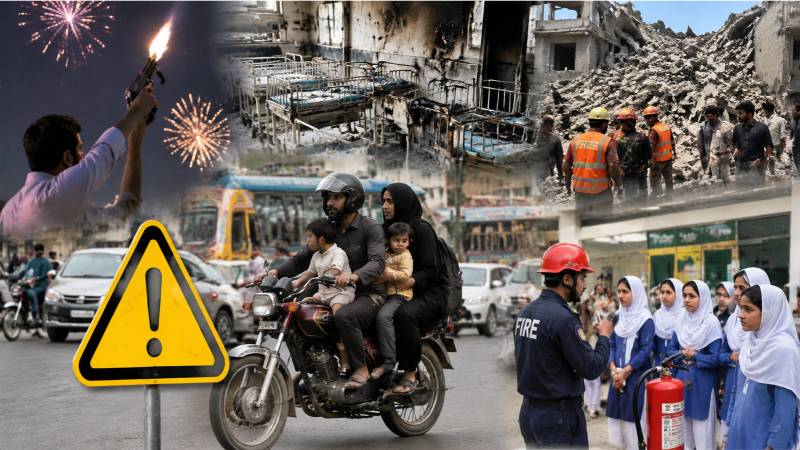
Every year, many people are killed or injured by celebratory aerial firing on national days, at weddings and on other happy occasions. This year, in Karachi alone, two people were killed and 94 injured on August 14, Pakistan’s Independence Day. A bullet fired into the air falls back to the ground at a speed of 150–300 feet per second, which is enough to kill or severely injure a person. Thus, aerial firing in the middle of a crowd has serious consequences, even when no harm is intended.
A more common problem is a lack of awareness of fires that may be ignited by combustible materials stored near exposed electrical wires or hot surfaces. The deaths of 14 children in a fire at the nursery of Pakistan’s premier hospital, PIMS, in Islamabad, were not merely the result of a failure to observe safety precautions; they were also a matter of shame for the hospital management.
Similarly, roof collapses are a common occurrence. A recent case involved the collapse of a school roof in Peshawar, resulting in the deaths of 31 students and a teacher. Whenever a fire, roof collapse or railway accident occurs, the authorities announce an inquiry that is seldom heard of again and often leads to no meaningful changes. Sometimes, a low-level official is held responsible, while procedural or institutional reforms are rarely undertaken. Life goes on without any lessons being learnt. A fatalistic attitude is pervasive and is often justified by invoking God's will.
Kite-flying, an enjoyable hobby, can also lead to accidents, including falls from rooftops and injuries to innocent bystanders who are slashed by the increasingly sharp metallic strings now in use. Even the annual kite-flying celebration, Basant, in Punjab had to be banned to prevent such accidents.
Safety is practised at two levels: first, as a personal value; and second, through institutional rules and practices. Individual awareness of safety is the foundation of collective safety practices in institutions and organisations. This awareness must be instilled by families as well as educational institutions. Children need to be taught about the dangers posed by hot surfaces, fires and unguarded heights. These are examples of precautions that must be inculcated from an early age. All in all, safety is a learned behaviour.
At the institutional level, safety must be consciously incorporated into everyday practices. Fire drills must be conducted in schools, and sprinklers installed in gymnasiums, hotels and hospitals. Above all, emergency services must be adequately provided, including fire engines, ambulances, medical facilities and police personnel trained to deal with emergencies.
Attention to safety in Pakistan remains a neglected practice. Cars and buses continue to operate on worn-out tyres. Pakistan's traffic is a contest of daring and power. Roads are poorly maintained and marked. Bus and truck drivers are often unable to read notices and road signs. Motorcycles have become a common mode of transport, with entire families travelling on them: children sitting on petrol tanks in front of drivers and two adults squeezed onto the back seat.
There is a tendency to under-report incidents and collect inadequate data nationally. However, international agencies, using different methods, present a considerably different picture. National statistics, for example, reported 5,000 accidental road fatalities in 2021, whereas the Asian Transport Agency estimated the figure at 27,568 deaths.
Unsafe practices within families are passed on to children. Neglecting fire hazards while cooking, hanging over ledges to retrieve an object, and failing to pay attention to uneven ground while walking or running are common behaviours that result in injuries. Holding on to external footholds or sitting on the roof of a bus are further examples of unsafe practices adopted when travelling on overcrowded buses and trains. Undoubtedly, a scarcity of services encourages unsafe behaviour, but disregard for safety has also become commonplace. Often, the folk belief that God will provide protection serves as a justification for continuing to engage in risky behaviour.
Families and schools are the primary sources of safety awareness. Schools can advance this awareness by teaching and enforcing safety rules. Social practices further reinforce these values and embed them in everyday behaviour. Both Pakistani society and the state have a role to play in cultivating safety awareness and promoting safe practices. Mass media should be used both to inform the public and to model safe behaviour. Pakistani television dramas, which enjoy such widespread viewership, could serve as a popular medium for raising awareness. Finally, safety regulations must be clearly defined and rigorously enforced, with consequences for violations by both individuals and institutions.