

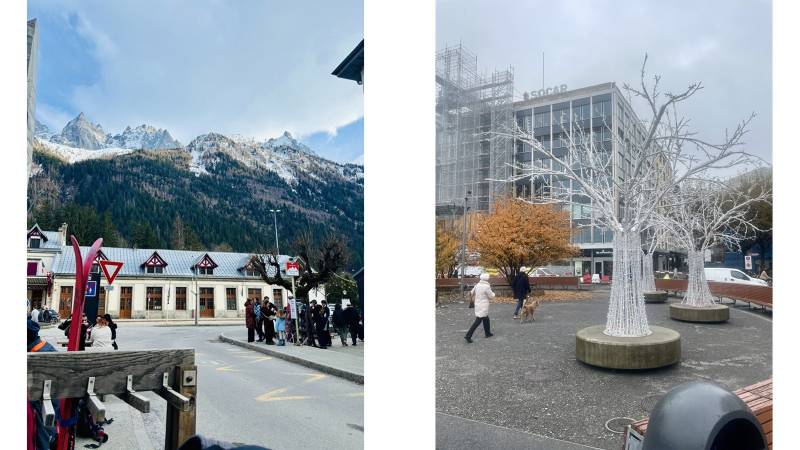
The distinct tranquillity that typifies Geneva was unmistakable. The “Peace Capital” of the world, a hub of diplomacy, multilateral governance, and humanitarian action, Geneva basked in its usual idyllic eminence.
Though I arrived in Switzerland at a time when the protest season across Europe was in full swing, the country, often dubbed the ‘Playground of Europe’, maintained its customary calm and sportive charisma, with juvenile unrest in the bordering states of France and Italy appearing like a distant, detached reality.
With the ski season about to kick in, preparations are now in high gear in Switzerland, the build-up continuing through November, the shoulder season when ski resorts prep up their winter services and slopes. Every year during this time, Geneva airport is transformed into an enormous Alpine gateway, as indigenous infrastructure in the city is overhauled and improvised to serve the winter sports gala and events industry. Arrival terminals at Geneva airport configure specialised conveyor systems for oversized ski and snowboard bags, and scale up staff around the airport exit.
The annual maintenance and cyclic refurbishing of cable cars and funiculars that lift skiers to exotic ski resorts also carries on across Switzerland’s French border, since Geneva serves as the primary international logistical gateway to French and Swiss ski resorts in the Alps like Chamonix, Verbier, and Flaine. Regional Alpine transport networks coordinate further to ramp up their systems and facilitate transit among various destinations.
Youth Protests and Social Discontent
Around this transitionary period, youth protests that were previously confined to France and Italy, and later sparked off in Austria, Germany, Portugal, Spain, Albania, Belgium, and the Czech Republic, spilled over into the winter-sports-mania-struck Switzerland last month. This year, as Skifieber (ski fever) and the annual Swiss winterising marches ahead under the shadow of protest marches, another youth movement strike is planned to be staged in several cities across Switzerland on the 20th of November.
Swiss Young Socialists, or Juso, the official youth wing of the Social Democratic Party of Switzerland operating as a legally independent organisation, is coordinating the protest which is aimed against ‘militarization’ and ‘austerity policies’ across Europe. The demonstration will march under the banner “Fight for our future, not their wars.”
According to Juso’s vice president Julien Berthod, no riots or looting are expected during the upcoming protest, though earlier protests last month in Zurich and Basel did turn fraught, as hundreds took to the streets rallying against social and economic discontent with “We’ve had enough” sloganeering.
In a country that votes four times a year, Swiss citizens will head to the polls this November to decide on issues ranging from pension financing to the War Material Act
Protestors also demonstrated on Halloween night in these cities last month, echoing anti-austerity demands against the rising cost of living and socio-economic discontent, as part of the broader youth-led movement sweeping across Europe, with some incidents of vandalism by revellers and rioters reported in the Swiss media.
Demonstrations across Europe are not directly coordinated, but the larger demands of what are predominantly Gen Z protestors coordinate in calling for better schools, lower food prices and rent, more funds for climate change, and sustained support from their governments to put an end to social hardship.
The Safety Net of Direct Democracy
In Switzerland, the social safety net is much more robust, and its unique political system of direct democracy offers ways for the people to express their opinions and discontent. The relatively peaceful protests in Switzerland can be attributed to a stable social safety net that prevents economic desperation and "evident pauperization".
Some other countries also use referendums, citizens' initiatives, and plebiscites as tools of direct democracy, but no other country employs it as extensively or on multiple government levels quite like Switzerland.
Mauro Poggia, a member of the Council of States from Geneva, highlights the differences between protests in Switzerland as opposed to those staged across the rest of Europe. While analysing the social unrest across Europe, Poggia singles out this system of direct democracy in Switzerland that provides its citizens with structured, legitimate avenues to express discontent and directly influence policies in a country that votes four times in a year. Swiss citizens can vote directly on political decisions and even propose changes to the constitution.
A week after the expected protests of the 20th of November, Switzerland goes to the polls again on the 29th of November, when Swiss citizens will vote on four proposals: additional pension financing, banning fireworks, taxation of married couples, and the War Material Act.
Direct democracy is one of the special features of the Swiss political system, where it allows the electorate to express their opinion on decisions taken by the parliament and to propose amendments to the Federal Constitution through initiatives, petitions, and referendums.
The electorate, hence, plays an active role in the decision-making process at all levels, as Swiss citizens aged 18 and above have the right to vote on issues affecting their lives and country. The Swiss example goes to show how letting the people have a say in policies and laws affecting and shaping their lives leads to a more satisfied society, less prone to aggression and mob violence, even while protesting against state wrongdoings or excesses.
Multiple Swiss surveys show that its citizens view direct democracy and political participation as the primary pillars of national cohesion, strength, and political pacification in Switzerland. Direct democracy advocates maintain that if the parliament doesn’t reflect what voters want, voters should make policies themselves. Experts also assert that the opportunity for political participation through direct democracy leads to economic stability, security, the rule of law, and trust. Political peace is thus achieved.
Switzerland’s political system, direct democracy, infrastructure, education and research, and healthcare together paint a picture of a country where state institutions function effectively and shape people’s everyday lives. The country’s greatest strengths lie in its institutions. It is, hence, functional, credible, caring institutions and social values that shape Switzerland’s self-image, not just its geo-cultural distinctions or national symbols.
While in Pakistan we stress socio-cultural identities and national symbolism as the only factors that unite or divide us and reflect our image as a nation, our institutional decline sadly remains unaddressed and unremedied by successive governments, and is worsening with time.
The ‘angry autumn’ that has descended upon Europe might or might not make its way into the cold winter days ahead, while in Switzerland the elevating and enriching (literally) effects of the approaching ski season will go a long way towards calming frayed tempers.