

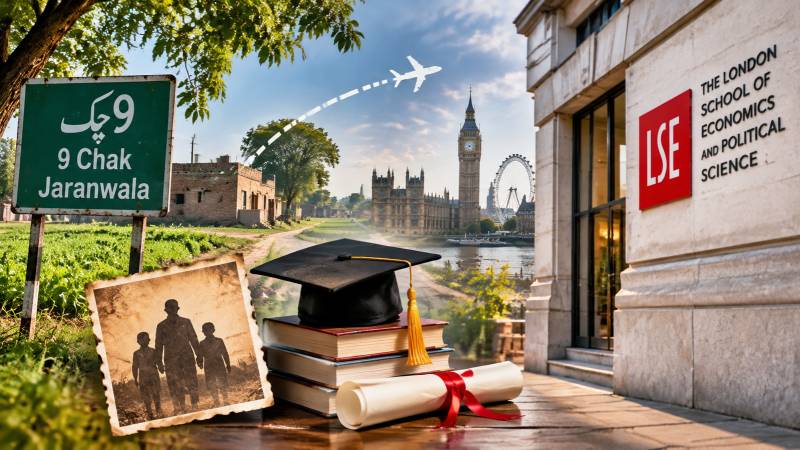
There is a small village called 9 Chak in Jaranwala, near Faisalabad, Pakistan. It is a place whose name many people outside the region may never have heard. Yet, today, someone from this village is studying for a Master's degree at the London School of Economics and Political Science (LSE), one of the world's leading universities. For me, this journey is not simply about reaching an internationally recognised institution. It represents a lifetime of family sacrifices, the power of education, and the responsibility that comes with opportunity.
Whenever I reflect on how I arrived here, my thoughts return to my father. He spent much of his life working towards one dream: to see his children receive an education and reach places that he himself could only imagine. He wanted me to study abroad, experience the world and build a future through education. Sadly, he passed away before he could see this dream become reality. I have travelled from Pakistan to London, but in many ways, I have brought his dream with me. My presence here is a continuation of his hard work and everything he hoped for.
My mother's contribution is equally significant. She made sacrifices that are difficult to explain in words. She put her children's future before her own comfort, opportunities and personal ambitions. There are things she gave up that many people might never imagine sacrificing. Today, I understand that my education was not simply my investment in the future; it was also hers. Following my father's passing, my elder brother took on an important responsibility in supporting our family and helping me continue this journey. His support, alongside my mother's, reminds me that the dream my father left behind is being carried forward collectively.
This experience has shaped how I understand economics. We often discuss the concept of human capital, which refers to the knowledge, skills and abilities individuals develop through education, training and experience. According to the World Bank's Human Capital Report, human capital is fundamental to economic growth, productivity and poverty reduction. However, what economic discussions sometimes overlook is the family investment behind the development of human capital. Before a student enters a university, families may already have invested years of income, time, emotional support and personal opportunities in that individual's future.World Bank's Human Capital Report
My journey also illustrates the economic concept of opportunity cost: the value of the next-best alternative sacrificed when a decision is made. The resources my family invested in my education could have been used in other ways. My father's years of hard work, my mother's sacrifices and my elder brother's continued support all represent investments in an opportunity they believed could transform my future. Consequently, studying at LSE is not something I can view as an achievement belonging to me alone. But this raises a more important question: what should we do with the opportunities we receive?
I believe that studying abroad should not simply become a pathway to personal wealth, international exposure or a better standard of living. It should also create a responsibility to contribute to the society from which we come. Students from countries such as Pakistan travel to international universities to acquire knowledge, develop professional skills and understand different economic and political systems. The real question is whether we eventually use that knowledge to address the challenges facing our own societies.
Economic development cannot be the responsibility of governments alone. While effective institutions, better governance and public investment are essential, sustainable progress also requires responsible citizens, productive businesses, engaged communities and individuals willing to contribute to society.
Living in London has also made me reflect on how economies function beyond government policies. In Pakistan, public discussions about economic problems frequently focus on criticising the government. Concerns about inflation, unemployment, poor public services, education and governance are legitimate. Governments have a fundamental responsibility to establish effective institutions, provide public goods, protect citizens and create an environment where businesses and individuals can prosper. However, economic development cannot be the responsibility of governments alone.
One observation from living in the UK is the extent to which individuals participate in economic activity alongside their other responsibilities. Many students combine university studies with part-time employment. People work in shops, restaurants, libraries, offices and different service sectors. Businesses depend on employees, communities depend on volunteers, and public institutions depend on people performing their responsibilities. This does not mean the UK has solved all its economic problems or that every individual has equal opportunities. It does, however, demonstrate an important principle: a country's economy depends on the collective participation of its people.
In economics, this can be connected to collective action, institutional effectiveness and productivity. Governments create the framework within which an economy operates, but individuals, businesses, educational institutions and civil society contribute to its functioning. Economic development requires both effective government and responsible citizens. Criticising public institutions is important, but criticism must also be accompanied by participation, accountability and practical contributions.
For Pakistan, this means moving beyond the expectation that economic progress will automatically follow a change of government. We need better governance, stronger institutions, investment in education, employment opportunities and a productive private sector. Equally, we need citizens who are willing to contribute through their professions, businesses, communities and everyday responsibilities.
Another important issue is social mobility: the ability of individuals to improve their economic and social circumstances, regardless of the background into which they are born. My journey from 9 Chak to LSE represents one example of what education can make possible. Nevertheless, it also highlights the unequal distribution of opportunities. There are countless talented students in villages across Pakistan who have the ability to succeed but lack access to quality schools, financial resources, professional networks and international opportunities. The OECD's research on skills and social inequalities highlights how socioeconomic background and unequal access to skills development can shape people's opportunities and economic outcomes.OECD's research on skills and social inequalities
The objective should not simply be to help a few individuals leave disadvantaged circumstances. It should be to create conditions in which the next generation has better opportunities without having to overcome the same barriers. Imagine what could happen if children in villages such as 9 Chak had access to good schools, qualified teachers, digital resources and opportunities to pursue higher education. The potential contribution to Pakistan's economy could be enormous.
This is also why I believe international education should be viewed as an investment with wider social returns. Whether someone studies economics, public policy, law, education or technology, the knowledge acquired abroad can contribute to improving institutions and addressing development challenges at home. Countries do not progress merely because their citizens obtain international degrees; they progress when knowledge is translated into productive work, effective policies and meaningful social change.
As I continue this journey, I carry two responsibilities. The first is towards my parents, whose sacrifices made this opportunity possible. The second is towards the society I come from, where countless talented people may never receive similar opportunities. I began this journey in 9 Chak, but I do not see London as its final destination. My father's dream brought me here, my mother's sacrifices made it possible, and my country's challenges give me a reason to make this education meaningful. Ultimately, the success of a country is not determined by how many of its students reach the world's leading universities, but by how effectively the knowledge, skills, and opportunities they gain are used to improve the lives of others.