

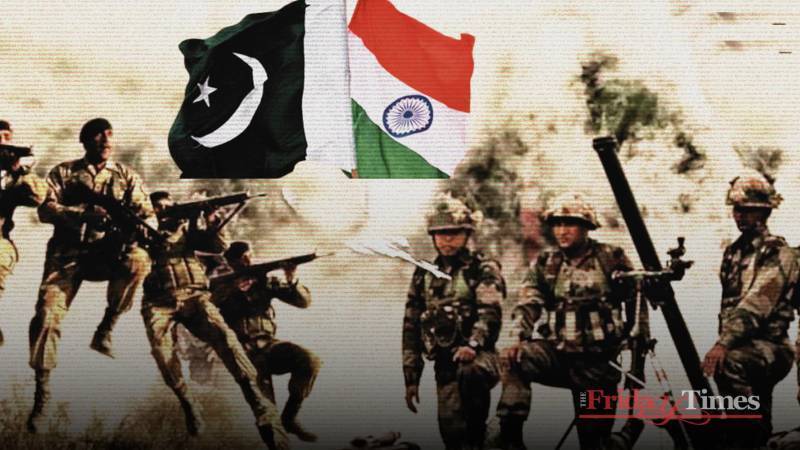
A paradigm shift has taken place in South Asia after the Indo-Pak ceasefire of 10 May. Prior to 7 May, the day when armed conflict took place between India and Pakistan following the terrorist incident at Pahalgham on 22 April, public opinion, media personnel, and state actors in India projected myths about their country based on false assumptions.
Myth number 1 was that Pakistan is economically broke, with its official foreign exchange reserves amounting to less than 10.2 billion dollars, as compared to India’s 700 billion dollars. Indian per capita income, economic growth rate, remittances, and income from tourism and IT are several times greater than Pakistan’s. As the world’s fifth-largest economy and soon to seek the third position in the global economy, the world respected India and took it seriously. In that case, there was no match between India and Pakistan in economic terms, and Islamabad would not be able to sustain any armed conflict with its eastern neighbour.
Myth number 2 was that India is the world’s third-largest military power, equipped with modern and sophisticated conventional weapons and a huge nuclear arsenal. That the lack of strategic depth of Pakistan, as compared to India, would lead to Islamabad’s capitulation in any future armed conflict.
Myth number 3 was that India has enormous influence in global affairs and foreign policy, with the West and the United States siding with New Delhi. India’s position in QUAD, G20 and SCO, along with other international organisations, qualified it to be a potential member of the UN Security Council. Meanwhile, Pakistan’s economic predicament and its image problem—failing to cope with the perception that it is a hub of extremism, violence and terrorism—put it in a disadvantageous position vis-à-vis India. For years, Pakistan, on account of allegations of sponsoring terrorism, was in the grey list of the Financial Action Task Force (FATF), and the international media critically reported events in Pakistan about suppressing democracy and human rights.
Myth number 4 was that, after years of popular uprising in its controlled parts of Jammu & Kashmir, India had succeeded in establishing peace in that war-torn region after revoking Articles 370 and 35-A on 5 August 2019, and introducing developmental programmes neutralising the radicalised youth of Jammu & Kashmir. India used the G20 tourism conference held in Srinagar a couple of years ago to prove that J&K was safe for tourists, to the extent that in 2022 and 2023, 15 million tourists visited Kashmir, including the Muslim-majority Valley.
All four myths about India exploded during its armed conflict with Pakistan from 7–10 May, when it miserably failed to prevail over Pakistan. Poor performance of its air force, which led to a loss of 500 million dollars due to the shooting down of its Rafale jets and other planes by Pakistan, and its failure to cope with Islamabad’s counterattack on 7 May also exposed the so-called military superiority of India vis-à-vis Pakistan. Neither its air force nor its army managed to put any dent in the Pakistani military, and its navy failed to prove the myth that it could blockade the port of Karachi and capitulate Pakistan economically.
Why did all such myths, which gained momentum during more than 10 years of Modi’s regime, shatter in the wake of the 7–10 May war? Not only did the morale of its armed forces suffer when all its claims to give a "bloody nose" to Pakistan failed, but no foreign power came openly to support India in its time of crisis. How did its media hype to "teach Pakistan a lesson" become a laughing stock for the entire world? Prime Minister Narendra Modi’s attempts to restore the morale of his country through so-called damage control measures—by addressing forces at the Adampur base and his speech on national TV—miserably failed. Indian opposition parties, including Congress, demanded an immediate calling of a parliamentary session with mandatory participation of the Prime Minister to discuss the strategic failures of India during its 7–10 May armed conflict with Pakistan.
India failed to give any logical reason for why its air force failed to deliver and why its navy and army merely acted as silent spectators
One needs to analyse the four shattered myths of India during its recent limited war with Pakistan from three angles.
First, since day one, there were people who questioned the rationale behind the Indian allegation that Pakistan was behind the terrorist attack in Pahalgham. Without producing any concrete evidence and not accepting Islamabad’s offer for an international, neutral investigation of the terrorist attack, India failed to prove its claim. Although the world, including Pakistan, condemned the terrorist attack in Pahalgham, India’s failure to provide any evidence of Islamabad’s involvement made the international community suspicious.
India not only blamed Pakistan for that attack but also threatened to teach its western neighbour a lesson and avenge past terrorist attacks such as the attack on the Indian Parliament in December 2001, the Mumbai attacks of November 2008, the Uri attack in 2016, and the Pulwama attack in Indian-occupied Kashmir in 2019. New Delhi tried to build momentum against Pakistan, but no significant global power sided with India. Hence, since day one, India failed to achieve its objective of putting Pakistan on the defensive.
Second, Indian strategic minds miscalculated Pakistan’s position when missile and drone attacks were launched on 7 May. Indian military power—particularly its air force—was exposed, as it failed to cause any significant harm to enemy warplanes. No Pakistani plane was shot down despite India having modern and sophisticated Rafale jets; whereas India lost six warplanes. India also failed to cope with Pakistan’s edge in technology, as it jammed radars and the functioning of Indian warplanes. The world watched the events of the 7–10 May Indo-Pak limited war carefully. India failed to give any logical reason for why its air force failed to deliver and why its navy and army merely acted as silent spectators.
Third, if India was right in its position by attacking Pakistan on 7 May with a resolve to eradicate the so-called terrorist infrastructure and cause a major blow to its military, it lacked the morale, skills, and planning to accomplish such objectives. And if it was proud of its economy, military strength, and international support, why did it agree to a ceasefire under the mediation of American President Donald Trump? Indian pride, power, prestige, and self-esteem, for which it was so proud, was gone with just one tweet from the American President, provided that it agreed to a ceasefire with Pakistan. It meant India found itself incapable of further fighting with Pakistan.
In essence, the Indo-Pak armed conflict of 7–10 May brings into the picture the hard reality of fault lines in Indian military and security doctrines. Even then, the Indian state is bent on threatening Pakistan, but with no credibility. Modi’s assertion that it will not come under any nuclear blackmail by Pakistan is another acceptance of its failure. Hiding behind the so-called Pakistani nuclear blackmail and sustaining its allegations of Islamabad harbouring terrorism in India will not work anymore. There are demands that Narendra Modi should take up responsibility for India’s humiliation and resign. Criticising the United States for letting down India, its so-called ally in QUAD, and taking steps against Turkey for its avowed support to Pakistan in the recent conflict will not work and will be counterproductive.
Having failed to teach Pakistan a lesson, the Modi government is now working overtime on two options: first, to sustain its suspension of the Indus Water Treaty and deprive Pakistan of its share of water; and second, to support the recent declaration of the Baloch Liberation Army of establishing an independent state of Balochistan. Before India ventures on its adventures against Pakistan, it should thoughtfully analyse with critical thinking the possible consequences of such acts and what went wrong in the 7–10 May war with Pakistan. Like in 1999, when the Vajpayee government investigated India’s failures in Kargil by establishing a commission, it should investigate the May 7–10 failures in its war with Pakistan in a proper manner. It is high time India learned lessons from its false myths pertaining to its military performance, Kashmir, and Pakistan. Only then can it deal in a better manner with issues concerning its only western neighbour.