

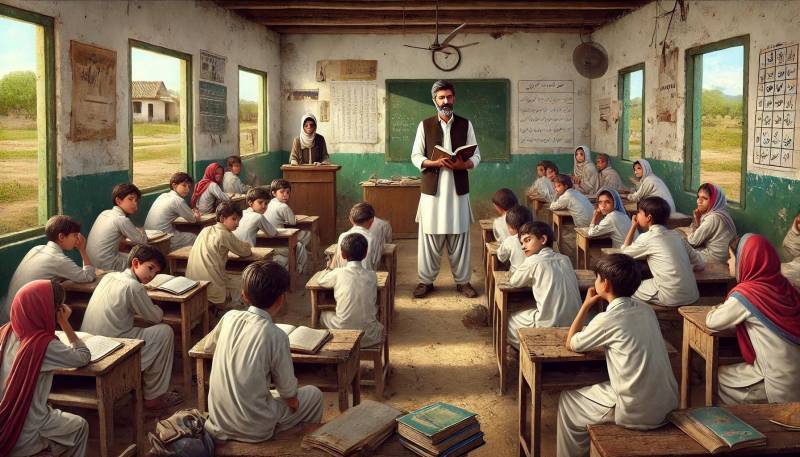
A recent report by the Pakistan Institute of Education (PIE) revealed that more than 25 million children are out of school in Pakistan. Some earlier recorded estimates have also highlighted figures close to this. Education in Pakistan has remained a persistently neglected subject. Many commentators and researchers have tried to delineate the factors that compel these children to remain out of school. The two prominent reasons that have been frequently emphasised are a lack of parental awareness and high poverty levels.
Nevertheless, a close examination of Pakistan’s educational landscape reveals a striking paradox to any observer. In contrast to popular belief, the importance of education has been gaining recognition among the masses. Whether one attributes it to rising awareness through mainstream or social media, or to some other reason, the fact remains: a considerable portion of the population – even those with the fewest resources – recognise that education is significant for transforming the lives of their future generations.
This is also evident from the National Non-Formal Education Statistical Report (2023–24). The report revealed that enrollment in the country’s non-formal education sector increased by twenty per cent in the past year – an indication that even families who are unable to send their children to mainstream schools at least want them to have some basic form of education and literacy.
Naturally, the question that arises is: if citizens are increasingly recognising the importance of education, as claimed in the above statements, is poverty the paramount reason behind alarmingly high dropout rates and the growing number of out-of-school children? The answer to this is, to a large extent, in the affirmative. At the same time, however, poverty alone does not explain the entire crisis.
It is true that in a country where nearly 45% of the population lives below the poverty line, only a small fraction of families can afford to send their children to private schools. However, it is also important to acknowledge that attempts have been made under various governments to address poverty as a major impediment to education. For example, in Punjab, the Punjab Compulsory Education Act of 1994, and later, in the aftermath of the 18th Amendment, the Punjab Free and Compulsory Education Act of 2014, both mandated free education for all children up to the age of sixteen.
Even though the implementation of these laws remained a key challenge, most public primary schools across Punjab had been charging a nominal fee of twenty rupees per month, an amount minimal enough for most parents to afford (while recognising that even nominal fees can burden those facing extreme poverty levels).
The central argument here is that, despite positive parental attitudes towards education and the ability to attend school at minimal cost, the two major reasons why a large number of children continue to be out of school are systemic barriers and institutional shortcomings.
Even when parents want their children to attend school, sometimes safety and security concerns can compel them to keep their children, specifically their daughters, out of school
Many parents view the quality of education provided in public schools with scepticism. According to the National Education Policy Development Framework, 2024, only five percent of children in Pakistan receive quality education. In many public schools, teacher absenteeism is a major issue. In 2023, it was revealed that as many as 56,000 teachers in Sindh attended schools only once or twice a month.
Similarly, the poor condition of school infrastructure also remains a major concern for parents. Many public schools, especially those located in rural peripheries, operate in structurally unsafe buildings. Ironically, even when parents want their children to attend school, sometimes safety and security concerns can compel them to keep their children, specifically their daughters, out of school. Unless these local realities that go beyond poverty and awareness are dealt with, compulsory education will remain elusive.
Since most of these issues – such as infrastructure maintenance, community attitudes, and service quality – are locally embedded, addressing them would require a bottom-up, locally led approach. Unfortunately, in Pakistan, local governments, a key institution that could have played a pivotal role in tackling these systemic issues, have long been absent. Their role in policy formulation and service delivery has also remained minimal, and at times, absent due to delays in elections.
There should be little doubt in the fact that to ensure effective service delivery in crucial sectors like education at the grassroots level, one thing that is of utmost importance is thriving elected local institutions. This is because government functionaries at the local level might be able to play a decisive role in education management practices, but might not be able to address the systemic barriers to education. These, on the other hand, could be best understood by locally elected representatives due to their knowledge and familiarity with local realities.
To better understand this idea, it is significant to mention the work of two leading political scientists, Archon Fung and Erik Olin Wright. Fung and Wright highlighted the examples of some prominent countries across the world that introduced reforms to ensure local-level participation in their work. These include Porto Alegre in Brazil, Chicago in the US, and Kerala in India.
The common element among these reforms was that they ensured the participation of ordinary citizens in the political process, so that they could play an active role in addressing issues that impact their daily lives. Fung and Wright have defined this model of governance as ‘Empowered Deliberative Democracy’ – empowered because it ensures empowerment of local-level stakeholders, and deliberative because it involves careful thinking of possible solutions at the local level.
Based on this model, the fundamental step to addressing the systemic issues in Pakistan’s education sector would be to involve local-level stakeholders in the service delivery of education. This means that ordinary citizens, through a formal institutional arrangement, must be given considerable authority to participate in decision-making and contribute to improving service delivery at the local level.
It merits attention that many crucial laws governing education in Pakistan, such as the Punjab Free and Compulsory Education Act mentioned above, did emphasise the role of local governments in the delivery of education. For instance, Section 4(2) stipulates that local governments must ‘ensure and monitor the admission, attendance, and completion of education for every child residing within their jurisdiction’. However, most of these provisions today stand unenforced on the ground, leaving millions of children deprived of their basic right to education.