

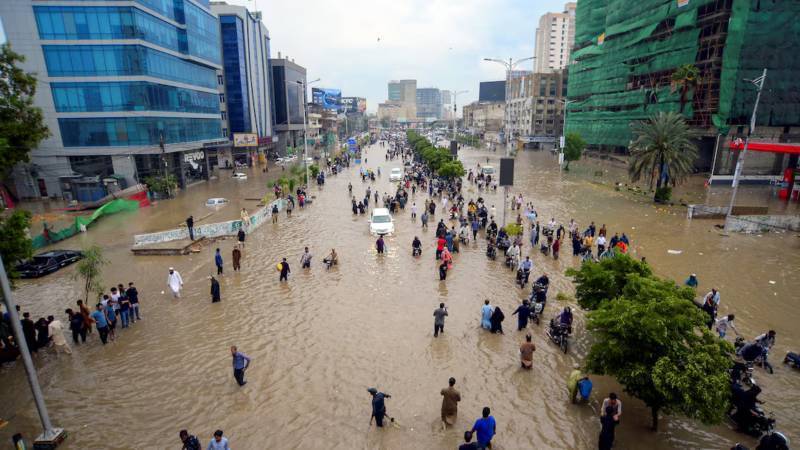
The rivers of Punjab have swelled like old serpents shaking off their shackles, overflowing over green plains, engulfing houses, and leaving paths of devastation that reverberate in each drowned street and ruptured dyke. What started as monsoon rains, initially a blessing upon crops and pastures, soon became a curse as the clouds poured immeasurable torrents upon the plains. Within days, villages were flooded, roads destroyed, and cities choked in putrid waters. What was once the boast of green fields now looks like an infinite ocean, from horizon to horizon.
The tragedy of Punjab is a tale of adversity that is both natural and human. The burden of over a decade’s worth of greater than ten lakh cusecs of water drenched into the veins of rivers and the armour-like protection long unheeded, strained under pressure. Sialkot, where industry and grit once filled the air, now gasps only in rescue boats. Suburbs of Lahore like Shahdara, Kasur, Narowal, Hafizabad, Jhang, Faisalabad, Multan, Okara, Sahiwal, Gujrat, Mandi Bahauddin, Rajanpur, Dera Ghazi Khan, and Sargodha—every one of them has borne the brunt of this watery attack. Embankments were intentionally cut open in most places to salvage barrages and important infrastructures, a tactic that cost villages to preserve cities. But each such decision is a blow, a reminder that mankind is too frequently compelled to succumb to the strength of water.
Punjabis have walked days of starvation, slept nights under open sky, the smell of stagnation coupled with the wails of children left to pick up the pieces on shattered roads. Animals, the unseen friends of village life, were driven to upper ground, but many perished in barns turned into jails. And as relief camps were set up and thousands were relocated, the sheer magnitude of water was a brutal reminder that no human hand can completely subdue nature’s fury.
But this is only halfway through. The floodwater, as an army in perpetual march, does not stop in Punjab. Its next destination is southwards—towards Sindh. The Indus, powerful though overburdened, takes this army of waters with all its vengeance along, and Sindh becomes now the battleground where embankments, barrages, and administration itself will be tried.
The citizens do not fear water but fear the lack of timely rescue, the lack of food in relief camps, the sluggish response of medical aid, and the inefficiency of the past demonstrated in each crisis
Eyes are glued to the rising gauges at Guddu Barrage, the first of Sindh’s great sentinels. Here the Indus encounters the burden of misery of Punjab for the very first time. Levels of discharge keep rising, and even though the barrage has been constructed to absorb gigantic flows, the age of its gates and the frailty of its bunding dykes weave a nervous tale. Encroachments along banks, hollowed and abandoned dykes, and villages built too close to the danger zone—all combine to render defences weak. The fear is straightforward: if Guddu fails, the flood will flow unchecked into the heart of Sindh.
Behind Guddu is Sukkur Barrage, the great engineering work that has for generations watered the province through its canals. Even though some of its gates were recently upgraded, the barrage itself is still under threat from the unprecedented pressure it will face in the next few days. Sukkur is not just an engineering feat; it is a lifeline, because its canals supply millions of acres and support whole communities. A breakdown here would not be a flood; it would be a generational disaster.
And still further to the south, the Kotri or Ghulam Muhammad Barrage stands between the churning Indus and the deltaic flats which blend into the Arabian Sea. Constructed decades ago, it has faced repeated tests of strength, but the volume of water now afloat can overwhelm even its utmost resistance. If waters overflow Kotri beyond control, the current will sweep over Hyderabad, Jamshoro, and into the vulnerable delta, where encroaching seas and retreating mangroves already consume the shoreline. The prayer is simple—that the floodwater flows harmlessly out to the Arabian Sea, leaving the people who live along the Indus unscathed. But prayer is not planning.
The vulnerability of Sindh is not just its geography but its administration. Embankments are weak along the katcha tracts, their upkeep long forgotten, their soil worn down by decades of invasion and graft. Each hollow dyke is an open wound in waiting to burst. In Kashmore, Ghotki, Sukkur, Larkana, Shikarpur, Khairpur, Dadu, and Hyderabad districts, people are already prepared for displacement. Relief camps are being readied, but their quantity and resources often lag behind the impending requirement. Katcha belt families are being encouraged to relocate, but many decline to abandon ancestral lands, holding on to memory and sustenance even as the water closes in.
It is during such moments that misgovernance turns into a second flood. The citizens do not fear water but fear the lack of timely rescue, the lack of food in relief camps, the sluggish response of medical aid, and the inefficiency of the past demonstrated in each crisis. To them, the flood is not just nature’s wrath but also the reflection of neglect.
Each drowned village is a lost library of stories, each destroyed crop a lost chapter of survival. The flood is more than water; it is memory in danger, culture in jeopardy, and identity at the mercy of forgetfulness
But even as this dark truth exists, the people of Sindh show remarkable resilience. Boats dot the shores, aid volunteers amass equipment, and neighbourhoods stand together in solidarity, aware that survival is a shared experience. And yet, the question hangs so heavily: can Sindh survive what Punjab could not?
The metaphor of the flood is larger than maps—it is one of the decisions of a nation. The rivers are not just carrying the water but also the weight of climate change, poor planning, and short-sighted policies. Every year, alarms ring, but embankments are still weak, drainage channels are plugged, and town planning is missing. What is happening today is not just the outcome of heavy rains; it is the consequence of decades of neglect. The rivers, in wrathful god-like manner, are reclaiming their ancient tracks, punishing the hubris of those who believed that they could defy nature.
And what then if the worst happens? What then if Sukkur’s giant gates give way, what then if Kotri strangles, what then if the delta cannot drain the waters quickly enough? Then Sindh’s most populous areas—Naushero Feroze, Hyderabad, Thatta, Badin, Jamshoro, Matiari, and even Karachi—would experience the insidious touch of disaster. The economic cost would be unmeasurable; fields would drown, livestock perish, roads vanish, and diseases spread in stagnant waters. Entire generations could be thrust into poverty, their futures washed away with their lands.
This is the alarm call which Sindh cannot afford to sleep through. The inundation is no uninvited visitor who comes stealthily; it is a long-invited guest, its coming heralded by Punjab’s suffering. The moment to get ready is not tomorrow, not when water rises at the threshold, but today. Dykes need to be strengthened, camps extended, medical personnel doubled, and evacuation enforced with urgency. Each delay is a risk with lives.
To expect the water to just flow into the Arabian Sea with no further destruction is to yield to fantasy. The sea itself is not a friend; its bulging tide is poised to drive the flood back, hindering the drainage, keeping the plains under water for extended periods. The Indus delta, already reduced in size and deprived of silt, cannot take such quantities without scars. To bank on luck is to court disaster.
Thus, Sindh has to get up with all its might. The barrages have to be like soldiers, the embankments like shields, the people like a chorus of endurance. If the water has to advance, let it advance over houses and into the ocean, not over lives and livelihoods. And if calamity cannot be altogether prevented, let it at least be made as gentle as possible by anticipation, readiness, and pity.
For what’s at risk is not land alone, but heritage, not houses alone, but histories. Each drowned village is a lost library of stories, each destroyed crop a lost chapter of survival. The flood is more than water; it is memory in danger, culture in jeopardy, and identity at the mercy of forgetfulness.
And thus Sindh stands on the lip of the tide, looking into the moving waters, aware that the next few days will determine not only the fate of its embankments but the pride of its people. Punjab has demonstrated what abandonment entails; Sindh still has time to learn, to move, to forestall disaster. The decision is in the hands which may not now tremble.
Let the flood be forgotten not as a ravager but as an educator, teaching us the price of complacency and the strength of togetherness. Let the Indus, though full of anger, bear its waters to the sea with less devastation than anticipated. And let Sindh arise—not when the waters recede, but now, ere the calamity falls.