


The Civil War was massive in scale for a conflict that was waged in the 19th century. It was by far the biggest war that was fought in the American mainland since the US was founded in 1776. Nothing on that scale has ever occurred in the US since then.
In his book, The American Civil War, John Keegan says that the total body count of the Civil War “exceeds that of the American fatalities of the Second World War.” In the Civil War, 200,000 were killed and a million injured, making it the bloodiest war fought on American soil.
The losses of the Civil War bear ‘comparison with the European losses of the Great War and Russia’s in the Second World War.’ Keegan, who studied at Oxford and taught at Sandhurst, says that “in many respects, the Civil War was and remains America’s Great War, in the way it is commemorated nationally in so many towns and battlefield cemeteries and subjectively and collectively in the American consciousness.”
The South had gone to war against the North to preserve the institution of slavery. In 1860, Abraham Lincoln had been elected president on a Republican ticket no less to emancipate the Africans who had been brought over to the US as slaves.
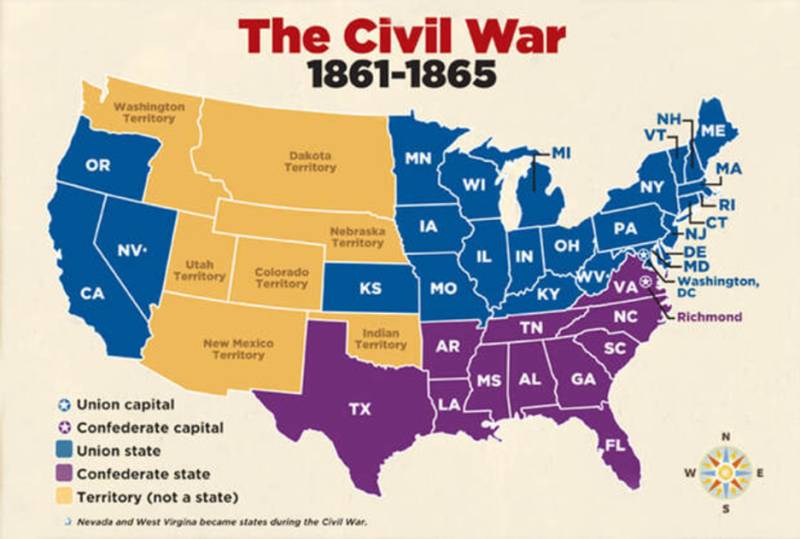
The North outnumbered the South in population. Its population was approximately 22 million citizens compared to the South’s 9 million, of whom only 5 million were free citizens. There were a few states in between, called the Border States, and they had a population of roughly 2.5 million free citizens and 500,000 enslaved inhabitants. Despite the smaller population, the South initially matched the North in troop numbers.
But the North was also more urbanized and industrialized while the South was overwhelmingly rural. The manufacturing output of the North was more than five times greater than that of the South.
The war was not expected to last very long but the armies of the South, led by General Robert E. Lee, who had finished second in a class of 42 cadets at the US army academy at West Point, put up a very strong defence. In fact, by 1863 they had brought the battle to the northern state of Pennsylvania.
A very bloody battle ensued at Gettysburg which was ultimately won by General George Meade of the North. As stated by Tim McGrath in his book, Three Roads to Gettysburg, thousands lay dead from both, intermingled with thousands of dead horses. The stench was intense and passersby would end up vomiting. It took days to bury the dead.
In 1986, I had an opportunity to visit the battlefield. By the time I arrived from New York City, dusk had settled in. The darkness that was spreading across the large cemetery made me think about the thousands of soldiers and officers who had fought there and died there 123 years ago. I reflected on the sentiments that President Lincoln must have felt on November 16, 1863 as he delivered a short speech that would go down as one of the finest ever given, not just in US history but in world history. This was the speech that saved the Union.
This battle, in retrospect, decided the course of the Civil War. But the war was not over yet. The South was putting up a tough fight.
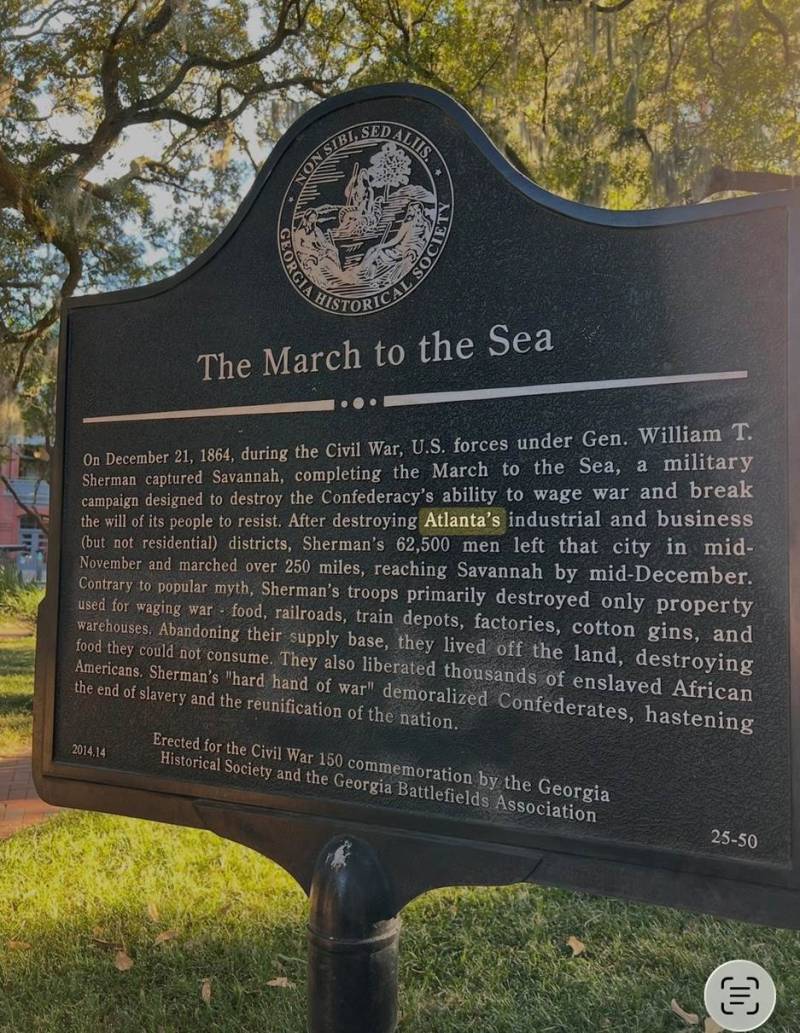
That task was left to General William Tecumesh Sherman. In his famous March to the Sea, he launched a destructive campaign from Atlanta, Georgia to Savannah, Georgia. The campaign covered 285 miles and ran from November 15 to December 21, 1864. By then, Sherman had come to realize that the South would not be defeated by simply defeating its military. It would be defeated once its economy was destroyed because then it would lose the will to fight.
He unleashed the 60,000 soldiers under his command to destroy railroads, turning them into Sherman’s neckties, factories, and farms between Atlanta and Savannah, which lies on the coast of the Atlantic Ocean. By marching through the heart of Georgia, which was a key southern state, Sherman demonstrated that the Confederate government could not protect its citizens. He made Georgia howl, by making the old and the young, the rich and the poor, feel the “hard hand of war.” Years later, in 1879, he would say that “War is hell.”
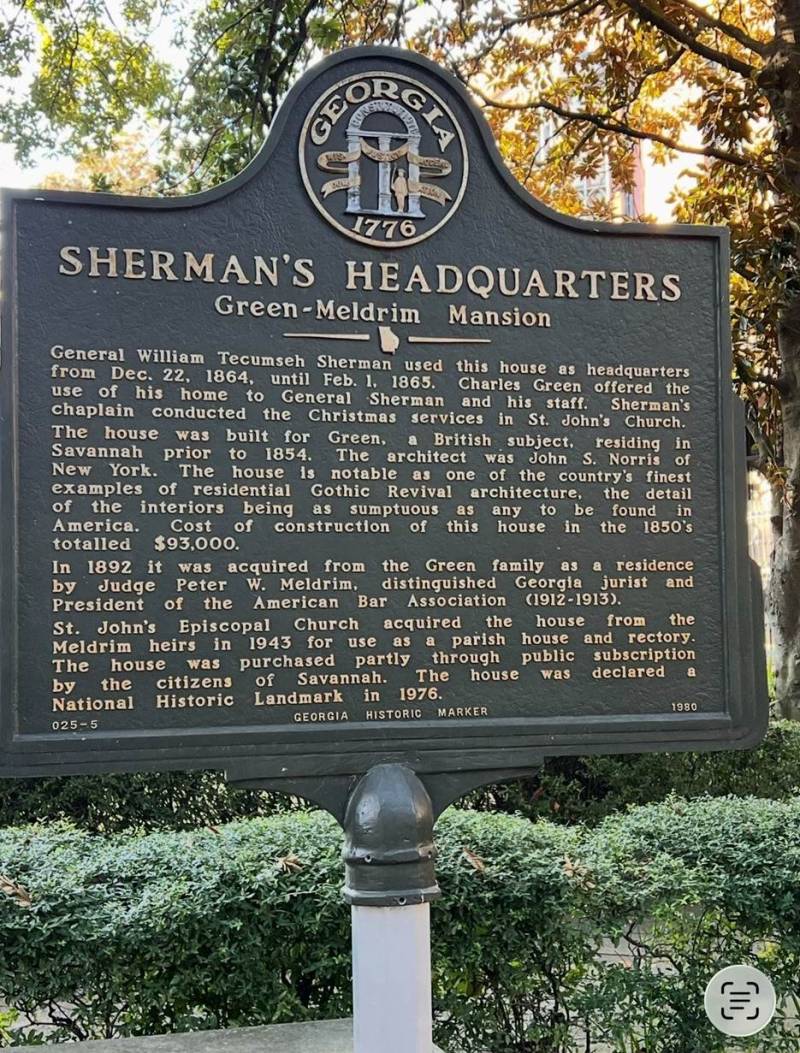
On December 22, 1864, Sherman famously messaged President Lincoln, offering the city of Savannah and its supplies as a “Christmas gift”. I have seen the place in Atlanta where his march began. A sign is posted there. I have also visited Savannah where the war culminated. A sign is posted at the building where he resided.
By April 1865, four years into the war, General Robert E Lee, the commander-in-chief of the Confederacy, had realized that his forces were outnumbered several times by the North and he had no food remaining to feed his troops. He decided to surrender his forces to General Ulysses Grant, who was commanding the forces of the North. Magnanimous in his victory, Grant thought it would be an unnecessary humiliation to call upon the surrendering army to turn over their sidearms.
The total body count of the Civil War exceeds that of the American fatalities of the Second World War, making it the bloodiest war fought on American soil
At that time, says John Keegan, an exchange of letters took place between Generals Grant and Lee, “characterized by an unusual tenderness.”
The letters are reproduced in Grant’s memoirs. He sent a letter to Lee encouraging him to surrender, since that ‘will hasten that most desirable event, save thousands of human lives, and hundreds of millions of property.’ Lee replied in the affirmative, and requested an ‘interview.’ The two met at Appomattox, Virginia where Lee surrendered his sword to Grant.
The war’s strategies and tactics were studied for decades across the globe and especially by the generals fighting the First World War, which is also called The Great War.
Sadly, while the war brought legal emancipation to the Africans who had been brought over as slaves, or to their offsprings, it failed to eliminate white-centric racism in American culture.
In 1939, to much acclaim, Hollywood released a movie that sought to romanticize the culture of the South during the Confederacy. Gone with the Wind spun the cruel narrative of the Civil War as not being a fight over emancipation but as a fight to destroy a “pretty world.” It completely avoided discussing the horrible practice of slavery, which was widely practiced in the South. Instead, a few enslaved characters were shown as being contented, loyal domestic servants with a familial outlook on life.
It portrayed the post-war “Reconstruction” era as a chaotic, dangerous period where the white Southerners were victims of corrupt political changes. When I saw the film with my family at the Drive-in theatre in Karachi in the mid-sixties, I was not aware that the film was rewriting a very troubled episode in American history. It came across as a romantic tale set during a tragically violent era.
Reconstruction was a turbulent 12-year period that followed the Civil War. It focused on reintegrating Southern states into the Union, rebuilding the Southern economy, and defining the legal status of nearly 4 million formerly enslaved people. The federal military was given control of the South. Three constitutional amendments were passed to promote interracial democracy.
The 13th Amendment (1865) abolished slavery, the 14th Amendment (1868) granted citizenship and equal protection, and the 15th Amendment (1870) granted voting rights to African American men. For the first time in US history, African Americans gained political power, with hundreds elected to local, state, and federal offices.
However, a violent backlash took place since the soul of white racism had not been eradicated from American culture. The notorious Ku Klux Klan (KKK) was born. The era ended with the Compromise of 1877, where federal troops were withdrawn from the South in exchange for Rutherford B. Hayes winning the contested 1876 presidential election, leading to the rise of Jim Crow laws.
Jim Crow laws were state and local statutes in the US, primarily in the South, that legalized racial segregation and disenfranchisement from the post-Civil War era until the late 1960s. Enforced to marginalize African Americans, these laws enforced “separate but equal” status in public facilities, schools, and transport, though facilities for Black citizens were uniformly inferior
The issue of white supremacy is still very much there in the US today, even in what is otherwise regarded as a liberal state – California. In the 1980s, a man who was in the energy auditing business told me that he was inspecting the energy integrity of a farmhouse in the Central Valley. He was shocked to discover that a closet had stored in it a full set of the white robes worn by members of the KKK gang.
In the late 1990s, I asked a librarian in Chattanooga, Tennessee, to point me toward the Civil War section, she smiled and said: You mean the War of Northern Aggression?
Barack Obama was the first African American to be elected president of the US in 2008. During his two-term presidency, a lot of symbolism took place in favour of the African Americans, and many economic programs were undertaken to improve their conditions. However, many African Americans felt that their economic and social progress did not live up to expectations, leading to a feeling of unfulfilled promises. Even Obama conceded that much work needed to be done to improve the inequalities in income between whites and blacks.
In December 2016, just a few weeks after the presidential elections, a driver at a stop sign lowered his window, cocked his hand as if it was a pistol, and squeezed his index finger as if he was firing at me? Why? My car’s license plate was personalized and bore my last name in capital letters. At a local high school, the stalls in the boy’s restrooms were painted with graffiti, with some reading Whites and others reading Non-Whites. In a neighbouring town, a Pakistani friend’s son, born and raised in the US, was called a Sand Nigger by a white man driving a pickup truck.
In 2013, I was in Charleston, South Carolina. We visited The Citadel, the military academy of the South. I was pleased to see that admission was not only granted to all visitors, but there was no entrance fee either. In the middle of the Quadrangle, I was amazed to see an M-3 Sherman tank, which I had seen several times in Cantonments of the Pakistan army. Later, I decided to check out Fort Sumter, where the first shots of the Civil War had been fired. To do that, I had to board a boat. As I was boarding, I noticed that the pier was called The Union Pier.
When I got a chance to chat with the Captain, I said: I saw a Sherman tank at the Citadel, and your boat left from the Union Pier. But I have failed to see the flag of the Confederacy being flown anywhere. I said I had come from California to see the Old South, and I am a bit disappointed. He said, “I know what you mean: people think we still own slaves.” But there was more than a touch of sarcasm in his voice when he made that statement.
But when it came time for dinner, we visited a plantation and saw replicas of cabins in which the slaves lived. The artificial figures of the slaves showed contentment.
In 2022, I took the cable car to the top of Stone Mountain in Atlanta in 2022 with my wife. When I saw the docent, I said we saw the massive carvings on the side of the mountain and were very impressed. It is the world’s largest high-relief sculpture, featuring President Jefferson Davis, and Generals Robert E. Lee and Thomas “Stonewall” Jackson. The carvings, which were completed after decades of work, span 3-acres and are recessed 42 feet into the mountain.
They are officially called a Monument to the Confederacy, which in theory had ended a century earlier. But I could not resist asking the docent, “Why are Abraham Lincoln, Ulysses Grant and William Sherman missing from the carving?”
Clearly taken aback either at my lack of knowledge or sarcasm, he stared at me with a stern face, leaned back, and extending his hand in another direction from me, roared: “To see them, you have to go North.”
All one can say today is that even though the North won the Civil War militarily in 1865, and slavery was outlawed, discrimination against people of colour proved much harder to erase from American culture. The words that Professor Barbara Fields, a historian at Columbia University, spoke in Ken Burn’s 1990 PBS documentary about the Civil War still ring true: “The Civil War is still going on, it’s still being fought and regrettably it can still be lost.”