

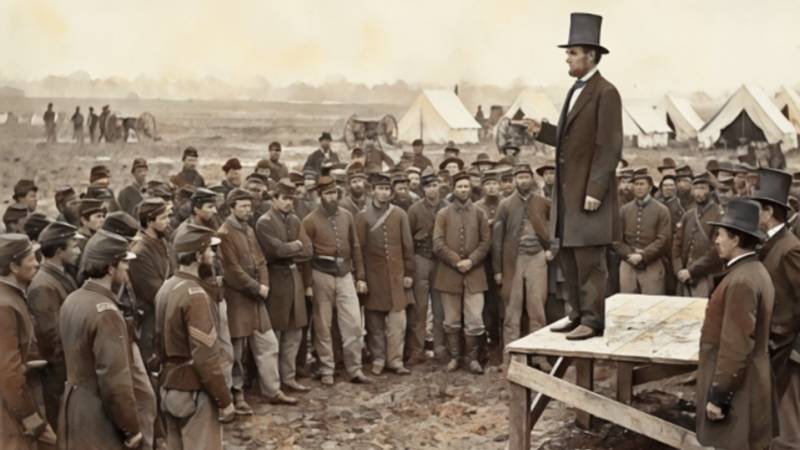
This may sound incredible, but Lincoln never attended college. He went on to pass the bar exam entirely on his own. Lincoln was an autodidact, or self-taught man. What is remarkable is that not only did he go on to become the president of the United States, but he managed to preserve the union when a Civil War broke out. Unfortunately, he paid with his life for uniting the country.
I had long wanted to pay homage to Abraham Lincoln by visiting his tomb. Finally, the day arrived when I was humbly standing next to it.
I was in Springfield, Illinois, on a business trip. The meeting ended early, leaving me some time to go sightseeing. I asked the concierge at the hotel for tips. Without any hesitation he said Lincoln’s tomb. Wow! I had assumed all along that he was buried at the Arlington National Cemetery in Virginia.
The tomb had a distinguished look to it and was visible from a distance. As I entered the room in which he was interred, I noticed that some words were written on the wall behind the tomb: “Now he belongs to the ages.” My mind flashed back to the time when I was in ninth grade at St Patrick’s High School in Karachi. These were the closing words of a play about Lincoln that was assigned reading in the class. These words were mentioned by Edwin Stanton, the Secretary of War, when he breathed his last.
How did it come to be that the son of a poor frontiersmen in Kentucky, a man who attended no college, let alone an Ivy League institution, and a man who spent much of his adult life as a country lawyer in the backwater of central Illinois, went on to acquire such stature?
Seward’s idea was excellent, but it took Lincoln’s ear for rhythm, alliteration and timing to create an image that touches the human soul a century and a half later
It was the gift of language that brought him these laurels. So much has been written about the man. Some focus on how he brought his political rivals into his cabinet. Others on his role as commander-in-chief during the Civil War. But one, by Fred Kaplan, is entirely focused on his writings and reveals how Lincoln acquired his singular status not just in US history but in world history.
Kaplan informs us that early in his childhood, Lincoln developed a passion for reading. There were very few books in his house so he would read them repeatedly until they became second nature to him. They would furnish him with a reservoir of aphorisms from which he would draw almost continuously, first in his legal career and then in his political life.
His father was a devout Baptist, so it is not surprising that he was a vociferous reader of the Bible. In particular, the stories of the Old Testament haunted him and stayed with him throughout his life.
Despite this reading of the scripture, Lincoln did not become particularly religious in his adult life. He went to church only now and then, seeing it largely as a social activity. Kaplan argues that there is little scholarly evidence that Lincoln believed in the afterlife or the divinity of Jesus. To him, the Bible was great literature, a book of ethics and morals.
Much of Lincoln’s early literary knowledge came from Thomas Dilworth’s Guide to English. Later, he discovered the works of Lord Byron, Robert Burns and William Shakespeare.
As he got on in life, he came to see the power of language in influencing people and shaping their views. He would write, re-write, edit and re-edit his speeches until they felt just right.
Appearances to the contrary notwithstanding, none of his major speeches were extemporaneous, including the eulogy he gave at the battlefield in Gettysburg, Pennsylvania, remarkable as much for its content as for its brevity. It epitomised what Shakespeare had written in Hamlet: “Bre vity is the soul of wit.”
William Seward (soon to be secretary of state) contributed an introductory paragraph to Lincoln’s first inaugural address. Seward was very well educated and had been one of Lincoln’s rivals.
Lincoln, who rarely used material drafted by others, felt obliged to use Seward’s contribution, even though it was flat in voice and rhythm and pedestrian in its imagery.
One of the passages read: “The mystic chords which proceeding from so many battlefields and so many patriot graves pass through all the hearts and all the hearths in this broad continent of ours will yet again harmonise in their ancient music when breathed upon by the guardian angel of the nation.”
When Lincoln was done recasting it, it read: “The mystic chords of memory, stretching from every battle-field, and patriot grave, to every living hearth and hearth-stone, all over this broad land, will yet swell the chorus of the Union, when again touched, as surely they will be, by the better angels of our nature.”
Seward’s idea was excellent, but it took Lincoln’s ear for rhythm, alliteration and timing to create an image that touches the human soul a century and a half later. Commenting on this aspect of language, a friend of mine told me that Strunk and White, in an early edition of their classic “The Elements of Style,” show that rhythm injects power into diction in a way that is without equal.
No rearrangement of the seven words in Thomas Paine’s memorable phrase, “These are times that try men’s souls,” can achieve the same effect. “These are trying times, soul-wise,” is an alternative that falls flat.
In the same way, while tomes have been written on democracy, no one has more clearly summed up the essence of the idea as Lincoln did in the Gettysburg Address when he called for preserving the “government of the people, by the people, for the people.” The address is just 272 words long. But Lincoln spent hours writing multiple drafts before finalising the speech. For a man whose integrity was beyond reproach, Lincoln could have rested on the power of his intellect and on the truthfulness of his ideas. But he did not. He knew that what mattered was not just the substance of the issue, as he understood it, but the substance of the issue as his audience, the people, understood it.
And he knew there was no other way to get through to them without putting the issue in words that they would understand and act upon. While it was the sword of the Northern Armies commanded by General Ulysses Grant that put an end to the Civil War, it was the force of Lincoln’s pen that restored the Union.